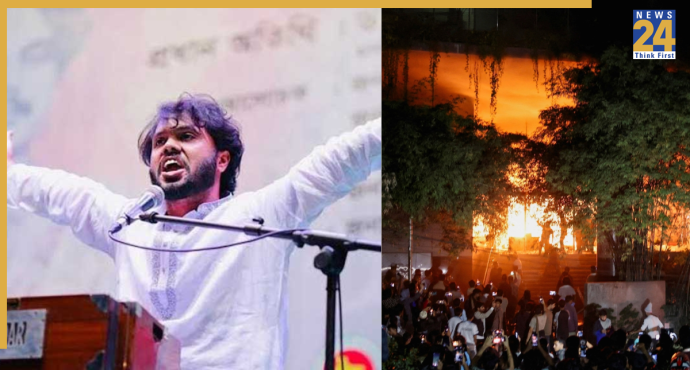


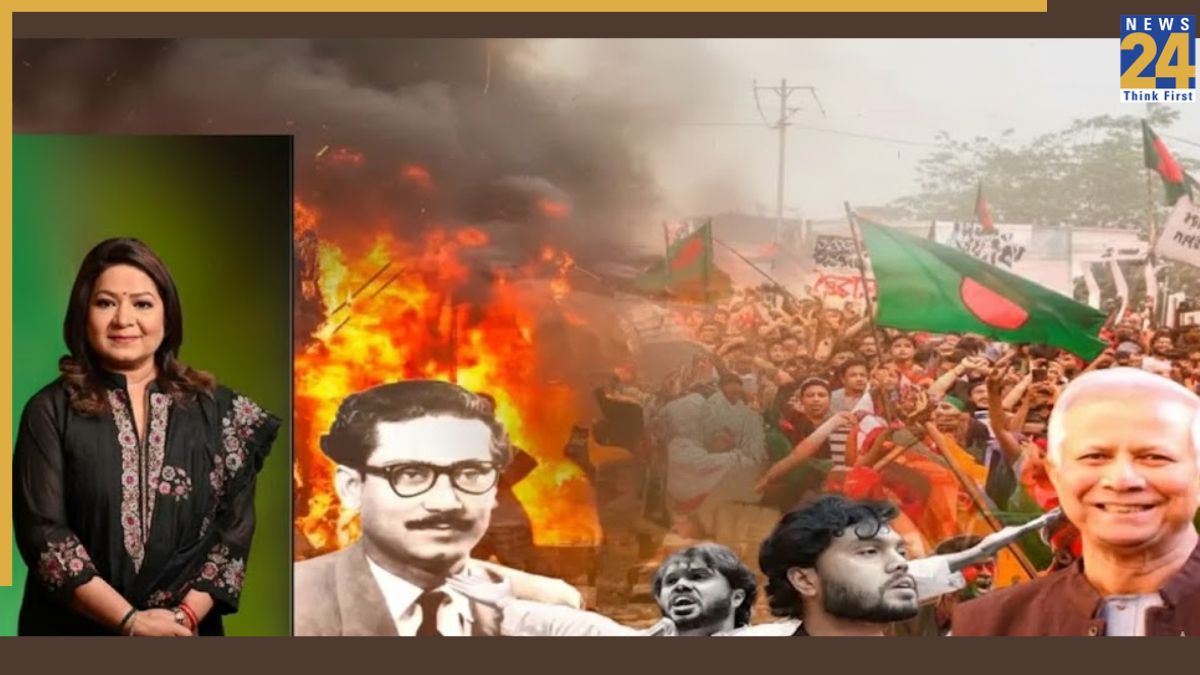


Bangladesh is engulfed in violence, and an undeclared government of extremists is effectively in power. Extremists have been on the streets since the murder of anti-India student leader Sharif Osman Hadi. There were chants and stone-pelting outside the Indian High Commission in Bangladesh. A Hindu man was brutally beaten to death in Mymensingh. All this is happening in Bangladesh, a country that owes its existence to India. The brave soldiers of the Indian army gave birth to Bangladesh with their blood. But today, extremists in Bangladesh are so dominant that they have forgotten India’s contributions. They are busy promoting an anti-India agenda.
Moreover, Bangladeshi extremists are determined to erase every trace of Bangabandhu, Sheikh Mujibur Rahman, from the country. About a year and a half ago, extremists created such a situation in Bangladesh that the then Prime Minister Sheikh Hasina had to resign and leave the country. Since then, Bangladesh has been under the control of Muhammad Yunus, with elections scheduled for February. Extremists have once again placed Bangladesh on a powder keg. Bangladesh and India share an international border of more than 4,000 kilometers. There are several points along the border where it is difficult to determine whether one is in Indian or Bangladeshi territory. West Bengal and Assam, which border Bangladesh, also have state assembly elections next year.
Now the question arises – will the fire in Dhaka also affect India? What do the Bangladeshi extremists ultimately want? Who is fuelling and supporting these extremists? Is Muhammad Yunus’s interim government itself instigating the extremists to postpone the elections in Bangladesh? Who made the extremist Sharif Osman Hadi a hero? What is the real behind giving so much respect to an extremist in Bangladesh? In this article, I will try to explain how deep the roots of what is happening in Bangladesh are. Who instilled hatred against Hindus there? How long have fundamentalists in Bangladesh been attacking Hindus?
On December 11, election dates were announced in Bangladesh, and the very next day, December 12, radical student leader Sharif Osman Hadi was shot in Dhaka. Hadi died while undergoing treatment in Singapore, and this sparked violence in Bangladesh. The election date in Bangladesh is set for February 12. Hadi was the Inqilab Manch candidate for constituency number 8 in Dhaka. This reveals the true nature and face of present-day Bangladesh, where the government has declared a radical like Osman Hadi a martyr. The Bangladeshi government has even observed a day of national mourning for this extremist. So, let’s first understand who has pushed Bangladesh to the brink of chaos and what it was about 32-year-old Sharif Osman Hadi that made the extremists rally so strongly behind him.
Images showed a massive crowd gathered on Manik Mia Avenue, just south of the National Parliament building in Dhaka, for the funeral prayer of radical student leader Sharif Osman Hadi. The 32-year-old was laid to rest in Bangladesh with honours typically reserved for a senior political figure. The interim government led by Muhammad Yunus declared Osman Hadi a martyr, announced a day of national mourning, and deployed police and paramilitary forces to maintain order during the funeral.
In Delhi, approximately 1800 kilometers from Dhaka, the Bangladeshi embassy flag was lowered to half-mast. This is today’s Bangladesh, a country that not only nurtures and protects extremists but also honours them. Hadi was shot on December 12, the day after the election dates in Bangladesh were announced. He was taken to Singapore for treatment but did not survive. Following the attack on Hadi, a wave of violence erupted across Bangladesh, with images of arson, stone-pelting, and protests emerging from different parts of the country. Hadi, a radical student leader, was known for making anti-India and inflammatory statements.
It is alleged that Hadi circulated a map he called “Greater Bangladesh,” which included several Indian states and bore the words “Sultanate-e-Bangla.” The Greater Bangladesh theory is particularly appealing to extremists, who are now using Hadi’s death as a political tool to create an environment favorable for seizing power in Bangladesh. Activists from the National Citizen Party (NCP) and Students Against Discrimination (SAD) have taken to the streets in his support. What’s striking is that amid all this, India has been a target of these extremists, with images of stone-pelting outside the Indian embassy in Dhaka emerging online. This reflects the volatile situation in extremist-dominated Bangladesh, where Hindu youth Dipu Chandra Das was brutally murdered in the Bhaluka area of Mymensingh at the age of 25, over accusations of blasphemy. Similarly, in the Jhenaidah district, extremists publicly attacked Gopal Biswas, a poor Hindu rickshaw driver.
It is being argued that hardliners are fuelling violence in Bangladesh to advance their strategy of postponing the elections. Even though the Awami League is out of the electoral process due to the ban, its strong support base is intimidating the hardliners. Perhaps this is why the extremists are making every effort to erase all traces of Bangabandhu, or Sheikh Mujibur Rahman, in Bangladesh. Even leaders of the Bangladesh Nationalist Party (BNP), who were once sympathetic to the hardliners, are now being targeted. In Lakshmipur, the house of a BNP leader was set on fire, resulting in the death of a 7-year-old girl and injuries to several others. In short, it remains difficult to predict whether the flames of violence in Bangladesh will subside or escalate in the coming days.
Hadi was actively involved in promoting the Greater Bangladesh agenda. Last August, when fundamentalists launched a movement against the Sheikh Hasina government, Hadi emerged as a prominent figure. The Sheikh Hasina government had spared no effort in suppressing fundamentalists in Bangladesh, and its close ties with India were well-known. Consequently, Bangladeshi fundamentalists received support from external forces. As a result, the fundamentalists, using students as their front, forced Hasina to leave the country. The challenge for India now is that if the violence continues in Bangladesh, the minority Hindu population may attempt to cross the border. This could lead to increased infiltration into Indian states bordering Bangladesh, particularly West Bengal and Assam. Furthermore, attacks on minorities, especially Hindus and Hindu temples, in Bangladesh show no signs of slowing down.
During the coup attempt against Hasina’s government, horrific images of violence emerged from Bangladesh. Terrified Bangladeshi citizens fled to border areas, seeking refuge across the border in India to save their lives. If the violence continues in Bangladesh and fundamentalists keep targeting minorities, similar incidents could spill over along the more than 4,000-kilometer border with India. Consequently, leaders and former diplomats alike are viewing the turmoil in Bangladesh as a threat to India as well.
A parliamentary committee chaired by Congress MP Shashi Tharoor has described the current situation in Bangladesh as the biggest strategic challenge for India since 1971. The violence in Bangladesh is attributed to Islamic fundamentalism, increasing Chinese and Pakistani influence, and the weakening of the Awami League. The parliamentary committee suggested that the problem can only be resolved through cooperation in Bangladesh’s development. Furthermore, if fundamentalists gain strength in Bangladesh, preventing infiltration from that country will become a major challenge for India. Moreover, it is no secret that the interim government led by Muhammad Yunus is operating at the behest of fundamentalists.
The question now arises: how can the fire in Bangladesh be extinguished? When Bangladesh’s largest political party stays away from the elections, what meaning will the elections have? If the people of Bangladesh are left with only radical groups as an option, what choice will they have? If these radicals come to power, they could promote an anti-India agenda and work to establish a “Sultanate of Bengal.” Anti-India forces may continue to strengthen these radicals behind the scenes. In such a scenario, attacks on the ground in Bangladesh, especially against the Hindu minority are likely to increase. There is also a chance of increased conspiracies against India. Bangladesh’s 4,000-kilometer-long border could pose a new and significant challenge for the country.
It is equally important to understand where this intense hatred towards Hindus in Bangladesh comes from. For this, we need to turn back the pages of history. The story dates back to the 1940s, when the freedom struggle was in full swing on the soil of Bengal. The Muslim League, led by Muhammad Ali Jinnah, had long been demanding a separate country for Muslims. The blueprint for a separate Muslim state, envisioned by Muhammad Iqbal and Chaudhry Rahmat Ali, did not include Bengal. However, the social dynamics of Bengal and the machinations of the British laid the groundwork for Hindu-Muslim politics. At that time, Hindus constituted 42 percent of Bengal’s population, while Muslims made up 33 percent. Two political parties were pitted against each other in Bengal: the Hindu Mahasabha and the Muslim League.
The Congress’ stance on Bengal was wavering. The most prominent leader of the Muslim League in Bengal was Huseyn Suhrawardy, who began his political career with Chittaranjan Das’s Swaraj Party before later forming the Independent Muslim Party. Within a few years, Suhrawardy became a major figure in Bengal politics and firmly supported Jinnah’s idea of a separate country for Muslims. Suhrawardy’s backing significantly strengthened the Muslim League. As a result, Bengal became aligned with the Muslim League’s plan for Pakistan. Muhammad Ali Jinnah had stated on several occasions that Hindu India and Muslim India should be divided because the two nations were fundamentally different, with many aspects of their cultures diametrically opposed. He advocated for the partition of India into Hindustan and Pakistan.
Jinnah had complete faith in his close confidant, Suhrawardy, who was then the Premier (Chief Minister) of Bengal. On the day of Direct Action, carnage erupted in Calcutta. There was neither police nor army on the streets that day, and no one was able to stop the rioters. Suhrawardy had already declared a holiday for August 16, 1946. Blood flowed through the streets of Calcutta for 72 hours, and thousands of people were killed. The Muslim League sought to incorporate Hindu-majority Calcutta and some of its surrounding districts into Pakistan. One prevailing idea was that violence could force Hindus to flee, thereby increasing the Muslim population in Calcutta. Following the Calcutta riots, brutal violence also broke out in Noakhali and Tippera. During this period, approximately one million Hindus fled from East Bengal, seeking refuge in states such as West Bengal, Assam, and Tripura.
Suhrawardy wanted an independent Bengal that would be neither part of Pakistan nor India. Bloodshed between Hindus and Muslims continued in the name of partition. Just five days before independence, Calcutta was engulfed in riots, with the situation there far worse than in most other parts of India. However, Mahatma Gandhi’s use of Satyagraha, non-violence, and fasting eventually helped restore peace in Calcutta. After the partition, Pakistan became a separate country, but persecution of Hindus continued. The Vested Property Act was used as a tool to seize the property of minority Hindus living in what was then East Pakistan. Under this act, the government could take possession of property, either temporarily or permanently. In 1951, a law was enacted granting the government the power to confiscate property belonging to those who had migrated from East Pakistan during the partition.
In 1964, the Disturbed Persons (Rehabilitation Ordinance) was introduced. This law prohibited minorities from transferring immovable property or land without government permission. This ordinance effectively crippled Hindu landowners in East Pakistan. Riots between Hindus and Muslims occurred periodically, often instigated by religious extremists. As a result, Hindus gradually began leaving East Pakistan. However, a different kind of discontent was simmering among the Muslims of East Pakistan.
Suhrawardy’s hands were stained with the blood of thousands of innocent people murdered in Calcutta. But what kind of person was he? A glimpse into his character can be found in the book Freedom at Midnight by Dominique Lapierre and Larry Collins. It states that during the 1942 famine, the whole of Bengal was devastated. However, Suhrawardy intercepted millions of tons of grain meant for the starving people of Calcutta, sold it on the black market, and amassed crores of rupees. He was always impeccably dressed and indulged in every luxury.
Suhrawardy played a significant role in instilling hatred toward Hindus in the DNA of Muslims in Bengal. Moreover, he harbored the dream of creating a separate country out of Bengal, although this dream never materialised. With independence came the partition of India, creating Pakistan in two parts, one to the west and one to the east of India. The people of both parts had little in common in terms of lifestyle, language, food, or customs; the only thread connecting them was Islam.
There was an underlying resentment toward Hindus, which was being fueled by fundamentalists. The consequences of this can be seen in the numbers: in 1951, the Hindu population in East Pakistan (now Bangladesh) was 22 percent, which decreased to 12 percent by 1974. This raises the question: where did the continuously declining Hindu population of Bangladesh go?
To understand how fundamentalists in Bangladesh treat even their own country’s liberal leaders, it is essential to examine the rise and fall of Bangabandhu Sheikh Mujibur Rahman. For this, we need to turn the pages of history to the 1970s. In the politics of East Pakistan, Rahman, who had begun his political career under the guidance of Suhrawardy, was rapidly gaining prominence. Discontent was steadily growing over how the rulers in West Pakistan were treating the people of East Pakistan. The situation became critical when plans were made to make Urdu the sole official language of all of Pakistan. In response, the people of East Pakistan began to unite under the banner of language and Bengali nationalism.
Mujibur Rahman emerged as the leader of the Bengali-speaking population of Pakistan. In the elections held in December 1970, his Awami League won all but two seats in East Pakistan. However, the then-President Yahya Khan refused to transfer power to the Awami League. In this situation, Rahman intensified the movement for an independent Bangladesh. To suppress this movement, the Pakistani army launched Operation Searchlight in Dhaka on March 25, 1971.
Millions of people were killed during Operation Searchlight. The fundamentalist Jamaat-e-Islami opposed the movement for a separate Bangladesh, and the Pakistani army supported them. The fundamentalist forces began targeting minorities, prompting Hindus in East Pakistan to flee to neighboring Indian states. Refugee camps were established in West Bengal, Tripura, and Assam to accommodate the millions who had fled, but these camps quickly became overcrowded.
In response, then-Prime Minister Indira Gandhi ordered the Indian army to advance into East Pakistan. The first attacks were launched by Pakistan, but the conflict ended on December 16, 1971, with the surrender of the Pakistani army in Dhaka. A total of 93,000 Pakistani soldiers surrendered to the Indian army, the largest surrender in world history. Pakistan was divided into two parts, and Bangladesh emerged as a new country on the world map.
Bangladesh came under the leadership of Sheikh Mujib, who harboured the dream of keeping Bangladesh completely free from extremists. He unequivocally stated that people of all religions in Bangladesh were free to practice their faith. However, a stark reality is that between 1951 and 1974, the Hindu population in Bangladesh decreased from 22 percent to 12 percent. Between 1964 and 1971, 1.7 million Hindus left Bangladesh.
The Jamaat-e-Islami played a major role in spreading the poison of hatred against Hindus in Bangladesh. Those operating under the umbrella of this extremist organisation tried to create a conflict between culture and religion. Jamaat supporters have been fuelling an anti-India agenda in Bangladesh for decades. The group received support from Pakistan. Although Mujibur Rahman’s political rise occurred under the patronage of the hate-filled Hussain Suhrawardy, Bangabandhu to build his Bangladesh on the strong pillars of socialism, nationalism, democracy, and secularism, where there was no place for discrimination based on religion.
A way to curb extremist ideology was enshrined in Bangladesh’s constitution, and better relations with India were seen as crucial for the country’s future. However, a secular Bangladesh with strong ties to India was never acceptable to extremists. In 1975, Rahman was overthrown and assassinated. After this, Bangladesh was transformed into the Islamic Republic of Bangladesh, and extremist forces began to dominate. A cycle of conspiracy, hatred, violence, and coups took root, a cycle that continues to this day.
The first general elections in independent Bangladesh were held in March 1973, with Mujibur Rahman’s Awami League winning 293 out of 300 parliamentary seats. However, the Awami League faced accusations of election rigging, and Rahman’s actions began to be perceived as dictatorial. As a result, on August 15, 1975, some officers of the Bangladeshi army attacked his residence with tanks, killing him along with several members of his family. His daughters, Sheikh Hasina and Sheikh Rehana, survived because they were abroad at the time.
Following the assassination, the army seized power, and former Army Chief Ziaur Rahman emerged as the new leader. In subsequent elections, his newly formed Bangladesh Nationalist Party (BNP) won a landslide victory with full support from religious fundamentalists. While the Awami League had advocated for a secular Bangladesh, the BNP was preparing to abandon secularism entirely. Bangladesh was now following a path similar to that of Pakistan, with coups and conspiracies becoming increasingly common in Dhaka.
Then-President Ziaur Rahman was assassinated in a government guesthouse. Following this, Abdul Sattar emerged as the new powerful leader in Bangladesh, assuming the interim presidency. Standing behind him was General Hussain Muhammad Ershad. The rulers were busy with their power struggles, and the radical elements in Bangladesh were working to consolidate their own power. They were attacking minorities to demonstrate their strength. Within a year, General Ershad made a bold move to transform himself from kingmaker to king, staging a coup against Sattar and seizing power. He imposed martial law. Just like in Pakistan, elections in Bangladesh were merely a formality now.
In 1988, a movement intensified to oust Ershad from power. After two years of protests, Ershad was forced to step down and attempts were made to hold fair elections. The BNP came to power, and Begum Khaleda Zia became Prime Minister. She was the wife of former President and Army Chief Ziaur Rahman. In the elections held in June 1996, the Awami League returned to power, bringing Bangladesh under the leadership of Sheikh Hasina, the daughter of Sheikh Mujibur Rahman. She sought to continue her father’s legacy, which included strengthening relations with India and curbing religious extremism. The country’s minority communities, especially Hindus, breathed a sigh of relief.
However, in the 2001 elections, the Awami League lost, and the BNP won a landslide victory, with Begum Khaleda Zia becoming Prime Minister once again. During the first few weeks of BNP rule, Hindus were targeted on the pretext that they had voted for the Awami League, though the violence subsided after some time. In January 2009, the Awami League returned to power, and Hasina became Prime Minister. She cracked down on religious extremists and, like her father, envisioned a prosperous Bangladesh through friendship with India. She remained in power continuously for about 15 years. However, on August 5, 2024, religious extremists overthrew her government. Since then, Hindus have faced intermittent attacks by extremist groups.
The Hindu population in Bangladesh has declined to less than eight percent. However, Hindus still make up more than 20 percent of the population in areas like Gopalganj, Moulvibazar, Thakurgaon, and Khulna. Historically, Hindu voters have played a significant role in Bangladeshi politics. Extremists believe that a large portion of the Hindu vote traditionally supports the Awami League, which is currently banned and unable to participate in the upcoming election.
Meanwhile, BNP leader Khaleda Zia is in poor health. The student-led National Citizens Party has recently allied with the extremist Jamaat-e-Islami. If elections are held in Bangladesh on February 12, extremists have already prepared strategies to seize power. They believe that the presence of Hindus is preventing Bangladesh from becoming a fully Islamic nation. Consequently, they aim to maintain an atmosphere of fear by attacking Hindu homes and temples, with the ultimate goal of making Bangladesh a country exclusively for Muslims.
Perhaps the people of Bangladesh have forgotten who saved them when the Pakistani army was committing atrocities. The Indian Army soldiers who fought for Bangladesh never questioned whether they, as Hindus, should fight to liberate Muslims from oppression. Yet, the frenzied mobs attacking minority Hindus today, instigated by extremists, seem to have forgotten that without India’s support, Bangladesh might not even exist.
Before independence, Hussain Suhrawardy had instilled hatred and violence into the social fabric of the region, and extremists continue to nurture this legacy to this day. There is also growing concern that Dhaka could fall under extremist control, similar to what has happened in Syria and Afghanistan.
Also Read: Sharif Osman Hadi buried beside Bangladesh’s national poet Kazi Nazrul Islam due to…