
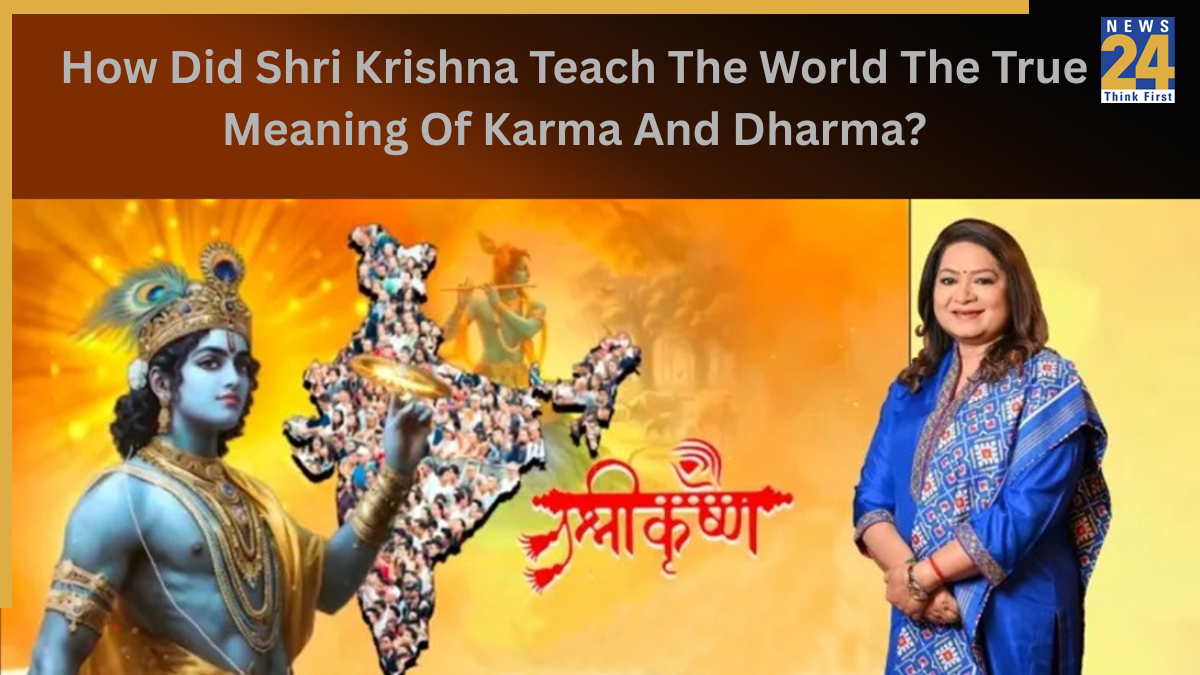


Bharat Ek Soch: What is that magnetic charm of Shri Krishna, which has drawn the entire world toward his philosophy, personality, and presence across millennia? Who truly is Shri Krishna, in whose path human civilization has seen its betterment? Krishna of the Dwapar Yuga represents the pinnacle of human perfection. People have embraced him according to their faith and convenience. For human civilization, Shri Krishna is a hero who stands both on the battlefield and the stage of life. He imparts the profound wisdom of the Gita on the battlefield of Kurukshetra and is also the playful, mischievous hero of Vrindavan. In the eyes of Acharya Rajneesh, also known as Osho, Shri Krishna is both a sanyasi and a family man. He is a yogi as well as a lover, versed in politics and also a guide to human consciousness.
How Helpful Could Shri Krishna Be In Dealing With The Current Challenges?
Shri Krishna neither gets stuck in the web of relationships nor gets lost in the trap of dignity. He is not bound to any one role. His life is full of challenges, and to face them, he does not wrap himself in the blanket of decorum. He moves forward according to the time, place, and situation.
In such a context, it becomes important to ask: Who is the Shri Krishna we worship? How relevant is he to our society today? How can he help us navigate the challenges we currently face? What kind of Karmayoga does Shri Krishna speak of? And what kind of inspiration should our politicians draw from him?
Today, in our special program Shri Krishna Kitne Zaroori?, we will try to find answers to some of these important questions.
Shri Krishna Faced Many Difficulties In Human Life
Shri Krishna of the Dwapar era is known as the politician of politicians, the diplomat of diplomats. He represents the pinnacle of experimentation in his time. Born as a human, inside the prison of his uncle Kansa, Shri Krishna was raised in the home of Yashoda and Nand Baba. His human life was full of challenges. He endured much – love, separation, struggle, fame, and even disrepute were all part of his journey. Yet, he never abandoned the path of dialogue. He gave great importance to relationships and never strayed from the path of action.
Rather than merely following traditional notions of dignity, he carved out a new path based on the needs of the time. He redefined Dharma and Karma. When it came to choosing between right and wrong, Dharma and Adharma, Shri Krishna did not hesitate to set aside personal relationships.
Even today, we face challenges similar to those of Kurukshetra. In such times, it becomes essential to understand how Shri Krishna has served as a source of inspiration for social and political movements, and what kind of politics and governance he might have envisioned to strengthen the India of today.
A Kurukshetra Still Exists In Today’s World
About two years ago, External Affairs Minister S. Jaishankar described Bajrangbali Hanuman and Shri Krishna as the greatest diplomats in the world. He argued that just as today’s world is multipolar, the India of that era was also multipolar, with many different states. In Kurukshetra, everyone had to choose a side – either this side or that. Even then, warriors like Dau Balaram chose not to align with any camp.
In a way, the current global world order closely resembles the situation of Kurukshetra. For example, U.S. President Donald Trump openly said, “My way or the highway,” implying that countries must either follow his terms or face heavy tariffs.
During the Russia-Ukraine and the Israel-Iran conflict, efforts were made to push situations in one direction or the other. India chose its path based on national interest. In such circumstances, Shri Krishna shows the way to redefine relationships. At the core of his thinking lies the protection of Dharma, that is, truth, and the welfare of humanity. For this, he believes in removing every obstacle that stands in the way.
From Kansa to Jarasandha, from Dronacharya to Bhishma, from Duryodhan to Karna – Shri Krishna never got swayed by affection or attachment. In a rapidly changing world, India’s diplomacy must reflect the same approach. In the interest of the nation, there should be no hesitation in letting go of outdated relationships and forging new ones.
Shri Krishna’s Example Given To Foreign Service Officers
Although Shri Krishna or Lord Hanuman are not part of the formal training curriculum for Indian Foreign Service officers, whenever new diplomats are trained in ethical and cultural diplomacy, the diplomacy of Shri Krishna is often cited as an example by the trainers. After the Pandavas’ exile ended, Shri Krishna was sent as an emissary to negotiate the return of their kingdom. The Kauravas held him in high regard, but the talks failed. It became clear that war between the Pandavas and the Kauravas was now inevitable.
In such a situation, how is secret information used at the right time? How is the enemy side strategically weakened? These nuances are captured in the book Rashmirathi by the national poet Ramdhari Singh Dinkar. While returning from the Kaurava court, Shri Krishna says to Karna, “Drop me a little distance away.” On the way, Shri Krishna reveals to Karna that he is the eldest son of Kunti, the eldest among the Pandavas.
Shri Krishna Displayed His Cleverness By Making A Strategic Proposal To Karna
Describing how the clever diplomat Krishna offers Karna to join the Pandavas, Dinkar has written:
कुंती का तू ही तनय ज्येष्ठ, बल बुद्धि, शील में परम श्रेष्ठ
मस्तक पर मुकुट धरेंगे हम, तेरा अभिषेक करेंगे हम।
आरती समोद उतारेंगे, सब मिलकर पांव पखारेंगे
पद-त्राण भीम पहनाएगा, धर्माचिप चंवर डुलाएगा।
पहरे पर पार्थ प्रवर होंगे, सहदेव-नकुल अनुचर होंगे
भोजन उत्तरा बनाएगी, पांचाली पान खिलाएगी।
Shri Krishna knew very well that Karna would never accept his proposal. He would never leave Duryodhan’s side. But Krishna also knew that the secret he revealed to Karna, about his birth and true family, would emotionally and psychologically weaken him on the battlefield.
In today’s times, information in diplomacy should be used in a way that serves national interests. In this context, it becomes important to understand: what kind of politics does Shri Krishna teach us? What kind of actions does he inspire in our leaders and those in power?
Transaction-Based Politics Is Not Good For Democracy
In the current democratic system, the trend of distributing free goodies to voters to win elections is rapidly increasing; that is, the culture of transaction is becoming stronger in our democracy. Political parties call it the main function of a welfare state, but it is also true that such a system is not good for the economic health of the country.
Not only this, but the political culture of taking credit for every small and big achievement and blaming opponents has also grown strong among leaders. Public interest lies at the centre of Shri Krishna’s statecraft. He did not hesitate to face infamy for the sake of public welfare.
To save Mathura from the repeated attacks of Jarasandh, Shri Krishna himself became Ranchod. He did not accept bloodshed just to protect his pride. Shri Krishna teaches us when to fight and when to avoid conflict. He is humble, gentle, and forgiving, yet does not hesitate to kill Shishupal when he crossed the limit.
There is no attachment to fame in Shri Krishna’s mind. He is a great warrior, but never boasts of his bravery. In this way, Krishna gives a message at every step through his actions: be humble, maintain relationships, communicate, and show concern. However, it is also true that the tradition of dialogue is gradually diminishing in our parliamentary politics.
A person’s class was determined by their deeds. In the time of Shri Krishna, there was no caste system, but there was the Varnashram system. A person’s category was decided based on their actions, with skill placed at the highest level. This is why the national poet Dinkar writes in his timeless book Rashmirathi:
मूल जानना बड़ा कठिन है नदियों का, वीरों का
धनुष छोड़कर और गोत्र क्या होता है रणधीरों का?
पाते हैं सम्मान तपोबल से भूतल पर शूर
‘जाति-जाति’ का शोर मचाते केवल कायर, क्रूर।
Shri Krishna – A Visionary Leader With Strategic Foresight
In the Dwapar era, Shri Krishna’s movement was social – a challenge to the then-existing system that aimed to give more importance to deeds and merit than to birth. Shri Krishna shows the path of leadership with a long-term vision, one that believes in planning for the next 5, 10, 15, or even 25 years.
This is why he asks Arjuna, the Pandava who went into exile along with his elder brothers after losing in a gambling spree, to prepare for the future. He told Arjuna to obtain the Pashupatastra from Mahadev and the Divyastra from Devraj Indra because he knew that war was inevitable.
In today’s time, a strong system for the protection of our borders is essential. We also need policies that can act as both the engine and the fuel for the country’s economic progress. However, there is a pressing need to reject the kind of politics that entangle our youth in casteism instead of equipping them with new skills and making them self-reliant.
Shri Krishna is neither just a character from mythology, nor merely a man of his time who became God. He represents a way of life – a lifestyle that propels human civilization forward. Those who have followed the path shown by him have always seen progress and betterment.
ALSO READ: Dard-E-Bihar: Do Criminals No Longer Fear The Police Or Law? Why Is Crime On The Rise?