
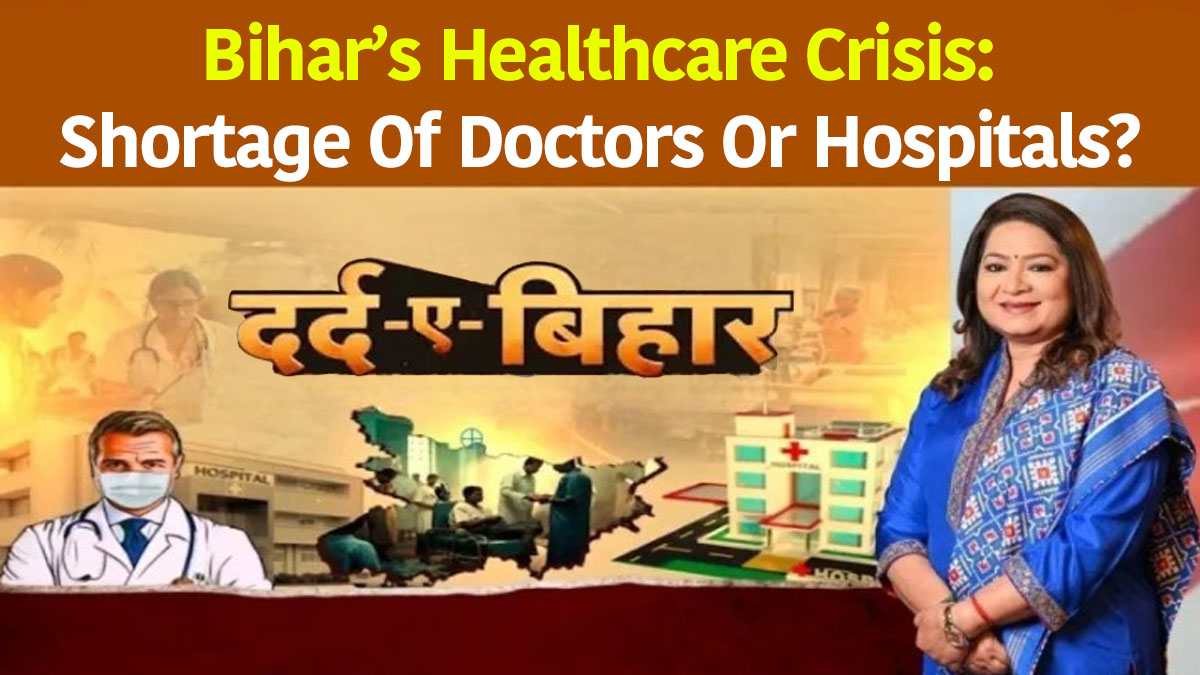


Dard-E-Bihar: Bihar now stands at the crossroads of perception and reality. On one side, there’s a narrative of a rising and transforming Bihar under the leadership of Chief Minister Nitish Kumar. On the other hand, the critics argue – What changes have happened in the state in the past 20 years? Both narratives give a classic half-glass dilemma – some see it as full, while others see it as empty. Bihar Health Minister Mangal Pandey has recently claimed that the medical facilities in the state have improved in the last 20 years. That said, when the RJD Chief Lalu Prasad Yadav’s health deteriorates, why is he taken to Delhi AIIMS for treatment? Why is he not treated in Patna instead? Lalu Yadav’s sons, Tej Pratap Yadav and Tejashwi Yadav, have already served as the health ministers of Bihar.
Nitish Kumar Also Had His Eye Operation Done In Delhi
Ironically, CM Nitish Kumar also got his eye operation done in Delhi, not in any hospital in Bihar. Bihar’s Deputy Chief Minister Sushil Kumar Modi who was suffering from cancer, died last year in a New Delhi hospital. Now, the question arises – Have the common people and the elite of Bihar lost faith in the state government medical system? Today in Dard-e-Bihar, we will talk about the condition of government hospitals in the state – the doctors, the medicines, and the treatment facilities available there. After all, how do the patients, doctors, and politicians of Bihar view the state’s public healthcare system? Apart from all this, where does Bihar’s health infrastructure stand in government statistics?
Before 2006, Block-level Govt. Hospitals Saw Just 39 Patients A Month On Average
Bihar’s Health Minister Mangal Pandey claims that there has been a radical change in the state’s government hospitals in the last 20 years. He cites data showing that before 2006, an average of just 39 patients visited a block-level government hospital in Bihar each month, whereas now around 11,600 patients reach there. The minister argues that this increase reflects growing trust in the state’s government hospitals. He also pointed out that while the health budget of the state was Rs 705 crore in 2004–05, it has risen to Rs 20,350 crore in 2025. But the big question remains: despite such high spending, why hasn’t the flow of patients traveling to Delhi for treatment from Bihar stopped?
Why Do People From Bihar Come To Delhi For Treatment?
Independent MP from Purnia, Pappu Yadav, has made special arrangements at his government residence in Delhi for people who come to the capital for medical treatment. Inside his house, you will find 100 to 150 people from Bihar who have come to Delhi seeking treatment. One of the responsibilities of MPs elected from Bihar is also to assist people from their constituencies who come to Delhi for medical care. This includes everything from accommodation to securing appointments in hospitals. Now, the question arises – when good treatment facilities are said to be available in Bihar’s hospitals, and if government hospitals have truly transformed, then why are people still traveling nearly a thousand kilometers to Delhi for treatment?
Government Hospitals Of Bihar Themselves Need Treatment
If you talk to people holding responsible positions in the well-known government medical colleges of Bihar, they all give the same response: all kinds of modern facilities are available in the hospital, there is no shortage of doctors, and the medical staff is dedicated to serving the patients. But when you speak to the patients, a different picture emerges. Many feel that the government hospitals of Bihar themselves are in need of treatment. Patients have reported a lack of facilities even at Darbhanga Medical College Hospital, which is considered the largest hospital in North Bihar.
Work Is Underway To Expand Patna Medical College Hospital
Similar scenes were witnessed at Magadh Medical College, where attendants were seen performing tasks that should ideally be handled by hospital staff. Work is currently underway to expand Patna Medical College Hospital (PMCH). If all goes as planned, by 2027, PMCH will become the second-largest hospital in the world. That, however, is a matter for the future. What’s equally important is to understand the current condition of Bihar’s major medical colleges—and to listen to the pain of the patients being treated there today.
CAG Report: Till January 2022, 58,144 doctors Were Providing Service In Bihar
On one hand, there are claims of better treatment and improved facilities in government hospitals across Bihar. On the other hand, there’s the pain and frustration of the patients. But there’s another side to Bihar’s healthcare system that the CAG report brings to light. According to World Health Organization (WHO) standards, Bihar needs 1,24,919 allopathic doctors, based on the state’s population of 12.49 crore. However, the CAG report reveals that as of January 2022, only 58,144 doctors were serving in Bihar. This clearly points to a massive shortage of doctors in the state.
Let’s look at this situation in more detail:
- As of March 2022, the total sanctioned posts for doctors at PMCH stood at 2,727, but only 1,749 doctors were deployed.
- At DMCH, there were 1,920 sanctioned posts, yet only 1,258 doctors were on duty.
- Similarly, at GMCH, out of 959 sanctioned posts, just 301 doctors were deployed.
When there is such a significant shortage of doctors even in Bihar’s most reputed government hospitals, how can patients expect quality treatment? Even in district civil hospitals, a clear gap exists between the government’s claims and the ground reality.
45% Of The Sanctioned Posts For Paramedics Are Vacant In Jamui And 90% In East Champaran
The CAG report highlights another troubling aspect of Bihar’s healthcare system – an acute shortage of staff nurses in government hospitals. In Patna, 18% of the sanctioned posts for nurses are reported vacant, while in Purnia the vacancy rate is as high as 72%. Similarly, 45% of the sanctioned paramedic posts are vacant in Jamui, and a staggering 90% in East Champaran. There is hardly any district in Bihar where the posts of doctors are fully filled.
In such a situation, many patients are forced to travel outside the state in search of better treatment. While some private hospitals offering modern treatments and surgeries do operate in Patna, including Jaiprabha Medanta Hospital, Paras Hospital, and Big Apollo Spectra Hospital, access remains limited.
Jaiprabha Medanta, which runs on a PPP model, has 25% of its beds reserved for government-referred poor patients. But this raises an important question: Why are such large private hospitals limited to Patna? And can the common man in Bihar afford the expensive care provided by these private hospitals?
In 20 Years, No. Of Government Medical Colleges In Bihar Has Increased To 12
Bihar’s population stands at nearly 13 crore, and managing healthcare for such a large number is undoubtedly a massive challenge. However, 20 years is not a short period when it comes to building infrastructure and improving systems. It is often argued that from independence until 2005, Bihar had only 6 government and 3 private medical colleges. In the last two decades, this number has risen to 12 government medical colleges. Additionally, there are 2 medical colleges run by the Government of India, and 9 private medical colleges. There are also plans to increase the number of medical colleges in the state to 42 in the next four years. Despite these developments, the real question remains: Why do people still have to leave Bihar for treatment, even after 20 years of claimed progress in the healthcare sector?
The Shortage Of Doctors And Nurses Must Be Addressed
If Bihar’s deep-rooted healthcare crisis is to be treated honestly, then the solution must begin at the primary level. The primary health centers (PHCs), which form the base of the state’s health system, must be strengthened. People’s trust in PHCs needs to be rebuilt through better services, availability of doctors, essential medicines, and basic infrastructure. With the rapid rise in lifestyle-related diseases, strengthening PHCs would also help ease the burden on district hospitals and medical colleges. Secondly, the shortage of doctors and nurses must be tackled as a priority. Without adequate medical personnel, no amount of infrastructure can deliver quality healthcare. Thirdly, there is a need for a transparent, accessible healthcare system where patients don’t need to rely on political or bureaucratic connections to get admitted or undergo operations. Until then, the dream of accessible and equitable healthcare in Bihar will remain unfulfilled.