


Dard-E-Bihar: Bihar has long been a land of wisdom, revolution, and peace. Lord Buddha attained enlightenment here. From this land, Emperor Ashoka gave the world the message of peace over war. Bihar’s Nalanda and Vikramshila universities enlightened the world with knowledge. From the land of Bihar, Mahatma Gandhi successfully advocated Satyagraha and non-violence against the British. Jayaprakash Narayan, too, gave the call for a total revolution from this very land. Today, however, the same Bihar is being called the crime capital of India by some, while others label it a great jungle raj.
An Average Of 229 Murders In Bihar Every Month
According to the data, there has been an increase of 80.2% in crime cases in Bihar from the year 2015 to 2024, whereas during the same period, the national average was 23.7%. The entire country was stunned when, in July, five criminals brandishing weapons entered Patna’s Paras Hospital and shot down gangster Chandan Mishra, who had been brought there for treatment.
Sand trader Ramakant Yadav was gunned down in Patna. In the first week of July, businessman Gopal Khemka was also murdered in Patna. These were some of the high-profile murder cases that made headlines on TV and in newspapers. But the figures from January to June show that, on average, 229 murders are taking place in Bihar every month.
In such a situation, the question arises: Is 20 years not enough to improve the law and order of a state? Has Nitish Kumar’s police force lost its credibility? Do Bihar’s criminals no longer fear the law?
When the lives and property of the people are not guaranteed, how will Bihar progress? How did Nitish Kumar come to be known as ‘Sushasan Babu’ after coming to power in 2005? How did he manage to improve the image of Bihar’s ‘jungle raj’? What was that jungle raj era like? What were the sharp and capable police officers doing back then?
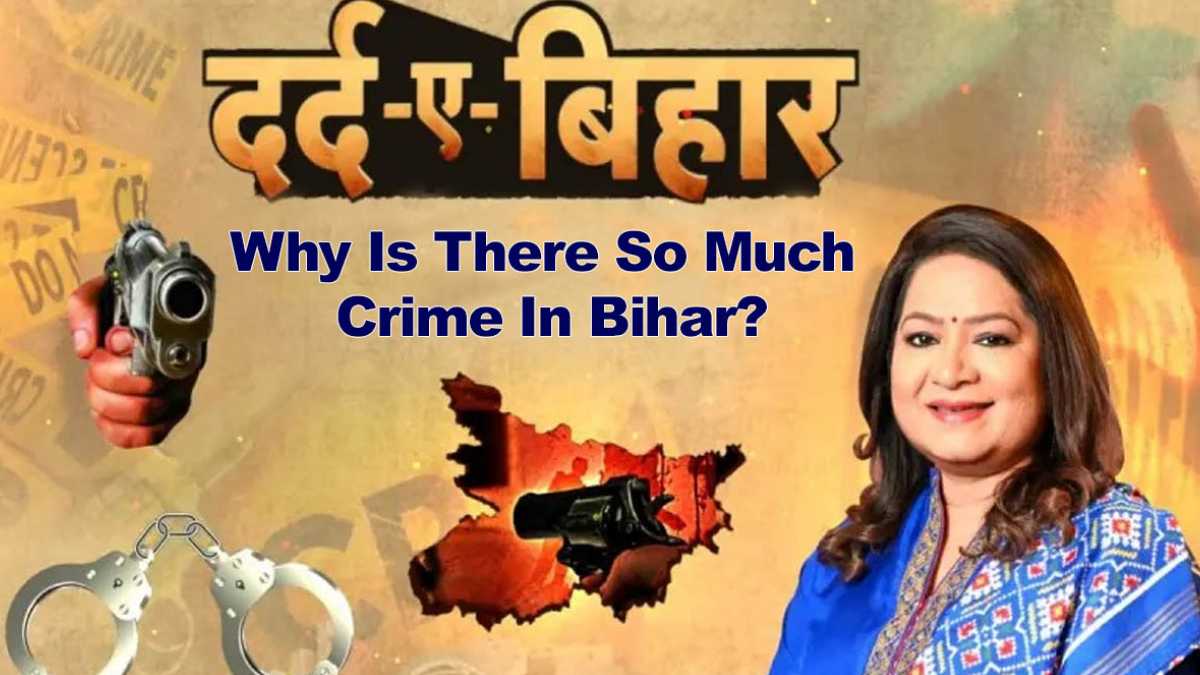
In Dard-e-Bihar, we will try to find answers to some of these serious questions: Why is there so much crime in Bihar?
Many Films Have Been Made On Crime In Bihar
There is neither a boom of factories nor jobs in Bihar. Neither good private colleges and universities, nor good private hospitals. Because the way Bihar has progressed over the last several decades, business houses from other parts of the country must have done a lot of calculations before investing in the state. One reason for this is also believed to be the crime graph in Bihar. Poor law and order is considered a major factor.
Once upon a time, the undeclared rule of musclemen prevailed in different parts of Bihar. Kidnapping, ransom, murder, and robbery were common. There are many stories of the nexus between politics and criminals. Bollywood filmmakers tried to portray the Bihar of that era through films like Shool, Abduction, Mrityudand, and Gangaajal.
20 Years Of Nitish Kumar As Bihar CM; Why Does Crime Still Flourish
Nitish Kumar came to power in 2005 by raising the issue of jungle raj during the rule of Lalu Yadav and Rabri Devi in Bihar. In his first term, he took many steps to control crime in the state. Their effect was also visible on the ground. This gave Nitish Kumar a new identity in the state – Sushasan Babu. However, given the way murders have been happening in recent times, it is now being said that there is a surge of criminals in Bihar. Criminals are committing murders in broad daylight. Let us try to understand, through some recent high-profile incidents, how, despite Nitish Kumar being in power in Bihar for 20 years, there is still a surge in criminal activity.
The head of Bihar Police, DGP Vinay Kumar, argues that the nature of crime today is such that the police can’t prevent most of these incidents. One of the reasons for the increasing number of murders is also said to be inter-caste marriages and property disputes. The police claim that kidnapping, robbery, and Naxalite violence are completely under control. However, according to data from the State Crime Records Bureau, from the year 2015 to 2024, there was an 80.2% increase in crime cases in Bihar, whereas the national average rose by only 23.7% during the same period.
DGP Vinay Kumar also argues that the rise in crime statistics is largely due to cases registered under the liquor ban law in Bihar. In such a situation, let us try to understand through statistics whether crime in Bihar is truly under control or spiraling out of control. What kind of steps are being taken by the police to rein in criminals in the state?
Now, just a few days are left for the Bihar elections. The question here arises: Are the opposition parties deliberately raising the issue of law and order in the state because of the upcoming elections?
Murder Cases In Bihar (Year-wise)
| Year | Number of Murders |
|---|---|
| 2015 | 3,178 |
| 2016 | 2,581 |
| 2017 | 2,803 |
| 2018 | 2,934 |
| 2019 | 3,138 |
| 2020 | 3,150 |
| 2021 | 2,799 |
| 2022 | 2,930 |
Total Crime Cases In Bihar (Year-wise)
| Year | Total Crime Cases |
|---|---|
| 2018 | 1,96,911 |
| 2019 | 1,97,935 |
| 2020 | 1,94,698 |
| 2021 | 1,86,006 |
| 2022 | 2,11,079 |
Statistics cannot give a wider picture of the presence of crime in any society. If a case is not registered, how will it appear in the statistics? Registering an FIR was considered a big deal in the past. That is, however, not the case today. There are now various ways to reach the police with complaints of crime. Crime incidents are also reaching the police through media and social media, and it is the responsibility of the police to take appropriate action on them. In such a situation, it is natural for the number of reported crimes to increase.
While 1,04,778 cases of cognizable crimes were registered in Bihar in the year 2005, this number increased to 2,57,306 in the year 2020. By May this year, i.e., 2025, the crime figure had reached 95,942. But it is also important to understand what Nitish Kumar did after coming to power in 2005. Fearless criminals began to fear the law.
Eliminating Jungle Raj From Bihar Was A Challenge
CM Nitish Kumar handed over the responsibility of ADG Headquarters to Abhyanand during his first term, who later also became the DGP of Bihar. The biggest challenge before Nitish Kumar was to eliminate jungle raj from the state. One thing was clear in the mind of IPS officer Abhyanand, that authority should never lie with the police, but with the law, because there is no difference between police authority and hooliganism in uniform if the law is not upheld. In such a situation, a plan was implemented in which everything – from arresting criminals to getting them convicted – was done swiftly. The police were also trained on how to conduct trials effectively.
Senior officials of the Bihar Police claim that the police infrastructure has improved significantly over the last 20 years. Bihar Police has been equipped with high-tech weapons. Infrastructure and a training mechanism have been developed to ensure that the state police can carry out prevention, detection, and conviction work with full efficiency. Today, the biggest challenge before the Bihar Police is dealing with cybercrime. For this, cyber police stations have been set up in every district, each headed by a DSP-rank officer.
But there is a harsh reality – half of the sanctioned posts in the Bihar Police are vacant. Patrolling and investigation are affected due to this shortage of personnel. This raises a crucial question: What was Bihar like before 2005? Where did the narrative of jungle raj originate? What exactly happened during that time? Where were the people who are now in high positions in the police, and what were they doing then? It is important to know and understand this as well.
When Lalu Prasad Yadav Became The Chief Minister Of Bihar
Lalu Prasad Yadav became the Chief Minister of Bihar in 1990. He had his own style of governing the state. On the other hand, the musclemen began turning crime into a business. Slowly, the kidnapping industry and extortion tax in the state started being discussed in every corner of the country. Before going to jail in the fodder scam, Lalu Yadav made his wife Rabri Devi sit on the CM’s chair. Both her brothers, Sadhu Yadav and Subhash Yadav, stood firmly with her. The number of people in the state wearing white kurta-pyjamas and roaming around with weapons suddenly started increasing.
Newspapers used to be full of news about kidnappings, extortion, and murders. People started talking about self-protection and began making their own security arrangements. In this new mood of Bihar, keeping weapons started being seen as a matter of respect, a matter of pride. Another system was working within the system – the frying pan of casteism, heated for politics, had taken a very dangerous form. Bloodshed was happening every day in the name of caste conflict.
Crime Increased In Bihar Between 1990 And 2005
In December 1994, the then DM of Gopalganj, G. Krishnaiya, was beaten to death. In March 1997, student leader Chandrashekhar was publicly murdered in Siwan. During that period, many massacres took place one after the other. For example, 58 people were shot down in Laxmanpur Bathe of Jehanabad. Similarly, 21 Dalits were massacred in Bathani Tola of Bhojpur.
The atmosphere in Bihar between 1990 and 2005 significantly reduced people’s trust in the police. When conflicts intensified over issues of caste, land, and wages, people began seeking protection under the banners of organizations like Brahmarshi Sena, Kunwar Sena, Sunlight Sena, and Ranvir Sena. Murder, kidnapping, robbery, and massacres became common topics of discussion in every corner of Bihar.
Those who felt they could not survive in such conditions boarded trains to other parts of the country. But now, murder incidents have once again risen rapidly in Bihar.
Businessmen are being targeted, and the common man is once again forced to wonder whether his life is truly safe. Why is the Bihar Police unable to control the criminals? Are top police officers not receiving clear signals from the political leadership on how to deal with criminals today? Because a strongman who recently came out on bail is openly saying that he will contest elections from the JDU and that Nitish Kumar will remain the CM for the next 25 years.
ALSO READ: Dard-e-Bihar: Healthcare Crisis Deepens, Hospitals Need Treatment Too