



Dard-e-Bihar: The political dynamics are rapidly changing in Bihar. As new alliances form and leaders reposition themselves, there’s talk about Chief Minister Nitish Kumar. Deputy CM Samrat Chaudhary and Vijay Sinha are also in focus. LJP Chief Chirag Paswan, RJD leader Tejashwi Yadav, and JSP chief Prashant Kishor are also making headlines. Amid this political commotion, a crucial question arises: Will Bihar’s crumbling education system finally see change? Will the day ever come when the students don’t have to migrate to Delhi, Mumbai, Bengaluru for higher studies? In News 24’s special series ‘Dard-e-Bihar’, we will focus on the dying education system of Bihar.
20 Years Of CM Nitish Kumar…
If we subtract 9 months from the last 20 years, Nitish Kumar has firmly held the chair of Chief Minister of Bihar. The Nitish government claims that there has been a significant improvement in the education system. Meanwhile, a case of unaccounted expenditure amounting to Rs 70,877 crore has come to light in the CAG report. Out of this, Rs 12,623 crore falls under the education department. Here, the question arises – where is the problem? Why is the condition of schools and colleges in Bihar not improving despite such a huge budget for education? If there has been improvement, then why are students still leaving Bihar for studies? Why aren’t institutions for professional courses being opened in the state like in other parts of the country? Why don’t we see private universities like Symbiosis, Sharda, or Manipal here? Who is responsible for this, after all? In today’s Dard-e-Bihar series, we talk about the ailing education system of the state.
Delhi University Receives 17,173 Applications From Bihar Students
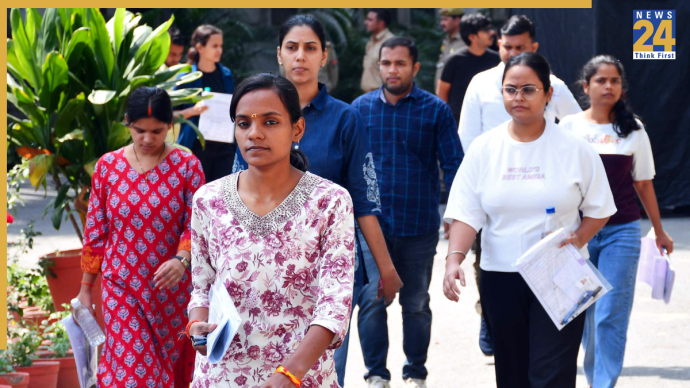
About 150 long-distance trains pass through Patna Junction daily. In the month of July, a large number of these trains are packed with students heading to different states for higher studies. This is because they have lost faith in the state’s education and security systems. Most financially capable parents feel that sending their child to a college in Bihar is like jeopardizing their future. Perhaps that’s why students continue to rush to other cities for higher education – a trend that has been going on for the last 40–50 years. This year, Delhi University received 2.39 lakh applications, out of which 17,173 were from Bihar.
‘Audio Viral Trend’, Tejashwi Yadav’s MLA threatens To ‘Beat With Shoes’
According to an estimate, every fourth student in JNU has a Bihar link. As per the data from the Bihar Caste Survey Report, 5.52 lakh students from the state are studying in other parts of the country. Suppose a child spends five years in higher education. Based on that, around 1.10 lakh students leave Bihar annually for studies. The crucial question here is: Who is responsible for making Bihar’s education system so sick? Was 20 years not enough time to fix it? How accurate is the picture of the education system being shown in government data? Since school education is the foundation, it becomes all the more important to take a closer look at the condition of Bihar’s government schools.
5 Teachers Are Responsible For Teaching 135 Students
A primary school in the Bajpatti block of Sitamarhi district exposes the government’s claims about Bihar’s education system. This school, established in 2003, is still struggling for basic facilities. Nitish Kumar became the CM just two years after the school was established, but the fate of this school has remained unchanged. Five teachers are responsible for teaching 135 children. In the summer, a tree is their only shelter, and during the rainy season, the children are forced to run and take cover in a dilapidated building nearby.
Another school, located in Ward Number 46 of Gaya Municipal Corporation, has been operating on the premises of a temple since 1998. To this day, the school has neither received its building nor been provided with basic facilities for the children, though the mid-day meal is served on time.
At the Urdu Primary School in Katihar’s Manihari Nagar Panchayat, children from classes 1 to 5 study together in the same classroom. The condition of the school reflects how serious the ruling party has actually been about improving the education system. This school was established in 1956. Many governments have come and gone, but the condition of this Urdu primary school has remained unchanged.
There is also a crumbling building in Lalganj, Vaishali. Here, classes are held from the 1st to the 8th standard. Locals know it as Bihari Shukla Madhya Vidyalaya. More than 80 children are enrolled in this school. Both teachers and students fear that the building could collapse any day.
In Araria’s Forbesganj, a picture exposing Bihar’s education system was seen in ward number two. In the school running under a shed, children have to make their own seating arrangements. There are 93 students enrolled in this primary school, the responsibility of teaching whom lies on 4 teachers. Similarly, in Begusarai, a primary school is running in this same building of Khapda, just 200 meters away from the education department. Currently, 5 teachers are deployed in this school and 150 children have taken admission in it.
School condition In Araria, Begusarai
In order to prepare children for the rapidly changing world, there is growing emphasis on training them in a high-tech manner from the very beginning. Computer coding is being taught, and AI is being introduced. At the same time, the condition of government schools in Bihar shows just how far behind the education system really is. However, the state’s Education Minister, Sunil Kumar, claims that the picture of Bihar’s schools has significantly changed.
After coming to power in 2005, CM Nitish Kumar introduced various schemes aimed at improving the education sector. As a result, school enrollment increased, but the quality of education has seen little to no improvement. Given the way school education has been handled by those in power, schools continue to lack basic facilities, and the overall standard of learning remains a concern. In such a scenario, the image of school education portrayed in government data seems very different from the ground reality.
183 Government Schools Lack Proper Infrastructure
When the foundation is weak, how can the building be strong? Somewhere, a school is being run under a tree; elsewhere, there is no proper arrangement for children to sit. In some places, school buildings have turned into ruins, and children are forced to study at the risk of their lives. According to information received through RTI, there are 183 government schools in Bihar that do not have their own buildings. The condition of Bihar’s schools is so poor, even though the Nitish government allocates nearly 20% of its total budget to education, the highest among all sectors.
The real pain of Bihar is that in some places, there are school buildings but no teachers. Where teachers do exist, they are burdened with many duties other than teaching. Most teachers are underqualified. While student enrollment in government schools increased during the Nitish government and the literacy rate figures improved, the harsh reality remains: the quality of education in Bihar’s government schools is extremely poor, leading to a high dropout rate. In 2023–24, the dropout rate at the secondary level in Bihar was 20.86%. Now, it becomes crucial to understand how far and how badly the standard of education in government schools has declined.
In the year 2022–23, 24,543,695 children were enrolled in government schools in Bihar. In 2023-24, the number dropped to 21,348,149. This means that the names of 3,195,546 children were removed from government school records in Bihar. It is believed that making Aadhaar mandatory helped reduce the number of ghost students.
Enrollment figures in primary education in Bihar have generally been good. However, the number of dropouts after Classes 10 and 12 remains high. Around 83% of children in Bihar do not get the opportunity to attend college. One of the major reasons behind the poor state of education in Bihar’s government schools is the lack of capable teachers. On the other hand, the state’s Education Minister claims that teacher recruitment and training have been carried out at a rapid pace.
Another key reason for the decline in the quality of education is that teachers are burdened with many responsibilities beyond teaching. For example, apart from classroom duties, teachers are often assigned tasks such as…
- Arrangement of Mid Day Meal
- Census
- House Census
- Livestock Census
- Caste Census
- BLO and Election Duty
- Promotion of Government Schemes
- Awareness Campaign
- Assistance in Examinations
Teachers are often required to perform non-academic tasks as well. This affects the studies of school students, and the foundation of their education begins to weaken. As the government education system collapsed, it paved the way for the rise of private schools and the coaching industry.
The quality of education in Bihar’s government schools is so poor that cracking entrance exams for prestigious institutes like IIT or AIIMS feels like a miracle for students studying in these schools. In such circumstances, many students board trains to cities like Delhi or Kota in Rajasthan to prepare through coaching.
If the teachers themselves are not trained, what will they teach the children? There is a need to work on multiple fronts at the same time to improve the learning environment in Bihar’s government schools. To bring the ailing system out of the ICU, capable teachers must be recruited. A proper mechanism must also be set up for regular teacher training, so they can stay updated and upgraded in line with the rapid changes in today’s world. If the teachers themselves are not trained, what will they teach the children?
A tall building of education stands on the foundation of strong school education, which in turn becomes the base for the progress of any individual, family, society, and state. In Bihar, education in government schools has largely become a formality. While statistics are often cited to claim improvements in the education system, students and their parents continue to view college-level education, and even university degrees, with doubt. This is why the trend of students leaving Bihar in search of better education and career opportunities remains unchanged. One of my colleagues once told me that when he joined Delhi University, in the course he was admitted to, every second student in the batch was from Bihar. Interestingly, many of the professors teaching in that college were also from Bihar, people who had once come as students themselves. Very few of those who left Bihar for higher education ever returned. Most of them have now become Non-Resident Biharis.
Only 39 Universities In Bihar
Now think, how much brain drain has taken place from Bihar in the last 4-5 decades? How much of the state’s money has gone outside? If Bihar had good colleges and universities, why would students leave for other states to pursue their studies? According to the All India Survey on Higher Education, there are 1,350 universities across the country, but only 39 are in Bihar. Patna University was once compared to Oxford, but today, whether it’s Patna College or BN College, all are struggling for basic facilities. There is a severe shortage of teaching faculty.
If there had been a better academic environment in Bihar’s colleges and universities, perhaps these students wouldn’t have left their homes and families to come to Delhi, a thousand kilometers away. Yes, the number of universities and colleges in Bihar has been steadily increasing. In 2018-19, there were 33 universities, which rose to 39 by 2023-24. The number of colleges grew from 892 in 2018-19 to 1,197 in 2023-24. But the real question is- What kind of education is being provided in these institutions?
To understand this, we must look at the current condition of Patna University’s reputed colleges. Patna College, established in 1863, was once a premier center of higher education in North India. Today, students there are struggling for even basic facilities. The library is still waiting for new books.
Not only is Patna College lacking in basic facilities, but this once most prestigious center of higher education in Bihar is also facing a severe shortage of professors. According to the official website of Patna College, the History Department is being run by just one Assistant Professor and three Guest Faculty members. Similarly, the Department of Political Science also functions with one Assistant Professor and three Guest Faculty. The Philosophy Department has only two Assistant Professors, while the Mathematics Department has just three.
Shortage Of Professors In Patna University
BN College, another key institution under Patna University, is facing a similar crisis. For instance, the Political Science Department has only one Assistant Professor and three Guest Faculty. The Chemistry Department has one Associate Professor and two Assistant Professors, while the English Department has one Associate Professor and two Guest Faculty. The situation in other departments is more or less the same. The condition of Patna’s renowned Science College is also far from satisfactory. The issue here is not just about infrastructure, but about quality education. Even the library of Patna College is in poor condition.
When there is a severe lack of basic facilities in the top colleges of Patna University and the colleges are struggling with a shortage of faculty, one can only imagine the condition of colleges in other parts of the state. Perhaps this is why students in Bihar start looking toward institutions in other cities of the country for higher studies as soon as they pass Class 12. According to data from the All India Survey on Higher Education, the total number of students pursuing higher education in the country in 2021–22 was 4,32,68,182. During the same period, the number of such students in Bihar was 26,22,946. These figures represent students in the 18-23 age group.
According to estimates, about one-fifth of Bihar’s students go to other parts of the country for college admissions. Among those who applied to Delhi University this year, 17,173 were from Bihar. Data also shows that 5.52 lakh students from Bihar are currently studying in other parts of the country, while around 27,000 students from Bihar are pursuing education abroad.
No Environment To Study As Per Needs
In the 1980s and 1990s, most students from Bihar went to other states for higher studies because it often took up to seven years to complete a four-year course in Bihar’s universities. But even though the academic sessions in Bihar’s universities have improved significantly over time, the exodus of students hasn’t stopped,, probably because there is still no learning environment that meets today’s academic and professional standards. There is a lack of basic facilities and a shortage of experienced professors.
The functioning of Bihar’s education system can also be understood through a recent incident. The selection of principals in five colleges under Patna University was not based on merit but done through a lottery system. Many departments of Patna College are running with just assistant professors and guest faculty. BN College faces the same situation. There was a time when getting admission into the colleges of Patna University was a matter of pride and competition. But in the current academic session, out of 4,445 undergraduate seats at Patna University, 950 are still vacant.
There is also a lack of quality institutions for technical and professional courses in Bihar. Despite having nearly 9% of the country’s population, Bihar has only 14,469 seats in government engineering colleges – a figure mentioned in the Bihar Economic Survey.
Only 7 Private Universities In Bihar
This year, 65 thousand students from Bihar appeared in the JEE Main exam for admission to engineering courses. Considering this data, just imagine how many students must be leaving Bihar every year to pursue professional courses elsewhere. Not everyone secures admission in government universities; a large number also enroll in private universities across the country for professional studies. However, starting a private university in Bihar is not easy. There are 503 private universities in the entire country, but only 7 are in Bihar.
Once, Nalanda University had more than three lakh books, and around 10 thousand students from all over the world came to study there. More than 2,700 teachers taught those students. There was a time when students from every corner of the world came to Bihar for education. But for the last 4-5 decades, Bihar’s students have been going to other parts of the country and abroad for their studies. Currently, Bihar has 4 central universities.
- Nalanda University in Rajgir
- Mahatma Gandhi Central University in Motihari
- Dr. Rajendra Prasad Central Agricultural University in Samastipur
- South Bihar Central University in Gaya
The condition of central universities in Bihar is good, but the quality of education in state universities remains questionable. Today, there is more emphasis on professional courses rather than traditional studies so that students can not only earn a degree but also secure campus placements soon after completing their courses.
In proportion to its population, Bihar lacks good institutions for professional and technical education. There were 8,774 seats in government engineering colleges in the state in 2021–22, which increased to 14,469 in 2024–25. Similarly, seats in polytechnic colleges rose from 11,211 in 2021–22 to 17,054 in 2024–25. Private universities are opening across the country to provide better education to students. But surprisingly, Bihar has only 7 private universities so far. There have been many challenges in starting private universities in Bihar.
One of the reasons for the lack of private universities in Bihar is the law and order situation in the state. There are 35 private universities in Uttar Pradesh, which borders Bihar. Madhya Pradesh has 20 private universities, and Rajasthan has 44. In such a scenario, if Bihar’s ailing education system is to be fixed, the rulers in power will have to honestly improve the condition of schools and colleges. Institutions that can train youth according to the global job market must be welcomed with open arms. Only then will the pace of student migration from Bihar reduce.
Change In The Name Of Karpuri Division
The decline of Bihar’s education system began in the late 1960s, when caste politics took center stage in the game of gaining power. During that period, the requirement of passing English was abolished. This change came to be known as the Karpuri Division. Politicians began using students studying in universities and colleges as political tools. As a result, university sessions started getting delayed, and students took two to three years longer to earn their degrees.
Universities became more hubs of politics than education. The political rise of Lalu Prasad Yadav and Nitish Kumar stemmed from Patna University’s student politics. When Lalu Yadav became Chief Minister, he experimented with opening a Shepherd School. When Nitish Kumar came to power, school education seemed to improve on paper, but it continues to decline on the ground. Nitish Kumar has an engineering background and has mastered the art of staying in power. However, it is very sad that the kind of education most government school children in Bihar receive today hardly prepares them to secure good ranks in competitive exams.
Students receive degrees upon graduating from colleges and universities, but only a few are truly prepared to compete in the job market. If Bihar is to be genuinely transformed, the entire education system, from schools to colleges, must be improved honestly and comprehensively. An ecosystem must be created where Bihar’s students have access to better institutions within the state. Students from other states should also come to Bihar for their studies. Merely talking about the glory of ancient Nalanda and Vikramshila Universities will not suffice. Honest efforts are needed to take Bihar’s education system out of the ICU.
ALSO READ: Bharat Ek Soch: 20 Years Of CM Nitish Kumar – Why Is Bihar Still Struggling With Industrial Growth?