

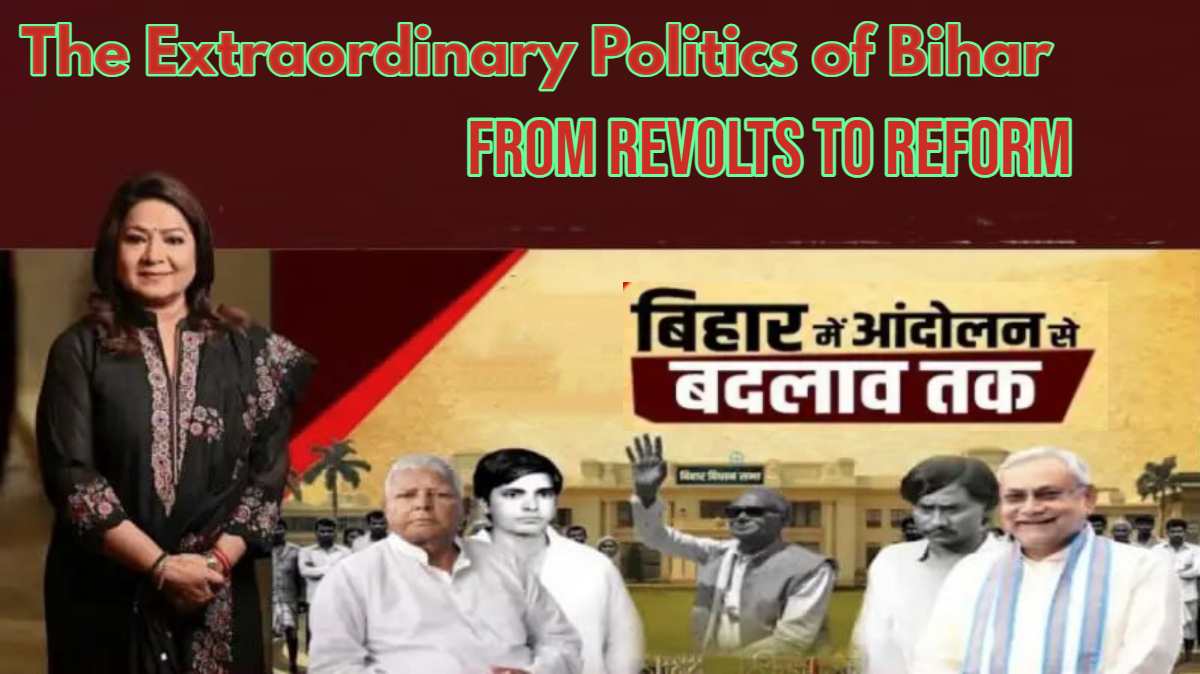


A popular saying goes like ‘what Bihar thinks today, the entire nation thinks tomorrow.’ Change often begins at the grassroots level, and Bihar’s historical records reveal that the state paved a new way for the nation. It was discussed earlier how the script of anti-congress sentiment was written on this land and how rulers, busy manipulating politics to emerge in power, were showing declining concern for the people. Amidst the uproar between the upper and lower classes, the leaders’ politics were thriving, but no honest efforts were made to open the closed doors of the common man’s future. In such a situation, the ordinary public, bewildered and frustrated, struggling to make ends meet, was slowly losing faith and trust in the government as well as the system. This gave rise to a movement that shook the entire political landscape from Patna to Delhi, making the domineering rulers realize the true power of democracy.
The land of Bihar has, time and again, witnessed changes and various powerful movements. Back in 1973, a peculiar feeling of anger against those in power was growing among the people during the months of September and October. Political leaders’ concern for the common man was gradually declining. A blind race for power gripped the leaders, who turned a deaf ear to public suffering. Under these conditions, students studying in the state universities began imagining a system where the ruling party would seriously listen to and address the voices of the most vulnerable in society. Eventually, Patna University campus became the epicenter of this.
Chimanbhai Patel Forced To Resign Under Intense Pressure From Student-led Movement
About 1800 kilometers away from Patna, students in Gujarat’s Ahmedabad became enraged due to a 20 percent hike in hostel food fees and the poor quality of food. The student-led movement quickly spread across the state and plagued Chimanbhai Patel’s Congress government. Under intense pressure from the protesting students, he was forced to resign in 1974.
Meanwhile, a sense of anger also prevailed among people of Bihar who were also suffering from inflation. The unemployed youth and students were becoming enraged with the government. Farmers and laborers joined the list, too. The government was aware of the swelling discontent among the people. Back in the turbulent 1974, the budget session of the Bihar Legislative Assembly was scheduled to begin on March 18, and tight security arrangements were already in place in Patna. Students began arriving at the Martyrs’ Memorial near the Legislative Assembly in Patna since early morning. Nearly 50,000 students gathered on the streets of Patna, out of which many were college students, while the rest were unemployed. Students gathered at the three gates of the Secretariat. Meanwhile, CRPF and police personnel, armed with rifles and batons, awaited the officers’ signal inside.
What unfolded on the streets of Patna on March 18, 1974, shook the ruling Abdul Gafoor-led Bihar government. The students’ rage had turned into an uncontrolled force. For them, Jayaprakash Narayan was a political saint who, while keeping away from power, spoke of systemic change. Meanwhile, during those days, Govindacharya was overseeing the work of the Rashtriya Swayamsevak Sangh in Patna. He, along with Ramakant Pandey and Lakhanlal Srivastava, went to Jayaprakash Narayan’s house and appealed to him to lead the movement.
Narayan’s involvement in the movement boosted the students’ enthusiasm to a great extent. He had already launched a campaign aimed at systemic reform and against all forms of corruption. Now it was time to give a direct and befitting fight. Narayana adopted the same path as Mahatma Gandhi, and a silent procession took place on the streets of Patna. The placards read, “क्षुब्ध ह्दय है बंद जुबान और हमला चाहे जैसा होगा हाथ हमारा नहीं उठेगा.” (A troubled heart, a shut tongue, and no matter how we attack, our hands will not rise)
Indira Gandhi’s Biggest Concern About Reviving The Congress Party
After Jayaprakash Narayan took charge of the leadership, the movement attracted a large number of students, as well as the unemployed and elderly. People started believing that their dreams could only be realized through JP’s revolutionary thinking and not the ruling Congress government. The pressure on then-Prime Minister Indira Gandhi escalated to the point that she enforced the ‘Emergency’. This was mainly due to Narayan’s revolutionary movement and a court decision.
During the Emergency, the entire nation was eventually turned into a prison, with many political leaders like Lalu Prasad Yadav, Nitish Kumar, and Ram Vilas Paswan being imprisoned. After the darkness of the Emergency lifted, the election bells rang, and the Congress party faced a total wipeout. Questions related to the methods even began to arise within the party. Indira Gandhi’s greatest concern back then was how to revive the Congress. Thus, she found the path to the party’s revival in Bihar.
Congress Regains Power In Bihar
When Karpoori Thakur decided to provide reservations to the backward classes, he faced strong opposition from the state’s ‘Power Elite’. Some ministers from the upper castes in his government opposed his policies. However, Thakur’s socialist politics were focused on advancing the agenda of social justice. He wanted to wipe out corruption from the system and end the backdoor practice of temporary appointments followed by regularization.
Resistance against Karpoori Thakur persisted within the Janata Party, leading to his government’s fall in April 1979. After the Belchi visit, Indira Gandhi paved the way for the party to regain lost ground. Within two and a half years, she returned to power at the center, and Bihar once again fell into the hands of the Congress. In the 1980 assembly elections, Congress won 169 seats, an absolute majority to form a government in Bihar. This election was also crucial for Lalu Prasad Yadav, who lost the 1980 Lok Sabha elections.
In such a situation, he tried his luck in the assembly elections and entered the Bihar Legislative Assembly after winning the Sonpur seat. However, Dr. Jagannath Mishra dominated Bihar politics at that time. Following a game of lame race for the Chief Minister’s post began within the Congress party, the consequence of which is that no Congress member has been sworn in as Chief Minister over the past 35 years.
In the 1980s, the Chief Minister’s seat in Bihar became a musical chair, with its occupants changing rapidly. The battle to protect and seize land, aided by guns and bullets, was being fought on the land of Bihar, from where the entire world took the message of peace instead of war. There, bloodshed for land, bloodshed between the upper and lower castes, and bloodshed over time changed everything.
ALSO READ: How Bihar Votes? Decoding the State’s Political Mindset Over the Decades