

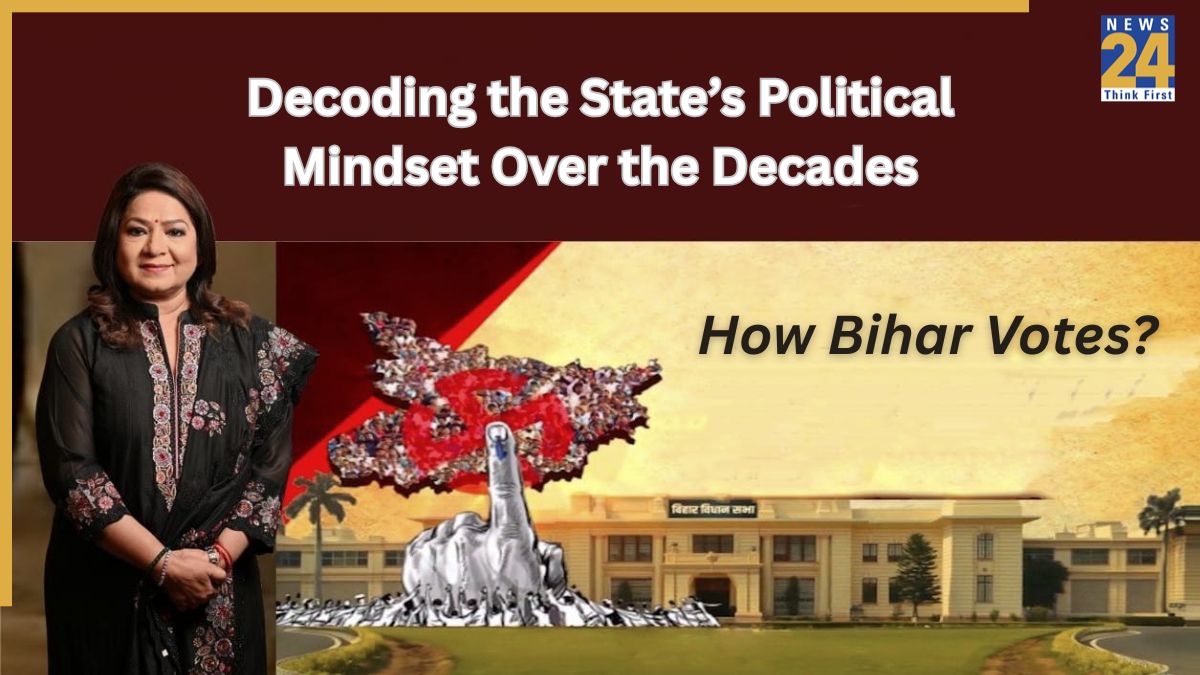


Bihar Elections 2025: The countdown for the Bihar Assembly elections, set to be held in two phases has officially begun. Political parties are pulling out new strategies and tactics to gain an edge over their opponents. Social media has become a key battleground, with parties and leaders making continuous efforts to create a wave of support in their favour. The election atmosphere is charged in Bihar, and everyone seems to be speaking out, loudly and passionately, making grand promises and bold statements. While leaders are making big promises, people of Bihar are silent. The voters are quiet and their thoughts unreadable. Every leader and political pundit is trying to read their minds, but understanding the mind of Bihar’s voters is no easy task. It seems like Bihar, on the map of India, is not just a state; it is an idea, a culture, and perhaps even a laboratory of politics.
There is a lot of talk about youth in election rallies this year. Every fourth voter in Bihar is Gen-Z, who will elect their MLA through their vote. They will also choose a new government that will work for the betterment of the state’s 130 million people. However, it is equally important to understand with what attitude Bihar has chosen its government and voted over time. To understand this better, there is a need to look back at the pages of Bihar’s past so that Gen-Z can gain knowledge about Bihar’s politics. Therefore, in this article, we will focus and discuss the political science of Bihar after independence.
The Political Science of Bihar
Bihar has been the work place of King Janak in Treta Yuga and King Jarasandha in Dwapar Yuga. Sage Valmiki was also born on its soil. From this land, Kautilya imparted the principles of governance to the world. Bihar’s soil has been the place of penance for Gautam Buddha, the workplace of Aryabhatta, who introduced the concept of zero to the world, and the laboratory of Sushruta, the father of surgery. Once, the rulers of present-day Afghanistan governed from Pataliputra, making the city renowned across the world. Bihar has always moved to its own rhythm, in its own way, whether during the era of the Mughals or the British.
From Champaran in Bihar, Mahatma Gandhi launched the first successful Satyagraha in the country, which eventually led to India’s independence 30 years later. To understand the political climate of Bihar, one must turn the calendar back to 1947, when the people of Bihar too breathed the fresh air of freedom on August 15, 1947.
While Pandit Jawaharlal Nehru led independent India, even during British rule, the people of Bihar had chosen Shri Krishna Sinha and Anugrah Narayan Sinha as their leaders. This duo was popularly known to as Sri Babu and Babu Saheb. In the first Bihar Assembly elections held after independence, Sri Krishna Sinha was unanimously elected leader. Sri Babu became the Chief Minister, while Babu Saheb became the Deputy Chief Minister. Bihar’s political landscape was defined by landmark reforms such as the Zamindari Abolition Act, and efforts were made to transform the state’s landscape through the establishment of industries.
Politics Without Differences or Discord
Amidst the development and change in Bihar, another strong current was blowing, the current of caste dominance and anti-Congress sentiment. A cold war was also raging between Shri Babu and Babu Saheb. During the 1957 Bihar elections, things became so heated over ticket distribution that Pandit Nehru summoned both leaders to Delhi. The situation was resolved with great difficulty.
After the elections, both became contenders for the post of Chief Minister. A vote was held among the MLAs, in which Babu Saheb received fewer votes, losing the race for the top post. Babu Saheb immediately went to Shri Babu’s house to congratulate him. Shri Babu, in turn, remarked bluntly, “How can my government function without you?” Anugrah Narayan Sinha was again made Deputy Chief Minister. This was the political science of Bihar in the 1950s, characterised by differences, not discord.
Congress’ Fortunes Decline Amid Caste-Based Alignments
Shri Krishna Singh had a unique style of politics. He spoke his mind boldly and confidently. He showed no hesitation in taking major and tough decisions in the public interest. The year was 1961, and the date was January 31. On this day, Shri Babu breathed his last. After his death, the Rajputs staked a claim to the throne of Bihar. Deep Narayan Singh was sworn in as Bihar’s second Chief Minister, but remained in power for only 17 days. After the Bhumihars and Rajputs, it was the turn of the Brahmins. Binodanand Jha ascended to the Chief Minister’s chair. Amid power manipulation and caste mobilisation, the Congress party’s influence was rapidly declining.
Following the Socialist Party’s defeat, Jayaprakash Narayan withdrew from politics. The political landscape in Bihar became increasingly unstable, making it difficult for the Congress to maintain its foothold. Under the leadership of Dr. Ram Manohar Lohia, the Socialists were given an opportunity to establish their political presence in Bihar. Karpoori Thakur emerged as a prominent leader of the Socialists in Bihar. The Socialists benefited from public dissatisfaction with the system and the government in Bihar. Just 20 years after independence, they eroded the Congress’ position in the state, paving the way for the first non-Congress government. The Jana Sangh also played a major role in this development.
When Bihar Became a Laboratory of Politics
New experiments were being conducted in Bihar for political power. Politicians were working on new equations based on the state’s social fabric. Leaders saw vast political potential among backward caste voters in Bihar. Political awareness among backward castes was rapidly growing, and their influence was steadily increasing. This was the miracle of the Patna political laboratory, where a Dalit reached the position of Chief Minister within just 20 years of independence. Other states in India also learned a practical lesson from the power manipulations and defections in the Bihar Assembly.
Six governments were formed and fell in two years. That period was from 1967 to 1969. The game of power-peddling in Bihar was in full swing. Meanwhile, Indira Gandhi, then Prime Minister, eroded the political ground of the Communists and Socialists with the slogan “Garibi Hatao.” In 1971, Indira Gandhi came to power at the Centre with a landslide majority, and its impact was felt in Bihar as well. The people of Bihar became disillusioned with the Socialist and coalition governments. Once again, they brought the Congress party to power with an absolute majority. But the leaders and rulers of the state did not learn from past mistakes. Chief Ministers were appointed and removed at the behest of the high command.
Patna University Changed the Course of Politics
The common man in Bihar was becoming increasingly frustrated and disillusioned with the political machinations of power. Everyone had their own problems, farmers had theirs, working people had theirs, businessmen had theirs, and students had theirs. A different kind of volcano was raging within Patna University itself. The distance between the Patna University campus and Gandhi Maidan, Bihar’s most popular political gathering venue, was not far.
During that period, students from various colleges of Patna University would often gather at Gandhi Maidan and deliberate for hours on the problems of the state. Indeed, a new generation of leaders was emerging at Patna University, with dreams of transforming the nation’s politics and system. Patna University’s student politics sparked a wave that transformed both the political landscape and ideology of the entire nation. The anger that began on the university campus soon turned into a massive popular movement, making the power-drunk politicians realise the true strength of democracy.
Also Read: Sitapur Ranks First in Farmer Registration, Accounting for 54% of the State’s Total Registrations