


Bharat Ek Soch: Bihar stands at the threshold of yet another election. The focus is now on Nitish Kumar, who has held the position of Chief Minister for the past 20 years. In its latest announcement, the State Government has promised to generate nearly 1 crore jobs in the next five years. Additionally, the Nitish Government is planning to launch a new industrial policy to boost the state’s economy. Preparations are also underway for setting up an ‘Idea Festival’ this month, with the aim of gathering 10,000 startup ideas. An expert team will later connect the shortlisted ideas with markets and investors. Out-of-the-box startup ideas will be granted Rs 10 lakh by the government.
Now the big question is: Why is all this happening now? Despite being called a ‘Vikas Purush’ and ‘Sushasan Babu’, why is Bihar still lagging when it comes to industrial growth and entrepreneurship?
Twenty years is a long time to change the ground situation of any state. However, Bihar is progressing at a relatively slower rate than most other states in the country. Isn’t it surprising? Why is there a limited number of factories in Bihar compared to other states? Why haven’t industrialists in Bihar set up factories? Why is the state’s per capita income less than half of the national average? Are shortcomings in policies responsible for the state’s backwardness? Was the intention of the administration flawed? Most importantly, who is responsible for sidelining industrial development?
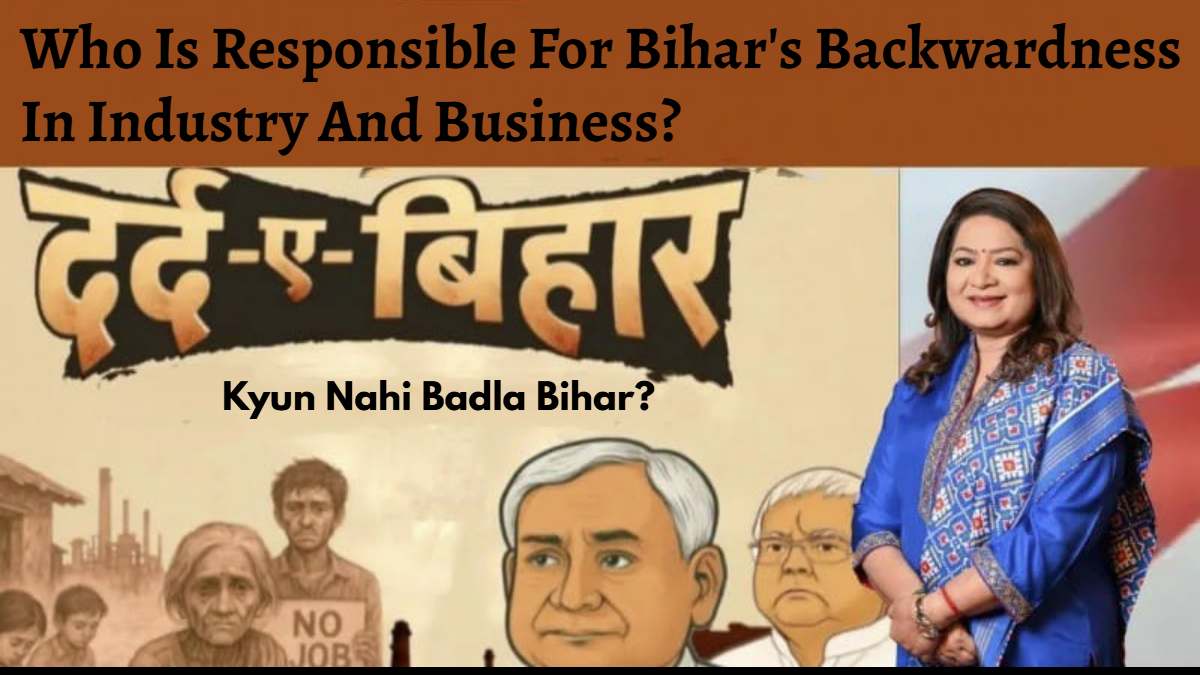
In the coming weeks, we will explore these serious issues in our special series-‘Dard-e-Bihar: Kyun Nahi Badla Bihar?’
Where Did Bihar’s Old Glory Go?
Every individual born in the land of Bihar takes pride in belonging to the land of the great Emperor Ashoka. This land embodies Buddha’s wisdom. It is the land that nurtured science-the land of mathematician and astronomer Aryabhatta. Chanakya taught the entire world diplomacy and politics from this land. The seed of ‘गणतंत्र’ (Republic) and ‘लोकतंत्र’ (Democracy) sprouted from this revered land. Vikramshila and Nalanda Universities showed the world the path of revival as modern international universities. It was the land of Champaran where Mahatma Gandhi started the Satyagraha movement against the British.
Where did Bihar’s old glory go? Why is it that the per capita income of the country is Rs 1,84,205, while that of Bihar is Rs 66,828-less than 40%? The biggest pain for most Biharis is that their income is significantly lower than the national average. It is worth reflecting upon that the Nitish Kumar-led Bihar government is preparing to launch a new industrial policy- the draft of which is almost final-at a crucial time when elections are drawing closer. It is being said that the new policy will be industry-friendly and investor-attractive. But there’s something to reflect upon: What’s behind the sudden move to introduce a new industrial policy just a few months before the elections? What was the state government doing for the last 20 years?
Why Has Bihar Struggled To Develop Its Industrial Sector?
When Prime Minister Modi mentioned his firm resolution while standing on the land of Motihari, one question arose in every youth’s mind-why has Bihar remained so backward in terms of industrial growth, even today? Nitish Kumar has held the position of Chief Minister of Bihar since 2005. In between, Jitan Ram Manjhi served as the CM from 20 May 2014 to 20 February 2015. The question that arises here is: Why has Kumar suddenly started talking about jobs and employment as the elections approach?
No. Of Factories That Rose Nationwide, But Dropped In Bihar
2013-14: No. Of Operational Factories In Bihar was 3,132, while across the country it was 1,85,690.
The following year, the no. of factories in the state decreased to 2942, while it rose nationwide to 1,89,466.
2015-16: 2,918 factories were operating in Bihar, and across the nation were 1,91,062.
2018-19: The graph went slightly upward in the state, but started decreasing again.
2021-22: The total no. of operational factories in the state decreased to 2,729, while it reached 2,00,576 in the country.
Will Employment Opportunities Like Gurugram Be Available In Gaya?
Bihar Industries Minister Nitish Mishra says that Bihar is changing rapidly. The people of Bihar have been shown a dreamy picture. They are wondering whether employment opportunities like those in Gurugram will be available in Gaya. Will Motihari be able to compete with Mumbai in terms of economic growth? Will industrial parks be opened in the region?
Bihar was once known as the ‘sugar bowl’. There were 33 sugar mills in the state, producing about 40% of the sugar in the entire country. However, according to the Bihar Economic Survey, 68.77 lakh quintals of sugar were produced in 9 sugar mills of the state. Between 1977 and 1985, the Bihar government acquired over 15 sugar mills. The factories, however, started shutting down one by one. A similar situation occurred with the rice mills operating in the state. During the wave of liberalization, new factories were being set up rapidly across the country, but even the existing factories in Bihar were shutting down.
New Policy Came, But Nothing Happened
Let’s rewind the clock! It was September 2020, and the Bihar Assembly election campaign was in full swing. Nitish Kumar stated that the majority of industries are set up in the coastal states. “We tried a lot,” he said. Shahnawaz Hussain, who served as the Industry Minister under the Kumar-led government from February 2021 to August 2022, says that when he was the Industry Minister, people used to say, “There are no industries, then what is the Minister for?” Hussain argues that the outcome of his actions is now coming to the fore. The question here is: when Nitish Kumar became the Chief Minister of Bihar in 2005, why did the state remain backward in terms of industrial growth until 2025?
It is also true that an industry policy was introduced in Bihar in 2006; however, it did not work out. A policy was again brought in 2011, but it failed. So, in 2016, the Bihar Industrial Investment Promotion Policy was launched, but even this did not stop the migration of people to other states in search of employment. JDU leader and former Industry Minister Shyam Rajak argues that even though there is no significant industrial growth in Bihar, there is no void either.
Why Did The Businessmen Avoid Setting Up Industries?
In the beginning, small and big businessmen showed interest in setting up industries and investing in Bihar, but the condition of the state remained the same. The goal of the Nitish government’s Bihar Industrial Incentive Policy, 2006, was not achieved. There was already an existing shortage of infrastructure. Moreover, law and order were not under control. Officers adopted an indifferent attitude towards industries, land was not acquired as promised, and there were obstructions in providing government subsidies.
A new industrial policy was introduced in 2011 with some reforms aimed at correcting the shortcomings of the previous policy, but it did not yield significant benefits. Then, another industrial policy was introduced in 2016. The Nitish government kept bringing one policy after another to promote industries in the state, yet there was no industrial boom on Bihar’s soil. In this context, Nitish Kumar has often been targeted by the opposition on the issues of industry and employment. The tone of political leaders keeps changing depending on whether they are in power or in opposition. However, the reality of Bihar’s backwardness in industrial matters is crystal clear and impossible to conceal.
An attempt was also made to remove bureaucratic obstacles from the process of land acquisition for factories. The single-window clearance system was introduced. A new exit policy was implemented, which established a mechanism to hand over the land of closed factories to BIADA and reclaim the lease amount deposited earlier. The surprising thing is that in a state like Bihar, which has immense potential, numerous MoUs are being signed and many business proposals are coming in-but the question remains: how many industries are actually being set up?
Shocking Figures
According to estimates, in 2019-20, 248 proposals were received, out of which 89 industries were established. In 2020-21, 284 proposals came in, but only 53 industries were set up. In 2021-22, 579 proposals were received, resulting in 72 industries being established. In 2022-23, 430 proposals arrived, with only 83 industries set up. In 2023-24, 393 proposals came in, and 88 industries were established.
From the current Industry Minister of Bihar to the former ones, everyone claims that there will be an industrial boom in Bihar within the next five years. Recent figures are being cited to show that projects worth over Rs 1,000 crore are now coming to Bihar. Currently, industries are being established in sectors such as food processing, manufacturing, ethanol, textiles, plastics, healthcare, and renewable energy. Dobhi in Gaya and Bihta in Patna are also emerging as industrial hubs. Until March 2024, there were 586 startups in Bihar, which increased to 1,522 within a year. Since 2016, there has been an investment of Rs 10,415 crore in 915 operational units, employing 41,816 people. However, even today, very few factories are being set up in Bihar compared to the number of industrial proposals received.
Leaders have a special ability to instantly inspire hope. Amidst the election season, the people of Bihar are being told that between 2025 and 2030, numerous new factories and industries, both large and small, will be set up across the state, eliminating the need to seek employment elsewhere. Those in power argue that the industrial ecosystem has now been prepared. Bihar’s first industrial township will be built in Gaya, and two special economic zones will be developed. Given this, it is natural to question: if industries have not flourished in the last 20 years, what guarantees that Bihar will shift into high gear industrially in the next five years?
Let us try to understand Bihar’s industrial development through data. The Economic Survey of Bihar 2024-25 mentions the status of factories operating in the state. According to the survey, in 2022-23, there were a total of 3,307 factories in Bihar, out of which 2,782 were operational. During the same period, 2,65,523 factories were operational across the country. To put this statistic simply, Bihar’s share in the country’s population is about 9 percent, whereas its share in operational factories is only 1.34 percent. Additionally, the people of Bihar lag far behind in terms of per capita income.
If a storm of change is indeed brewing in Bihar, with new industrial areas coming up, then why do lakhs of Bihar’s youth migrate every year to other states for employment? According to statistics, 2.9 crore people from Bihar live in other states in search of employment, with the highest number migrating to Delhi.
Here are the figures:
- 19.34% in Delhi
- 14.12% in Jharkhand
- 13.65% in West Bengal
- 10.55% in Maharashtra
- 10.24% in Uttar Pradesh
- 7.06% in Haryana
- 6.89% in Punjab
- 4.79% in Gujarat
Former Industry Minister Shahnawaz Hussain says that the people of Bihar will go wherever they find opportunities-even if it means going to the moon. Searching for opportunities is in the DNA of the people of Bihar. Indeed, whoever finds better prospects will move there for employment. If this argument holds, then how many people from Maharashtra, Gujarat, Punjab, or Haryana migrate to Bihar in search of better opportunities? How many workers from Punjab work in Bihar’s fields?
Statistics show that 15.8% of people migrate from Bihar to other states for employment, while the national average is only 6.1%. Bihar also trails behind in terms of per capita income.
In 2011-12, the per capita income in India was Rs 63,462, whereas in Bihar it was only Rs 23,525.
In 2015-16, it was Rs 94,797 in India, but only Rs 33,218 in Bihar.
In 2019-20, India’s per capita income rose to Rs 1,32,341, while Bihar’s was Rs 48,263.
In 2023-24, India’s per capita income reached Rs 1,84,205, but Bihar’s was only Rs 66,828.
Why Are Private Institutions Or Universities Not Opening In Bihar?
Over the last few decades, the standard of education in Bihar has declined, causing about 5 lakh youth to migrate annually to other parts of the country for studies, enrolling in renowned government and private universities. This raises the question: why have private institutes or universities for professional courses — such as Symbiosis and DY Patil Medical College in Maharashtra, Manipal University in Karnataka, Vellore Institute of Technology in Tamil Nadu, BITS Pilani in Rajasthan, or Amity, Galgotias, and Sharda University in Uttar Pradesh-not been established in Bihar? Who is responsible for the outflow of Bihar’s resources and the resulting brain drain? People from Bihar have made a name for themselves in business across the country, yet for several decades, the environment in Bihar has been such that most successful Biharis living in other states hesitate to return or set up factories or universities in their home state.
Today, it is being argued that Bihar is number one in the ethanol industry. Britannia set up its first factory in the state in 2011, and the second factory was built in 2023-24. A Pepsi unit started in Begusarai, and the second plant is ready in Buxar. People of Bihar are being told they will no longer need to go outside the state for employment, but it is also true that 2 crore 90 lakh people from Bihar are currently living in other parts of the country for work. Those associated with the ruling party argue that this is not migration but a search for better opportunities-something the people of Bihar have always excelled at.
The reality is that due to the lack of factories in Bihar, the youth have had to turn to other parts of the country. It is the responsibility of the state to create an ecosystem for setting up factories and industries. The way crime is rapidly increasing in Bihar, with businessmen being murdered, is alarming. On average, more than 225 murders take place every month. In such a situation, why would industrialists want to invest in Bihar by putting their lives at risk? It is the responsibility of the state to maintain law and order. Nitish Kumar also holds the Home Ministry. He bears greater responsibility for Bihar’s backwardness in terms of industrial development and per capita income, as he has been in the driving seat of the state for the last 20 years. His Chief Ministerial position remained secure, but Bihar’s fate did not change.
Before Nitish Kumar’s tenure, Rabri Devi and Lalu Prasad Yadav were in power in Bihar. The agenda of social justice was pushed to such an extent that there was probably no space left for industrial growth. A special policy of the central government after independence is also considered one of the reasons for Bihar’s industrial backwardness.
Three Reasons For Bihar’s Backwardness
At the time of independence, one part of Bihar had fertile land for agriculture, and the other part had immense mineral wealth. Bihar, which was made so rich by nature, is considered to have lagged behind in the race of progress after independence due to three specific reasons. First, the freight equalization policy of the 1950s. Second, the feudal or semi-feudal society of Bihar was not mentally prepared to move away from traditional farming and business. Third, looking at the social fabric and temperament of the state, the politicians and bureaucrats did not show much interest in setting up industries.
Half of India’s mineral wealth was found in the land of this province, but other states were reaping its benefits. All the headquarters of minerals were located outside Bihar, and the sales tax from them went only to those states. However, in the initial years after independence, there was considerable emphasis on industrial development in Bihar. Projects like Kosi, Chachan, and Damodar Valley were initiated during the tenure of Shri Krishna Narayan Singh. The HEC plant and Bokaro Steel Plant were set up in Hatia. During that period, a promising picture of industrialization emerged in Barauni, Begusarai, where a refinery, an NTPC plant, and a fertilizer factory were established. This created an ecosystem that transformed people’s lives.
But in the 1960s, Dr. Ram Manohar Lohia started a political movement to give the backward classes a share in power. Bihar became the first vocal laboratory for this movement. In 1967, the first non-Congress government was formed in Bihar. After that, the Chief Minister’s chair in the state became increasingly unstable. Saving their government became the primary focus of those in power. In 1977, during the Karpoori Thakur era, an initiative was taken to set up new industries.
Not Only Sugar, Rice Mills Were Also Shut
Between 1977 and 1985, the Bihar government acquired more than 15 sugar mills. The situation became such that the shutters of rice mills also started falling rapidly. Amidst the politics of forward-backward, children of upper-caste families began catching trains to other states for studies and employment. Lalu Yadav, who became the Chief Minister in 1990, pushed the agenda of social justice with such force that industry and industrial development were left far behind. The image of Bihar deteriorated to such an extent that, for capitalists, setting up an industry was seen as a loss-making deal or a loss of capital.
Before independence, Bihar had 33 sugar mills, which have now come down to just 9. The condition of rice mills in the state is also more or less the same as that of the sugar mills. In such a situation, it is still far-fetched to expect how much the offers of the policy currently being prepared to encourage industry and investment in Bihar will attract business houses.
It sounds very good to say “Bihar First, Bihari First,” “Make in Bihar,” and “Sell in Bihar,” but to achieve these goals, the leaders, officers, and people of Bihar will have to work together with complete honesty. One will have to rise above the mindset of making new announcements only during the election season.
ALSO READ: Bharat Ek Soch: From Tariff Clashes To Deal-Making! Is Trump Running America Like A Private Company?