
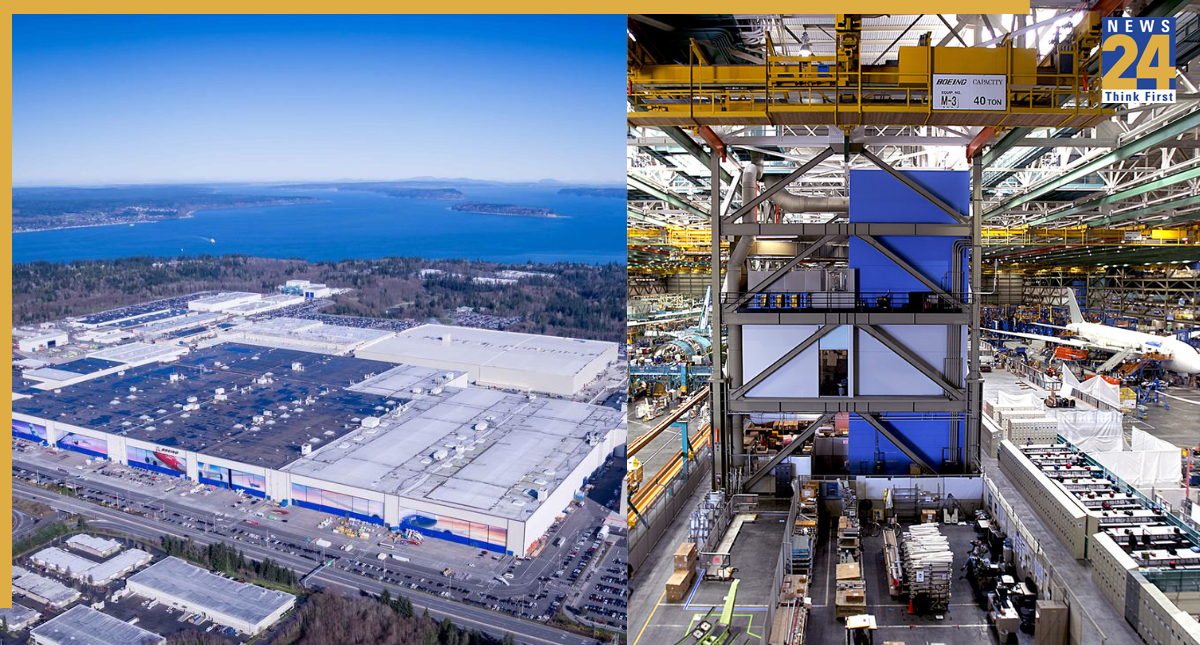


Have you ever wondered where the world’s largest commercial airplanes are built and how thousands of complex parts come together to create machines that soar through the sky? The answer lies in the city of Everett, in the US state of Washington, home to the Boeing Everett Factory the largest airplane manufacturing facility in the world.
Spread across an enormous area, this iconic plant is not just a factory but a fully functioning industrial city where innovation, engineering and human effort combine on an extraordinary scale.
A Factory of Unmatched Scale
The Boeing Everett Factory was opened in 1967 to build the iconic Boeing 747, often referred to as the “Queen of the Skies.” Over the decades, the facility has expanded significantly. Today, the factory covers an area of nearly 400,000 square metres, making it the largest building in the world by volume.
The sheer size of the structure is difficult to comprehend. Aviation experts often note that the space inside the plant is so vast that thousands of Olympic-sized swimming pools could fit within its walls.
A Workforce the Size of a Small Town
What truly sets the Everett plant apart is the number of people working under a single roof. Around 30,000 employees operate here across multiple shifts. From engineers and technicians to electricians and quality inspectors, the workforce is as diverse as it is massive.
With so many people on site every day, the factory feels less like an industrial unit and more like a small town. Dedicated systems ensure smooth coordination, safety and efficiency throughout the massive facility.
Moving Around on Wheels, Not on Foot
Because of the enormous distances inside the plant, employees rarely move around on foot. Workers commonly use bicycles or electric carts to travel from one section to another. For many, commuting within the factory can take several minutes, highlighting just how large the building truly is.
Humans and Robots Working Side by Side
The Everett Factory operates 24 hours a day, combining human expertise with advanced robotic technology. Skilled workers and automated systems collaborate on various stages of aircraft assembly, from constructing the fuselage to installing wiring systems and fitting engines.
At any given time, as many as eight large aircraft are in different stages of production. While one plane may be undergoing structural assembly, another could be receiving internal wiring, and a third might be having its engines installed.
Thousands of Aircraft Built Over the Years
Over the years, the Everett plant has produced thousands of wide-body aircraft for airlines across the globe. According to company records, more than 1,300 Boeing 767 aircraft, nearly 1,700 Boeing 777 jets, and over 1,000 Boeing 787 Dreamliners have been assembled at this facility.
Each aircraft represents years of planning, engineering and meticulous craftsmanship, making the Everett Factory a cornerstone of global aviation manufacturing.
More than five decades after it first opened, Boeing’s Everett Factory continues to stand as a symbol of industrial scale and technological ambition. It remains one of the most fascinating examples of how modern engineering and human effort come together to shape the future of air travel.