
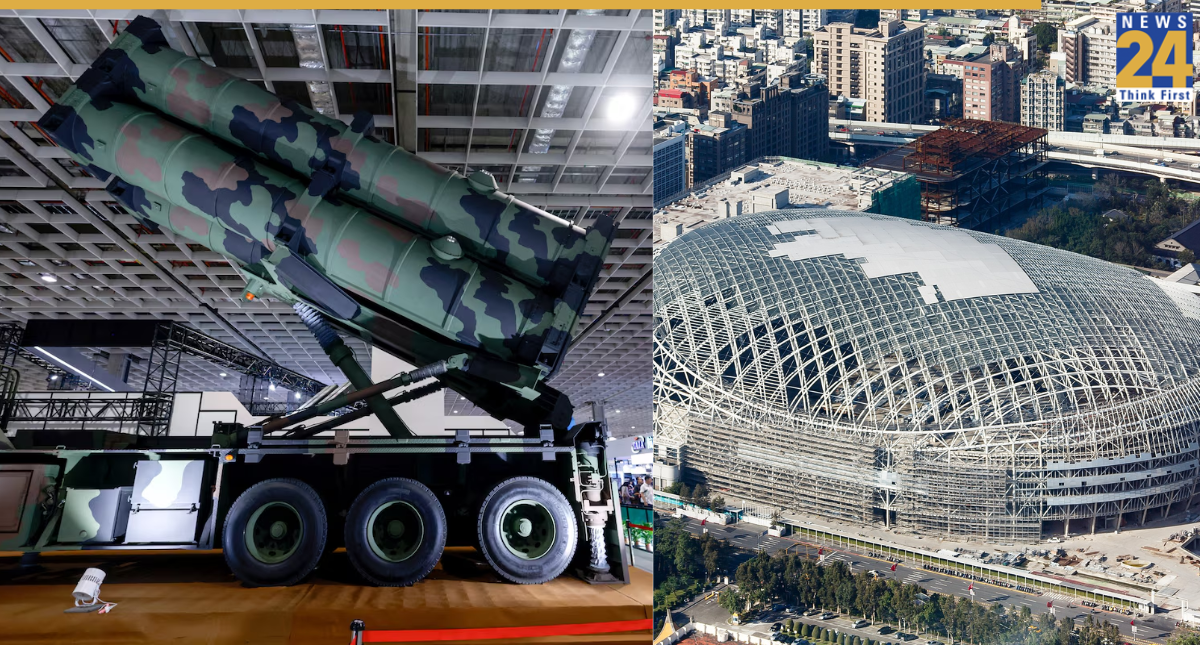


Taiwan has announced a major push to strengthen its defenses as tensions with China continue to rise. The government has proposed an additional $40 billion defense budget, to be spent over the next eight years, mainly on a new multi-layered air-defense system called T-Dome. Officials say this system is designed to shield the island from Chinese fighter jets, ballistic missiles, cruise missiles, and drone attacks threats Taiwan believes are becoming increasingly urgent.
The proposal comes as the United States continues to encourage Taiwan to increase its defense spending and accelerate military modernization.
A Massive Long-Term Security Plan
According to the government, the $40 billion “special budget” will be used between 2026 and 2033. President Lai Ching-te had already pledged to raise Taiwan’s defense spending to 5% of GDP, and the new budget fits directly into that promise.
For 2026 alone, Taiwan has already increased its regular defense budget to $31.18 billion, pushing total spending to roughly 3.3% of GDP. In an op-ed published in The Washington Post, President Lai said that much of the special budget would go toward buying advanced weapons from the United States and cooperating with the U.S. on new defense systems.
Defense Minister Wellington Koo explained that the $40 billion figure represents the upper limit of the special budget. The funds will be used to buy precision-strike missiles and strengthen joint weapons development programs with the United States.
What Is T-Dome?
President Lai formally revealed the T-Dome project on October 10, comparing it to Israel’s Iron Dome, though experts say the two systems are quite different.
According to Taipei-based defense analyst J. Michael Cole, Iron Dome is mainly designed to intercept short-range rockets. T-Dome, however, must handle a much wider range of threats including fighter jets, drones, cruise missiles, and ballistic missiles launched by the People’s Liberation Army (PLA).
Taiwan already operates several systems: the U.S.-made Patriot PAC-3, the locally developed Sky Bow and Tien Kung systems, and is waiting for deliveries of NASAMS from the United States. T-Dome will link all these systems through advanced radars, sensors, and command centers to create a single, fast-responding defensive “umbrella.”
Defense expert Su Tzu-yun says T-Dome will have two main components:
- Command and Control Network: Fast threat detection, radar integration, and real-time decisions on which interceptor to launch.
- Interceptor Layers: Multiple missile types positioned at different altitudes to counter various incoming threats.
Why Taiwan Believes T-Dome Is Urgent
The war in Ukraine has influenced Taiwan’s thinking. Officials say Ukraine’s survival has shown the importance of a strong, layered air-defense network that can protect soldiers, infrastructure, and civilians during the first wave of missile strikes.
Despite years of military upgrades, Taiwan still trails far behind China in the number and range of weapons. Analysts warn that the PLA has hundreds of missile launchers on the mainland, as well as warships near Taiwan, capable of firing hundreds of missiles within minutes.
“If Taiwan can neutralize the first sudden missile strike, Beijing will have to think many times before launching an attack,” Su Tzu-yun said.
For Taiwan, T-Dome is not just about weapons it is about giving the island enough breathing room to survive the first critical moments of a potential conflict.