
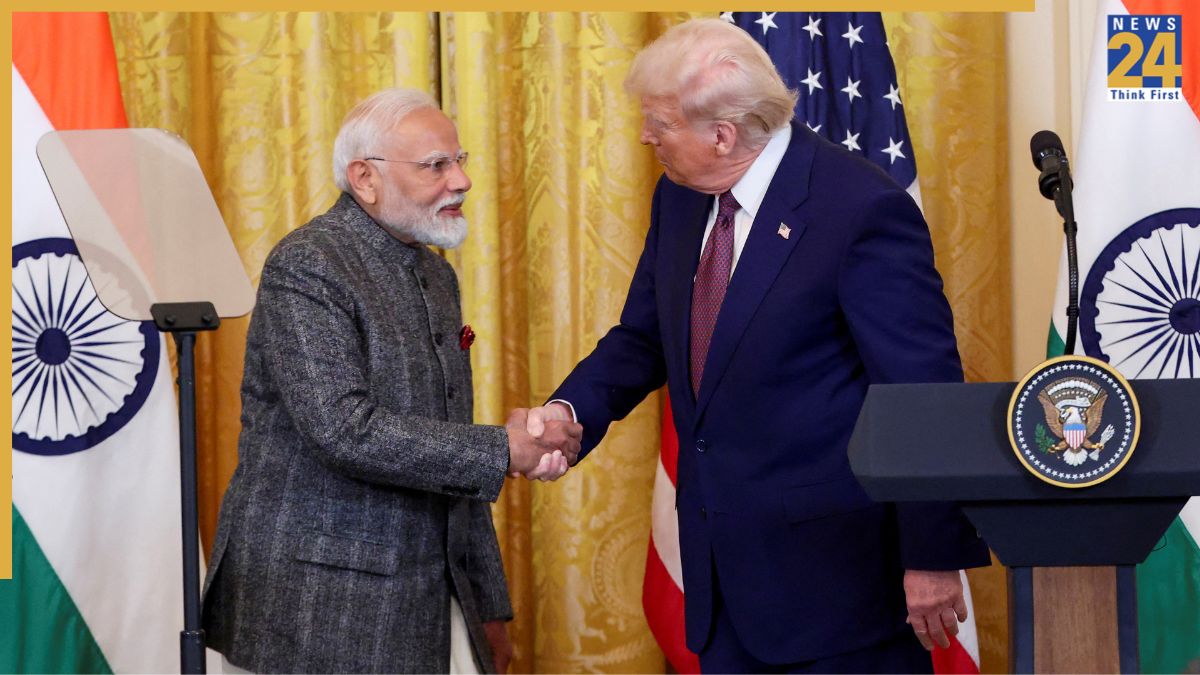


The US government has recently been criticising Europe excessively, even warning that it is heading toward “civilisational erasure.” Now, the Trump administration seems to be have taken this stance further. President Donald Trump is reportedly considering a new “Core 5” or “C5” leaders’ club that would include the US, China, Russia, India, and Japan.
What is ‘Core Five’?
It is anticipated that the formation of Core 5 group could serve as a hard-power alternative to the G7, sidelining Europe and traditional democratic, wealth-based alliances. While there has been no official confirmation on this matter, American publication Politico reported that the idea for the new hard-power group came up in a longer, unpublished version of the National Security Strategy that was published by the White House last week. Though, Politico said it could not confirm the existence of the plan, it highlighted that Defense One reported it.
The new idea, outlined in draft national security thinking, suggests that existing forums like the G7 and G20 are not enough for a multipolar world. Instead, it focuses on deal‑making among major population and military economic powers. This worries US allies, who fear it could legitimise “strongmen,” elevating Russia over Europe and potentially weakening Western unity and NATO cohesion.
“The strategy proposes a ‘Core Five,’ or C5, consisting of the United States, China, Russia, India, and Japan – several countries with populations over 100 million. It would meet regularly, like the G7, at summits on specific topics. The first on the proposed C5 agenda: security in the Middle East, specifically the normalisation of relations between Israel and Saudi Arabia,” the report stated.
Is it a ‘Trumpian’ idea?
According to Politico, the White House has denied the existence of this document, with White House Deputy Press Secretary insisting that “no alternative, private, or secret version” of the 33-page official plan exists. However, national security experts believe the idea has a “Trumpian” connection to it and could be appropriate for the White House.
The publication quoted Torrey Taussig, who served as director for European affairs on the US National Security Council during the previous administration as saying: “This is consistent with how we believe President Trump views the world, which is non-ideological, through a sympathy for strong players, and through a tendency to cooperate with other great powers that maintain spheres of influence in their region.”