

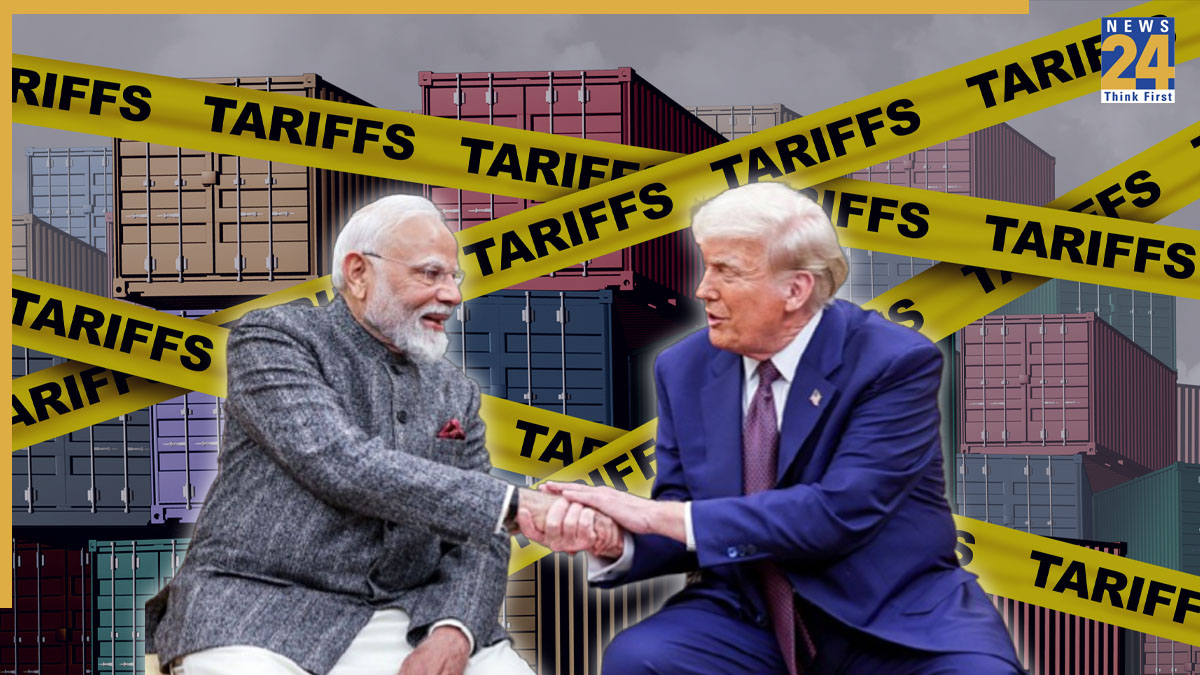


The United States has hinted at a possible reduction of the 50% tariff imposed on India, with President Donald Trump himself signalling flexibility. In a reciprocal move, India appears ready to offer relief to the US, with officials saying that if Washington eases tariffs, India could reduce duties on a wide range of products. The development comes as both countries are close to a potential India-US trade deal, aiming balanced agreement that safeguards sensitive sectors while boosting bilateral commerce.
While this development is significant ahead of the trade deal finalisation, in this article, we explore the potential factors that may have eased trade tensions between New Delhi and Washington.
Resilient Indian Exports
According to a Reuters report, India’s resilient domestic economy and a smaller-than-expected decline in exports are working in its favour during ongoing trade negotiations with the US. Exports to the US fell 8.6% year-on-year to $6.3 billion in October, a drop significantly lower than the 12% decline recorded in September, although both months reflected the impact of the 50% tariff imposed by the US on Indian goods.
Escaped the worst impact of tariffs, no hurry for trade deal
The report quoted a senior official as saying that, for now, India has escaped the worst impact of the 50% US tariff. He added that while textile export orders have seen a significant decline, the broader economic impact remains limited. This gives India room to take more cautious steps in trade negotiations. Also, India has made it clear that it will not rush into any agreements, unlike Japan and South Korea, which quickly finalised deals with the US under tariff pressure.
India may reduce tariffs on 80% of goods
According to reports, officials familiar with the India-U.S. trade deal have expressed hope that the US will eventually reduce the 25% tariff imposed on India’s Russian oil purchases and move toward an overall 15% tariff. In return, they said, India is willing to cut tariffs on more than 80% of goods while protecting other sensitive sectors, including agriculture.
Reassuring figures across sectors
Trade figures from April to October 2025 are also reassuring. The United States remains India’s top export destination with $52.12 billion, driven by strong demand for engineering products, pharmaceuticals, electronics, and gems and jewellery. The UAE, Netherlands, and China followed with exports of $22.14 billion, $11.98 billion, and $10.03 billion, respectively. Meanwhile, China remains India’s largest source of imports, reflecting the country’s continued dependence on vital global supply chains. Additionally, Indian exporters have also diversified and reached African and European markets.