

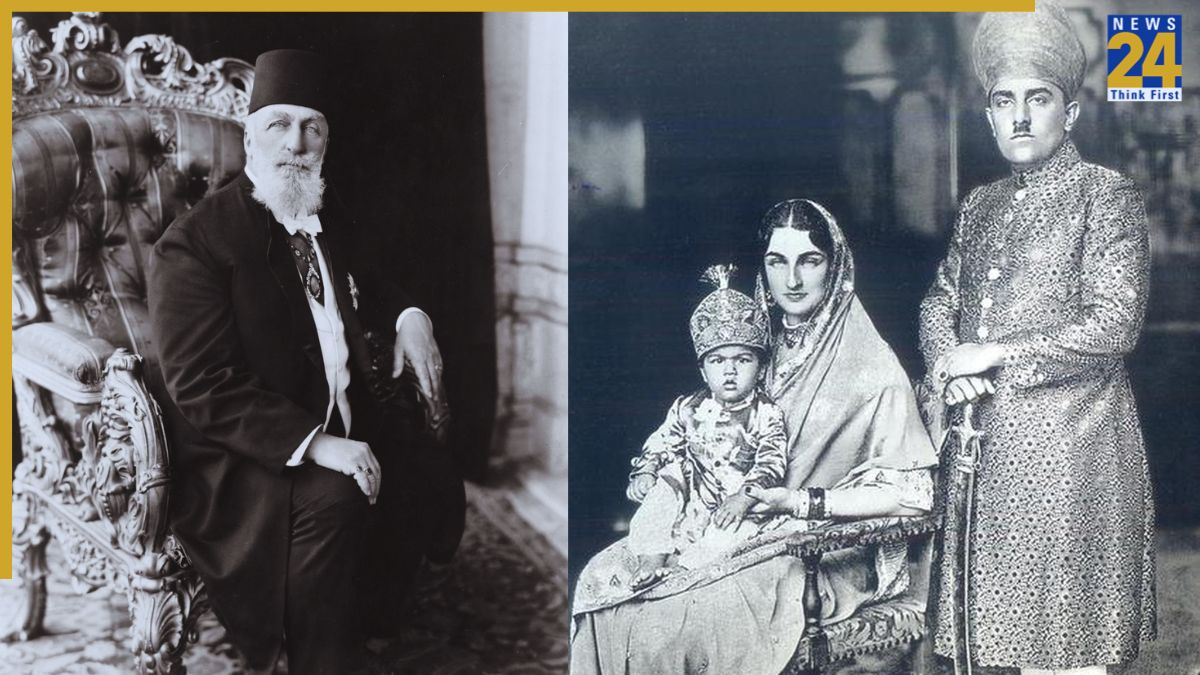


The first half of the 20th century, between the two World Wars, was a period of transformation for the Islamic world. It was marked by collapse of centuries-old traditions and political upheaval. The defeat of the Ottoman Empire, which had fought alongside the Germans in World War I, not only reshaped the Middle East but also ended the 1300-year-old Islamic Caliphate. European powers carved up the entire Middle East, leading to the rise of the modern Turkey, which abolished the Islamic Caliphate, where the Caliph was considered the ruler of the Islamic world.
Following this, several organisations attempted to restore the Caliphate, but none succeeded. Interestingly, the very first attempt to revive the Caliphate was made by the last Ottoman Caliph himself, who chose an unexpected location in India, a princely state ruled by the wealthiest man in the world at the time.
The story of restoring the Islamic Caliphate
In his book ‘The Indian Caliphate: Exiled Ottomans and the Billionaire Prince,’ Middle East Eye’s UK political correspondent, Imran Mulla shares a little-known story from that era. This is the story of the last Caliph, Abdulmecid II and his final attempt to become the leader of the Islamic world. Abdulmecid was the nominal leader of the Muslim world, and just 15 months after ascending to the throne, the Caliphate was abolished in March 1924 by Mustafa Kemal Ataturk, the leader of the Turkish Republic.
The last caliph of the Ottoman Empire was exiled overnight, put on the Orient Express train and sent out of the country. But he did not give up easily. As Abdulmecid did not want to be known as the last caliph, he devised a daring plan to revive the caliphate. The book mentions how from his villa on the French Riviera, Abdulmecid launched a plan to resurrect the institution and transform world history. Indian politician Shaukat Ali had brokered a marital alliance between the Ottomans and the Nizam of Hyderabad, the world’s richest prince, who governed a state the size of Italy in the Indian subcontinent.
The last Caliph saw hope in India
Mulla writes in his book that Abdulmecid’s idea was to leverage the prestige of the Ottoman dynasty to gain recognition as Caliph from a large group of Muslim leaders and scholars worldwide. This would create an institution, independent of the Ottoman Empire that would derive its legitimacy from the support of Muslims around the globe. For this, he looked for support from the region that at the time had the largest Muslim population in the world, the British India. A key part of this plan was a marriage alliance between Abdulmecid’s daughter, Princess Durru Shehvar, and Azam Jah, the son of seventh Nizam of Hyderabad, Osman Ali Khan. This marriage was brokered by the Indian politician and freedom fighter Shaukat Ali.
The Nizam ruled Hyderabad, the largest princely state in British India. He was one of the wealthiest men in the world at the time. There was a grand plan behind this union between the Ottoman dynasty and Hyderabad. The son born to Durru Shehvar, who would be Abdulmecid’s grandson, was to be groomed to become the new Caliph. Notably, Shehvar received marriage proposals from the royal families of Egypt and Iraq but chose Hyderabad, underscoring India’s prominence in the Islamic world at the time.
The failed plan
However, the plan of the last Caliph ultimately failed. The partition of the Indian subcontinent in 1947, followed by the annexation of the Hyderabad princely state into India the next year, dealt the final blow to this plan. With the end of the Nizam’s rule, the claim to the Caliphate lost its strong foundation. Mulla writes that the plans Abdulmecid had devised after the fall of the Caliphate, amidst the formation of the new Turkish state, failed once again amid the creation of a new Indian nation.