
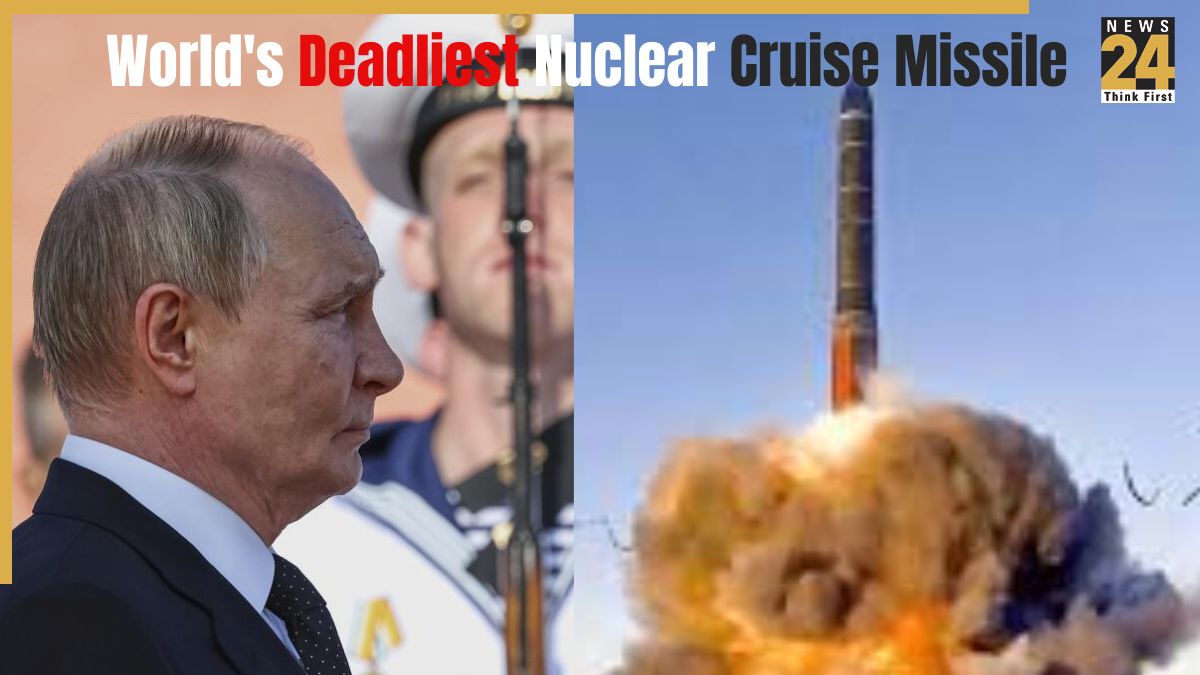


The world’s deadliest nuclear cruise missile has been developed by Putin’s Russia. The 9M730 Burevestnik, also known as Skyfall, will soon be active in Moscow’s arsenal. Interestingly, the revelation of the new weapon came during a discussion between Russian President Vladimir Putin and his US counterpart, Donald Trump, about the Ukraine war. Powered by a nuclear reactor, the missile is capable of unlimited range and can circumnavigate the Earth multiple times before hitting its intended target, with a range of up to 20,000 km. What are the deadliest features of this nuclear cruise missile? Read on to know more.
9M730 Burevestnik missile
The Burevestnik is a nuclear-powered cruise missile that can carry a nuclear warhead. It can fly at very low altitudes, manoeuvre, and display extreme agility. If the test becomes successful, Russia will be the first country in history to have an operational cruise missile capable of carrying a nuclear warhead that uses a nuclear propulsion system. All nuclear missiles that are currently in use are ballistic missiles.
10 Top Facts Of 9M730 Burevestnik missile
- Powered by nuclear energy, capable of traveling up to 20,000 km
- Designed to bypass the US missile defence system
- Poses dangers due to radiation and technical risks
- Russia is developing it as a deterrent and to influence the global balance of power
- Uses a small nuclear reactor to heat air for propulsion, providing continuous thrust without relying on traditional fuel
- Similar to the discontinued U.S. Project Pluto from the 1950s.
- Essentially unlimited range of up to 20,000 km (about 12,400 miles), allowing it to theoretically circle the globe multiple times before striking a target
- Designed as a low-flying cruise missile at altitudes of 50-100 meters
- Aims to evade radar detection and interceptor-based missile defenses by hugging terrain and following unpredictable paths
Dimensions and Design Of 9M730 Burevestnik missile
The missile is similar in size to the Kh-101 cruise missile but is 1.5 to 2 times larger, with a fuselage length of at least 12 meters. Its wings are mounted on top of the fuselage, and it has protrusions designed for taking in air heated by its nuclear reactor.