
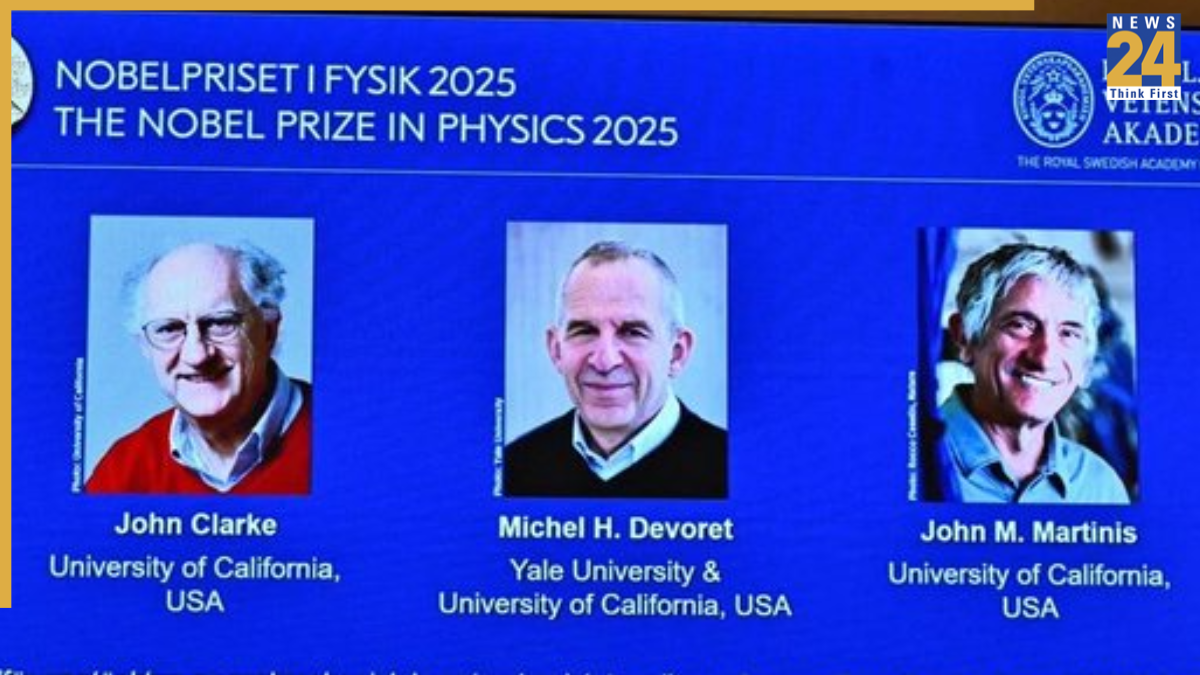


Nobel Prize 2025: The Nobel Prize 2025 in Physics has been awarded to John Clarke, Michel H. Devoret, and John M. Martinis on Tuesday for their groundbreaking discovery of “macroscopic quantum mechanical tunnelling and energy quantisation in an electric circuit.” The Royal Swedish Academy of Sciences declared the trio as the winner in Stockholm on October 7, 2025.
The laureates shared the Nobel Prize for conducting a series of experiments in 1984 and 1985 at the University of California in Berkeley, which demonstrated how quantum tunnelling can be observed on a macroscopic scale, involving many particles.
2025 Nobel Prize in Physics awarded to John Clarke, Michel H. Devoret and John M. Martinis “for the discovery of macroscopic quantum mechanical tunnelling and energy quantisation in an electric circuit.” pic.twitter.com/gia0LLRpyo
---Advertisement---— ANI (@ANI) October 7, 2025
John Clarke of the University of California, Berkeley, Michel H. Devoret of Yale University and the University of California, Santa Barbara, and John M. Martinis of the University of California, Santa Barbara built a “superconducting electrical system that could tunnel from one state to another.” The trio’s pioneering work also showed that the system absorbed and emitted energy in doses of specific sizes, just as predicted by quantum mechanics.
“I’m completely stunned, it never occurred to me that it would be the basis of a Nobel Prize, “said New Physics laureate John Clarke, who was completely surprised on being awarded the 2025 Nobel Prize in Physics.
Olle Eriksson, Chair of the Nobel Committee for Physics, said, “It is wonderful to be able to celebrate the way that century-old quantum mechanics continually offers new surprises,” highlighting the laureates’ deep impact on both fundamental science and the future of digital technology.