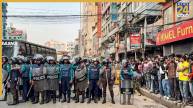

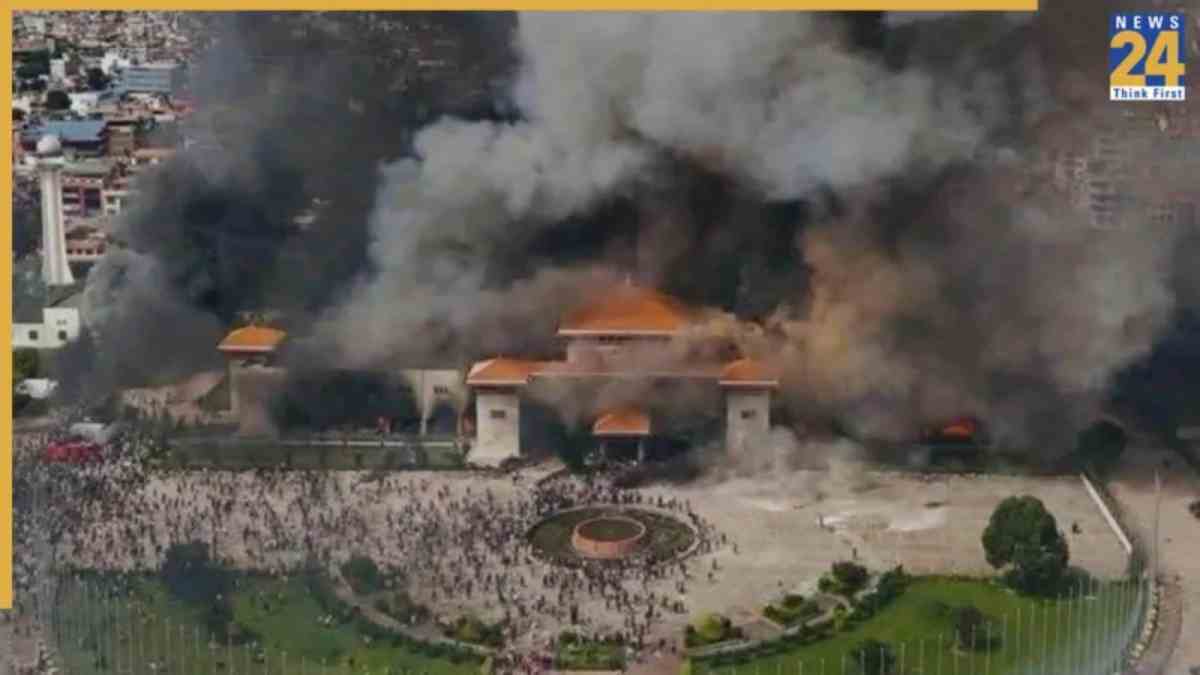


Nepal is currently reeling under one of the worst periods of political unrest, led by Gen Z over the ban of 26 social media platforms and rampant corruption. Amidst this, questions such as ‘Is the United States behind the rise of this youth-driven agitation?’ and ‘What role is America playing in the political turmoil in the Himalayan country?’ are arising.
Though the KP Sharma Oli-led Nepalese government had lifted a ban on the 1st day of the protest, which left as many as 19 people dead, the demonstrators did not stop. The protests continued even after the resignation of Oli and four ministers from his cabinet, thus turning into a mass uprising.
The allegation of rampant corruption and bad governance is a common issue. But who must have thought that the protest against the government would turn so violent that Gen Z would vandalize, set fire to government buildings and properties? What happened all of a sudden? Let’s go back in time to when a similar protest erupted in February three years ago. During that time, thousands took to the Kathmandu streets, protesting against MCC (Millennium Challenge Corporation) Compact, approved by the Nepalese Parliament. It was moved by the Nepali Congress-led coalition govt under Sher Bahadur Deuba.
In 2004, the US administration established an aid agency named MCC. According to the US national security strategy papers, the Corporation’s main aim is to further the US national security agenda. In October 2023, MCC CEO Alice Albright announced a $500 million grant to Nepal aimed at enhancing the country’s electricity infrastructure. As part of the agreement, Kathmandu committed to contributing $130 million to the project. A key component of the plan involves building a 315-kilometer transmission line, which would link to the Indian power grid, enabling Nepal to export surplus electricity.
It is not a hidden fact that MCC was just another means for the United States to accelerate the process of weaponizing foreign aid. In 2022, while introducing MCC to the National Security Strategy, US President George W. Bush said, “The events of September 11, 2001, taught us that weak states, like Afghanistan, can pose a great danger to our national interest as strong states.”
He further added, “The United States will deliver greater development assistance through the New Millennium Challenge Account to nations that govern justly, invest in their people, and encourage economic freedom.” America’s strategy can be understood by the fact that the MCC board is composed of US government officials.
According to analysts, MCC’s main objective is to ruin the already divided left politics. The US has, time and again, played a major role in fueling the enmity in the Himalayan nation. During the communist revolution in Nepal, the US supplied weapons to Kathmandu. It also encouraged France, Germany, and Switzerland to supply arms and ammunition to Nepal. The Civil War concluded with the defeat of the army. As per the report, about 40,000 fighters were killed on both sides. Experts say that the United States subverted the movement when it failed to stop the communists.
Washington is not happy that Nepal has moved closer to Beijing. All of Nepal’s Prime Ministers, who belonged to the communist parties, have moved closer to China. In May 2017, Nepal and China officially signed the Beijing’s Belt and Road Initiative (BRI) cooperation framework during Prime Minister KP Sharma Oli’s visit to China. The agreement paved the way for Beijing to make major inroads in Nepal. Experts believe that America wants to ruin the communist forces that flourish in Nepal. Now, it wants to take advantage of the protest in Nepal led by Gen Z.