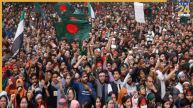


The last three years have seen massive political upheaval in India’s neighbouring countries. After Sri Lanka’s economic devastation, the change of power in Bangladesh, and Imran Khan’s departure from power in Pakistan, Nepal has now joined this chain. The movement that started in protest against the ban on social media soon turned into a nationwide movement, in which more than 22 people have died so far. Due to this heavy public pressure, Former Prime Minister KP Sharma Oli and Outgoing President Ramchandra Paudel had to resign from their posts.
The current situation in Nepal also seems to be a repetition of incidents like Bangladesh and Sri Lanka, where the discontent that started on a small issue later turned into an anti-corruption wave. People’s anger over the social media ban in Nepal later turned into a widespread movement against corruption and economic slowdown. Even after the government withdrew the ban, the protest did not calm down, rather, slogans like “KP Chor, Desh Chhod” started echoing in the streets of the capital. People started demanding comprehensive changes in the political structure. According to sources, KP Sharma Oli may soon flee to Dubai, just as Bangladesh’s Sheikh Hasina had earlier sought refuge in India in 2024 and Sri Lanka’s Gotabaya Rajapaksa turned to the Maldives in 2022.
Tuesday was the most violent day so far, with protesters setting fire and vandalising the private homes of outgoing President Paudel, Oli, and other ministers. The famous Hilton Hotel in the capital Kathmandu, which is owned by a leader of the ruling party, was also set on fire. The scenes resemble incidents that have been seen earlier in Bangladesh and Sri Lanka, where protesters broke into leaders’ homes, looted them, relaxed in bedrooms, broke furniture, and bathed in swimming pools.
Public resentment over unemployment, corruption, and unstable politics is evident, but the intensity and consistency of the movement has raised the question whether this is just a result of the social media ban, or has Nepal become the new epicentre of the proxy war between the US and China?
This apprehension deepens when it is seen that Nepal and China’s relations have become stronger during former Prime Minister Oli’s tenure. After becoming Prime Minister for the fourth time in July 2024, Oli made his first foreign visit to China, while traditionally Nepal’s leaders have been visiting India first. During this visit, he signed an agreement under China’s Belt and Road Initiative (BRI) project, which provided Nepal with financial assistance of $ 41 million.
Nepal’s inclination towards China has become a matter of concern for the US. The growing influence of BRI in South Asia has already trapped countries like Sri Lanka in a debt trap, causing Sri Lanka to default in 2022. Alarmed by China’s growing influence, the US this year relaunched the ‘Millennium Challenge Nepal Compact’ under the leadership of Donald Trump, which provides assistance of $ 500 million for energy and road development. This US initiative has come directly in opposition to the BRI, making Nepal’s internal politics more complicated. The current instability in Nepal is not a sudden situation, but it is the result of discontent brewing for years. Since the formation of the republic in 2008, 14 governments have been formed in Nepal, most of which have been coalitions. Oli, Maoist leader Pushpa Kamal Dahal ‘Prachanda’, and five-time Prime Minister Sher Bahadur Deuba – all three have been accused of corruption. Discontent among the youth towards these leaders is continuously increasing, which has been further deepened by economic stagnation and lack of employment.
Just a few weeks before the social media ban, a campaign called “Nepo Kid” created a stir on social media, in which the luxurious life and alleged corruption of the children of leaders were exposed. At the beginning of the year, protests had started in Nepal demanding the restoration of the monarchy, in which people declared the experiment of secular republic a failure.
Today, Nepal is facing a major political crisis. The most important question is whether this is completely internal instability or another face of the tussle between global powers? With leaders stepping down, foreign influences clashing, and public anger running high, it’s clear Nepal is at a very sensitive juncture.
Also Read: Who Is Hamas leader Khalil al Haya, the main target of Israel airstrike in Qatar