

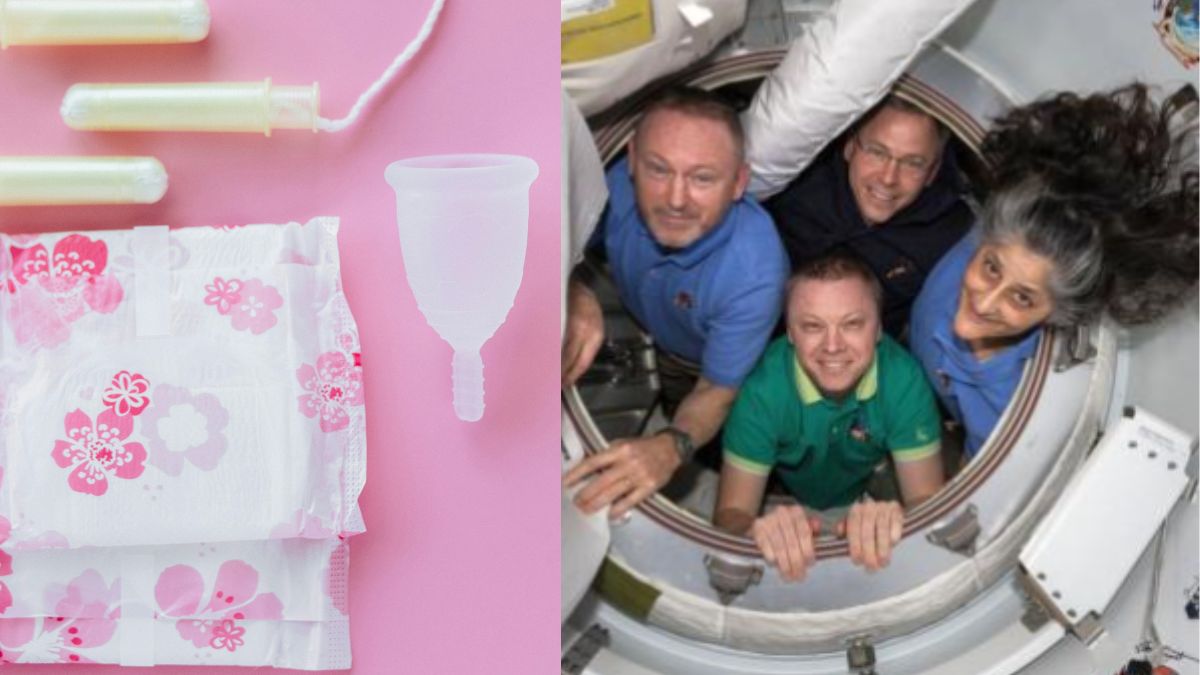


NASA astronauts Sunita Williams and Butch Wilmore, who were stranded in space, safely returned to Earth this morning. They were brought back by a SpaceX vessel, landing off the coast of Florida. Their unexpected nine-month stay, originally planned as an eight-day mission, raises countless questions—How did they survive? Were they able to drink water and eat like us? How did they manage to sleep for nine months in space? Did they have enough supplies, and how did they ration food? What kept them from losing hope? Among the many curiosities, one question that particularly fascinates women on Earth is: How did Sunita Williams manage her periods while in space? Here’s all your queries answered.
Do Women Menstruate in Space?
Managing menstruation in space is a topic that has evolved alongside women’s increasing participation in space missions. Despite initial concerns, studies have shown that the menstrual cycle functions normally in microgravity. However, practical challenges such as limited hygiene facilities and waste management have led many female astronauts to opt for menstrual suppression during their missions before. This is commonly achieved through continuous use of hormonal contraceptives, allowing them to avoid periods altogether. Long-acting reversible contraceptives, like intrauterine devices (IUDs), are also considered viable options due to their extended effectiveness and minimal maintenance requirements.
For astronaut Sunita Williams, who recently returned from an extended mission aboard the International Space Station (ISS), these considerations are especially relevant. However, no information on this has been made public yet. Originally scheduled for a short-duration flight, Williams and her colleague Butch Wilmore experienced delays that prolonged their stay to over nine months. During such extended missions, the choice to suppress menstruation becomes even more practical for women, but again according to reports, it is completely dependent on personal choice. Reducing the need for menstrual hygiene products and simplifying waste management in the confined environment of the ISS.
Is Menstruation Physiologically and Psychologically the Same in Space?
It’s important to note that while menstruation in space is physiologically similar to that on Earth, the decision to suppress it is often based on logistical considerations. Each astronaut’s approach is tailored to her personal health, mission duration, and the specific conditions of the spaceflight.
Also Read: Can Indian Origin Sunita Williams Claim Record For The Longest Time In Space? Here’s What We Know
How Was This Managed Before?
Back in 1963, Valentina Tereshkova made history as the first woman to travel to space. Since then, more than 100 women have followed in her footsteps, pushing the boundaries of space exploration. But one question still sparks curiosity—how do female astronauts handle their periods in microgravity? Does menstrual blood behave differently in space? Could it, like everything else, just float away?
Also Read: ‘Looking Forward To Seeing You In India’: PM Modi’s Heartfelt Note To Sunita Williams As NASA Astronaut Heads Home
In space, the body may feel weightless, but that doesn’t change how menstruation works. Unlike the cardiovascular system, which tends to slow down in microgravity, the menstrual cycle carries on as usual. And no, blood doesn’t just float around unpredictably.
But here’s where things get tricky. According to an article published by Elle, the International Space Station has a urine processing system that recycles water from astronauts’ pee. That’s one big reason why many female astronauts choose to suppress their periods during missions. While space tech wasn’t originally designed to deal with human blood, some waste disposal systems on the ISS have now been adapted to process it properly.