
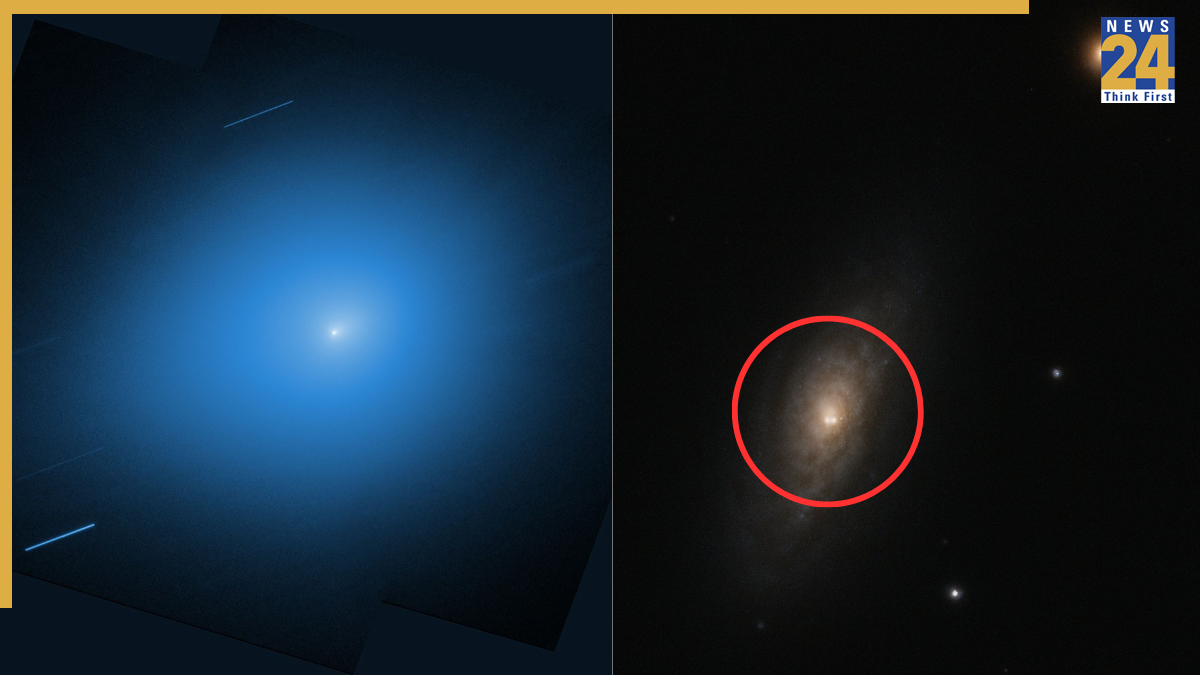


The Interstellar comet 3i/ATLAS has become a new obsession for astronomers and space enthusiasts as they race to capture the exceptional passage occurring close to our part of the universe. The Hubble Space Telescope has captured fresh images of an interstellar comet as the object is about to approach Earth later in the month. Comet 3I/ATLAS has intrigued astronomers as it originated outside of our solar system, and hence, it was discovered travelling through our celestial neighborhood in July. Only the third Interstellar object observed speed up through our solar system, as astronomers also directed numerous missions to focus on the comet. Scientists have fully relied on these observations to map the object’s path and to gather hints about what it’s made of. The gases released as the comet heated up and vaporized during its close approach to the Sun in October offered valuable clues.
Hubble to first observe the comet’s teardrop
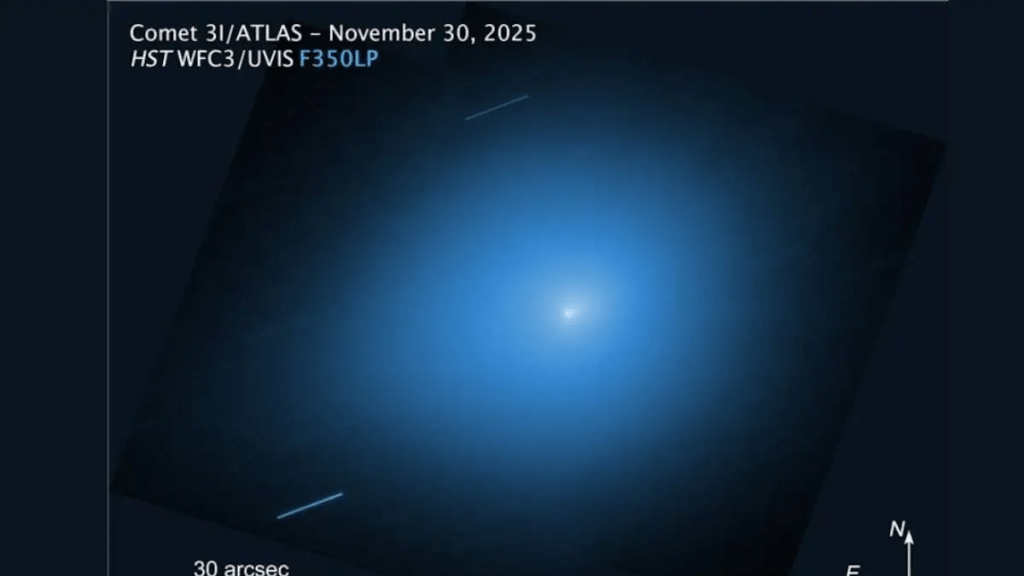
Hubble was first to observe 3I/ATLAS in July after it was discovered shortly, providing a more details view of the comet‘s teardrop shape at that time. Astronomers spotted 3I/ATLAS with the Hubble again on November 30, when it was about 286 million miles away from Earth, and using the Telescope’s Wide Field Camera 3 instrument, captured a clear shot that time.
After months of speculation, including the presence of alien technology, NASA shared some findings from over 20 missions to provide the most detailed understanding so far of this icy traveler from another star system.
Scientists are able to locate the 3D shape
Studying 3I/ATLAS involved bringing together data from over 20 space missions, ranging from those orbiting Earth to probes near Mars and beyond. By combining these observations, scientists were able to map the comet’s 3D shape along with its coma and tail.
It originated from a very old planetary system and is older than ours, possibly. It offers a unique glimpse through interstellar space into the composition and the history of the stars and their planetary systems.
Spotting Two Tails – Key Points
- The Juice spacecraft is designed to study whether Jupiter’s biggest moons — Ganymede, Callisto, and Europa- could support life.
- The spacecraft used five of its scientific instruments, along with its Navigation Camera (NavCam), to photograph and study the comet.
- The smaller antenna currently transmitting data can only send information very slowly.
- Their solid cores are mixtures of rock, dust, ice, and gas left over from the early formation of the solar system.
NASA says the comet should remain visible to telescopes and spacecraft for several more months.
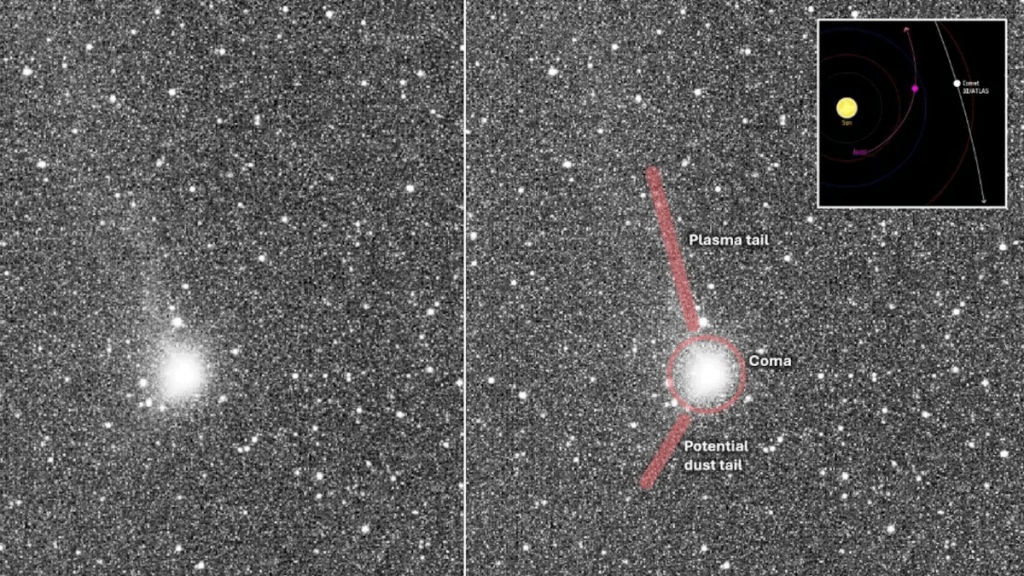
Image captured by amateur astronomers
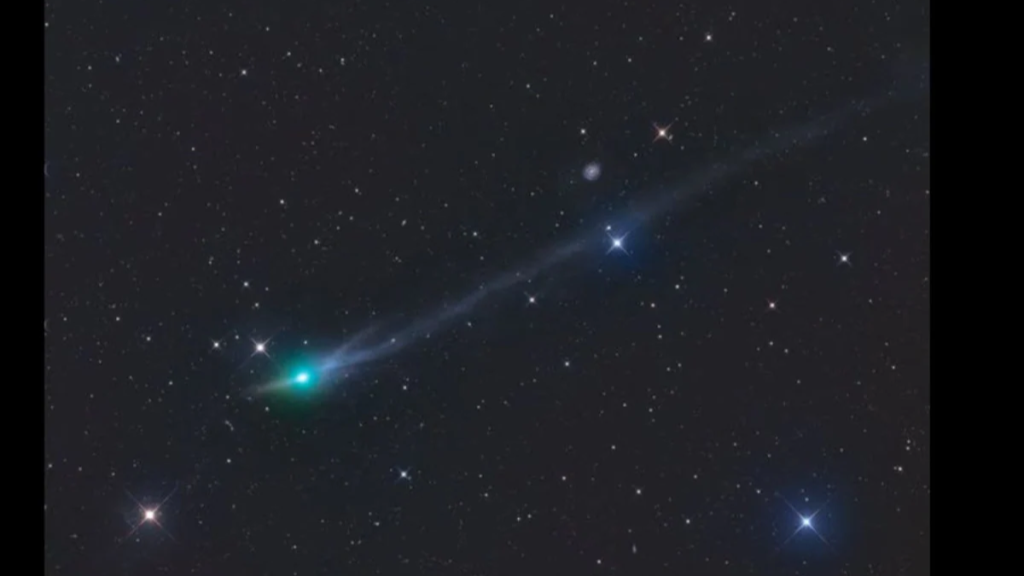
Amateur astronomers Gerald Rhemann and Michael Jager captured a breathtaking image of the comet on December 2, 2025, using a 12-inch telescope in Farm Tivoli, Namibia, with exposure times of 20, 6, 6, and 6 minutes.