

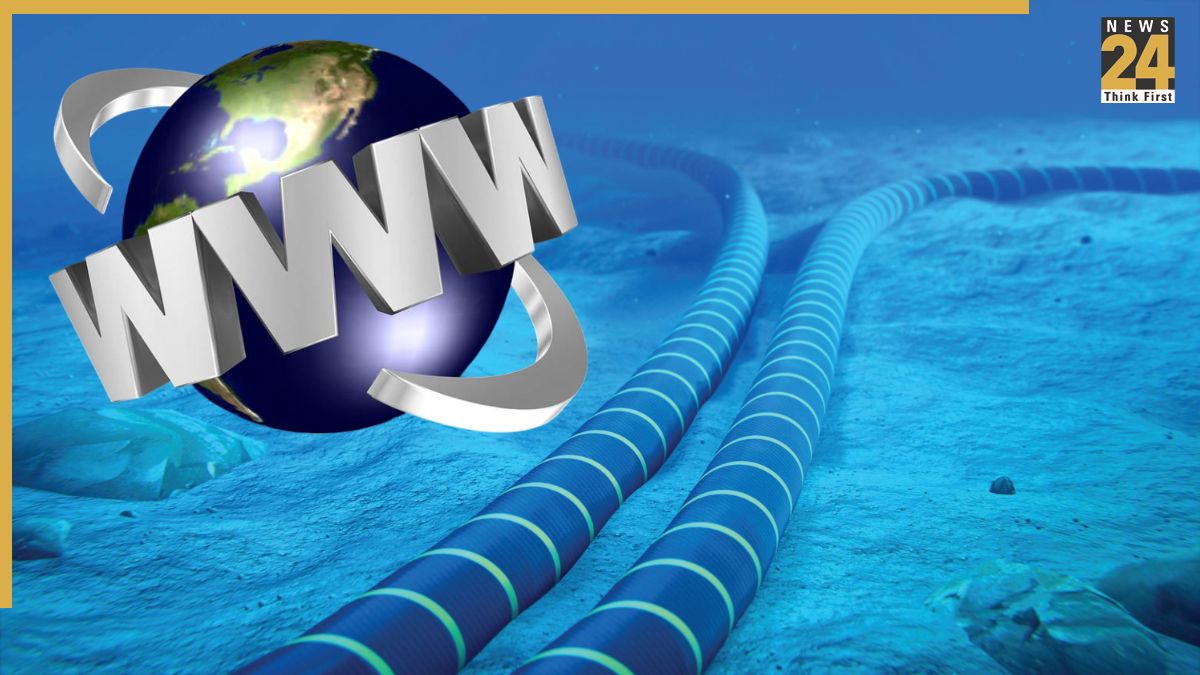


We often think that the internet on our phones comes from satellites or mobile towers. In reality, 99% of the world’s internet traffic travels through undersea cables that span the globe. Surprising, isn’t it? Many people first learned this when an undersea cable was cut in the Red Sea, disrupting internet access in several countries, including those in the Middle East. The global network relies on these thick undersea cables. From who owns them to how they work, here’s everything you need to know.
According to a BBC report, 1.4 million kilometres of undersea telecommunications cables are laid across the oceans to provide internet worldwide. If connected in a line, their length would be roughly comparable to the diameter of the Sun.
How are these undersea internet cables made?
These are not ordinary cables and are made using a specialised technology, which makes their production quite complex. The internet cables rely on fiber optic technology and are crucial for transmitting data at the speed of light. Very thin glass fibers are first inserted inside, carrying data through laser beams almost at light speed. Layers of copper, plastic, and steel are then added to allow electricity to flow and protect the cable from ocean pressure, rocks, and large fishing nets. Once all these layers are in place, the cable becomes thick.
How are these cables laid undersea?
Laying these cables underwater is a massive task. According to OceanIQ, a company affiliated with the Global Marine Group and a key player in the process, the work goes through several stages – route planning, sea survey, securing permits, designing the cable system, manufacturing, laying it under the sea, and finally, activating it.
The cable is first loaded onto a ship and wrapped around a huge drum so that it can be released steadily during installation. The ship then follows a pre-set route, gradually lowering the cable into the sea through a slide-like pipe, which ensures it is placed in the right position on the seabed. Once the process is complete, a Remote Operated Vehicle (ROV) is sent down to check if the cable has been properly positioned and secured.
Who owns the undersea internet cables?
Millions of kilometres of internet cables are laid across the world. According to TeleGeography, most undersea cables were earlier owned by telecommunications companies. Several telecom firms would form a consortium, and any party that wanted to use the cable could join. But this model changed in the late 1990s, when many private companies entered the market and began laying their own undersea cables. Both models still exist today. In recent years, even more players have joined in, with content providers like Google, Meta, Microsoft, and Amazon becoming major investors.
ALSO READ: What Exactly Is the ‘Nano Banana’ Trend and Why Is It Blowing Up Online?