

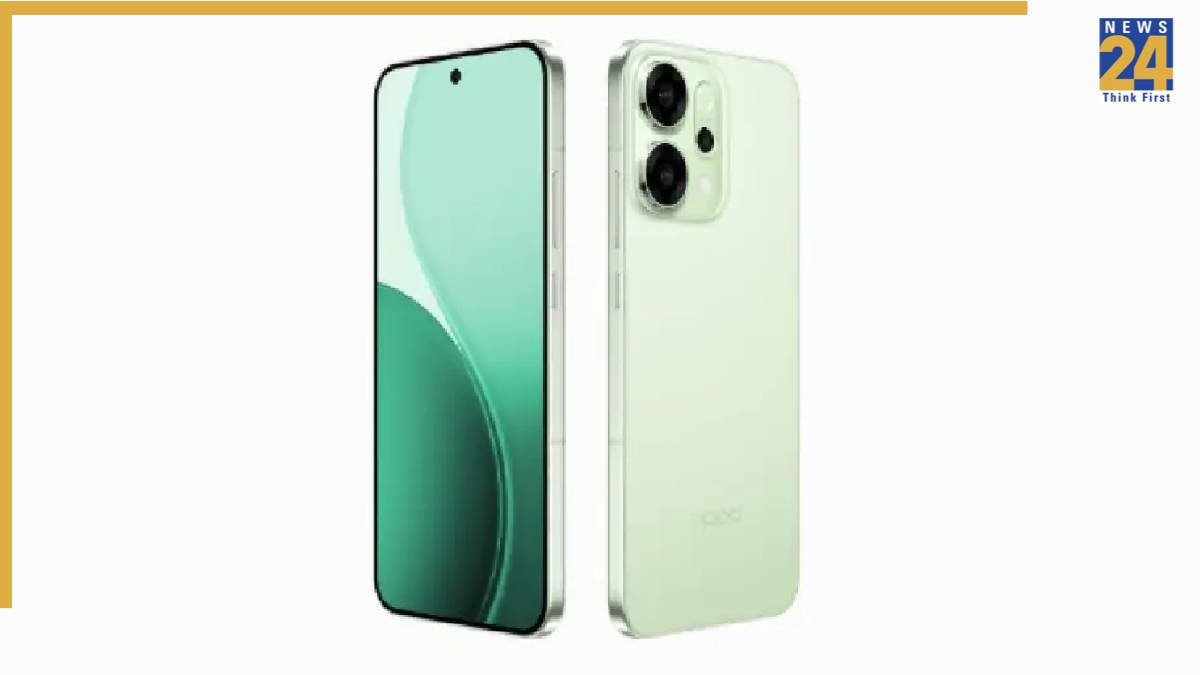


Mobile phone manufacturers are constantly on the verge of changes, shifting into new dynamics. Hence, they often think of their next moves way before their current product launches. Following a similar pattern just six months after the launch of the Reno 13 series, Oppo has brought to us their all-new Reno 14 and Reno 14 Pro. To help new buyers be aware of the merits and demerits of the phone, I have been using the Reno 14 5G for a week.
Currently, the Oppo Reno 14 (8GB/256GB) model has been priced at Rs 37,999 on the official Oppo website. The 12GB/256GB version has been priced at Rs 39,999, and the all-new 12GB/512GB version has been priced at Rs 42,999. On paper, the phone has all the ingredients of being a strong mid-range contender: a MediaTek Dimensity 8350 chipset, along with a 50-megapixel camera setup, a large 6500 mAh battery, and a slew of AI features. Here’s what we think about the Oppo Reno 14.
A Mammoth Battery That Does Not Add to the Phone’s Weight
As soon as I split opened the box and unpacked the phone, I realized it didn’t carry the hefty weight that we generally associate with phones that have a battery upwards of 6500 mAh. Even with the soft silicone case that has been incorporated in the box, the phone feels light. Beyond that, Oppo seems to have funneled hours and hours of arduous hard work to get the design right—and I must say they have succeeded. Even after being priced below 40K, it feels premium in hand and offers subtle design details that add to its aesthetics.
The review unit I received was in the Forest Green shade, and from certain angles, the phone seems completely black-until you look at it in a well-lit environment. The whole rear panel shifts to a resplendent green that has a subtle light green ring around the camera sensors, an understated design detail that stands out when you use the phone without a cover.
The brushed aluminium frames and the thickness of 7.5 mm ensure that the phone isn’t too hefty to handle. Thanks to the petite design of the phone, single-hand operations will be easy to execute. Users don’t have to worry about the occasional phone drops and slips either—the IP69 rating and Gorilla Glass 7i protection ensure that the phone is able to handle the knocks and drops with ease.
Display
The Reno 14 is equipped with a 6.59-inch AMOLED display with a 1.5K resolution and a 120Hz refresh rate. Based on your usage, you can change the settings to FHD+ or higher resolution. The screen has the valiant protection of Gorilla Glass 7i.
While using the phone outdoors, we faced no issues at all. The display easily reaches 600 nits in normal use and up to 1200 nits in High Brightness Mode. Users can choose between Vivid, Natural, and pro colour Modes. The phone also has HDR10 support and an image sharpener that will ensure you have the best media viewing experience.
CPU Performance
Under the hood, the phone is powered by a MediaTek Dimensity 8350 chipset. The processor features four ARM Cortex-A715 cores that have been individually clocked at (1×3.35 GHz Cortex-A715 & 3×3.20 GHz Cortex-A715 & 4×2.20 GHz Cortex-A510). The onboard graphics are handled by the Mali-G615 MC6 processor unit.
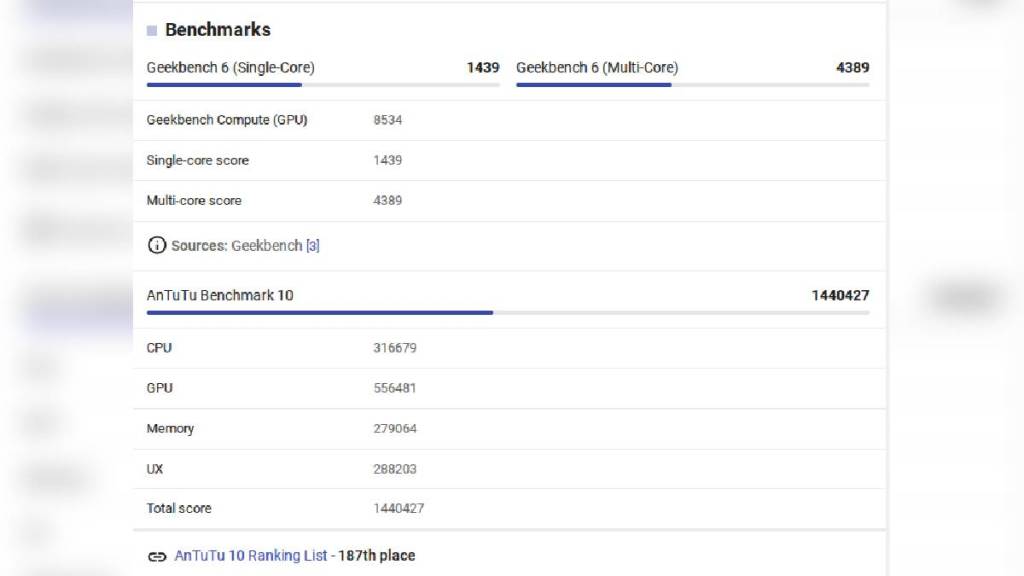
The combination of a robust processor in this price range, along with a capable GPU, ensures that users get to experience solid gaming capabilities.
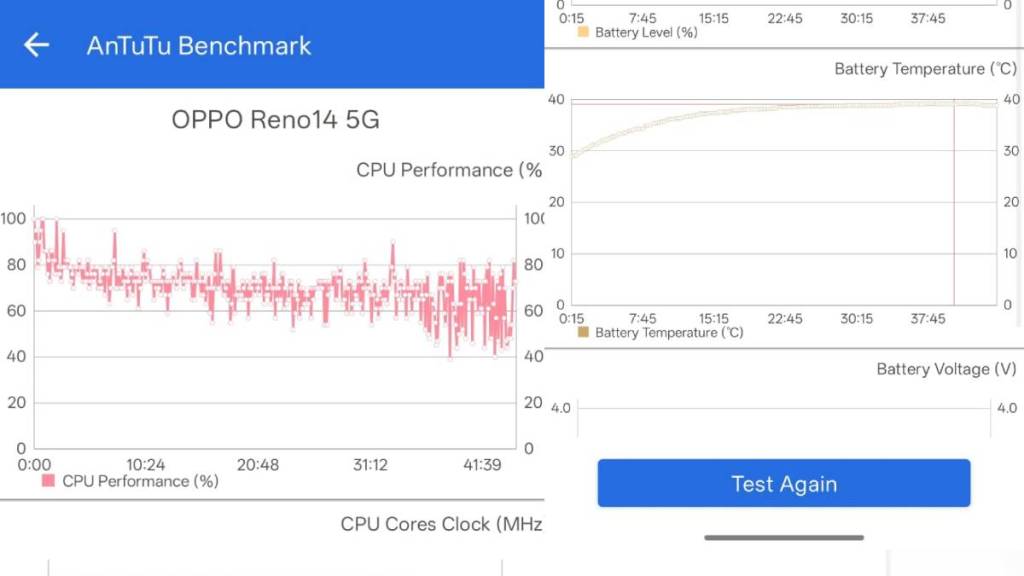
To further ensure that users get extended hours of gameplay, the phone has been equipped with a nano dual-drive cooling management system—the system comprises a 4700 mm² VC along with a 16,596 mm² aerospace-grade heat dissipation area, during a stress test, the battery temperature peaked at close to 40 degrees Celsius. We tested the phone while playing BGMI on High to Ultra settings at 90 FPS, and we have no niggles to report about. The experience was smooth, there were no frame drops, and the phone maintained its temperature. Of course, during extended hours of gaming, the battery would take a hit, but in normal usage, there wasn’t a detail out of line.
During a stress test, the battery temperature peaked at close to 40 degrees Celsius.
Oppo has promised three years of Android updates and five years of security updates. We had no issues with the interface. With the new Flux theme, you get newer features to personalize the experience further. The device does have a significant amount of bloatware, but users will have the capability of uninstalling the software as per their choice.
Just like every other phone in the market, the Reno 14 has its fair share of AI features. These include tools for reducing blur in images, reflections, and whatnot. Beyond that, there are also features like AI Summaries and Live Translation.
Users can enhance their music listening experience with a plethora of music modes. The onboard speaker is nothing to write home about, seriously, especially while trying to listen to audio on full tilt. But during calls, it showcases no lapses and brings forth crisp and clear distortion-free sound.
Battery Life
The mammoth battery complements the phone’s performance profoundly. Even during Netflix streaming, extended usage, and Instagram scrolling, the battery lasted for more than 9 hours. And even when the phone runs out of juice, the 80W SuperVOOC charger is there to take the phone up from 0 to 100% in under 45 minutes.
Camera Performance
The Reno 14 is equipped with a triple camera setup at the rear. The phone has a 50 MP primary sensor with a 1/1.5” Sony IMX882 sensor, f/1.8 aperture, and Optical Image Stabilization (OIS). Complementing this is an 8 MP ultra-wide camera with OV08D sensor and f/2.2 aperture.

And the pièce de résistance is the 50 MP 3.5x periscope telephoto lens, with a 1/2.76” Samsung JN5 sensor and f/2.8 aperture.
The selfie camera is a 50 MP front unit that uses the same Samsung JN5 sensor. The camera application is well optimized and has a ton of features that include Night Mode, High Res, Panorama, Slo-Mo, Time-Lapse, Underwater Mode, Dual View Mode, and Breeno Scan.
Verdict – Rear Camera
The trifecta of premier camera sensors at the rear end works in perfect synergy to offer users crisp and well-detailed photographs. The 3.5x periscope lens ensures that you get a sharp shot even at 30x zoom. Portrait shots didn’t disappoint us either, in both 2x and 3.5x modes. Natural bokeh surrounded the subject. The phone performed brilliantly in low-light environments as well, but:
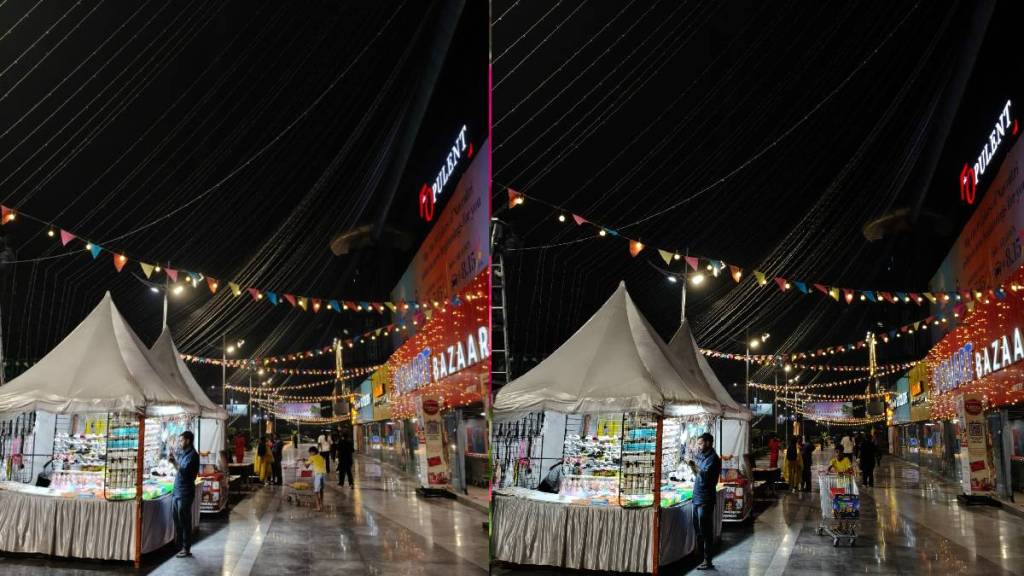
One of the key issues I felt—and this could be a personal observation—but while taking night shots, the camera often overexposed the frame. To take a well-detailed shot bereft of any reflections, I often had to toggle the exposure bar slightly. But it’s a detail many won’t notice. In the daylight, it’s an absolute marvel to behold. It delivers vivid photographs, and the well-optimized display further ensures that the images are colour correct.
Selfie Camera
Most users won’t notice a minute detail I was able to witness. While in direct sunlight, the phone is able to capture the skin tone perfectly. But when shots are taken under artificial lighting, although the sensor was able to capture perfect details, it was a bit hesitant and added a slight orange hue to the skin tone. Maybe a further update will fix the issue.
We shot small videos at 4K 60 FPS—no issues there as well. The phone was able to capture good details and audio seamlessly.
Final Verdict
A premium feel and an immaculate sum of overall performance, let down by an OS riddled with bloatware. If you seek a minimalist experience, be ready for a clean-up. In almost the same price range, you can also look towards the OnePlus 13R, and if you wish to spend slightly less, the OnePlus Nord 5 could be a perfect alternative as well. Both of these phones are serious competitors.
Also Read: Indian mappls app to compete with google maps: 3D navigation for flyovers and elevated roads