

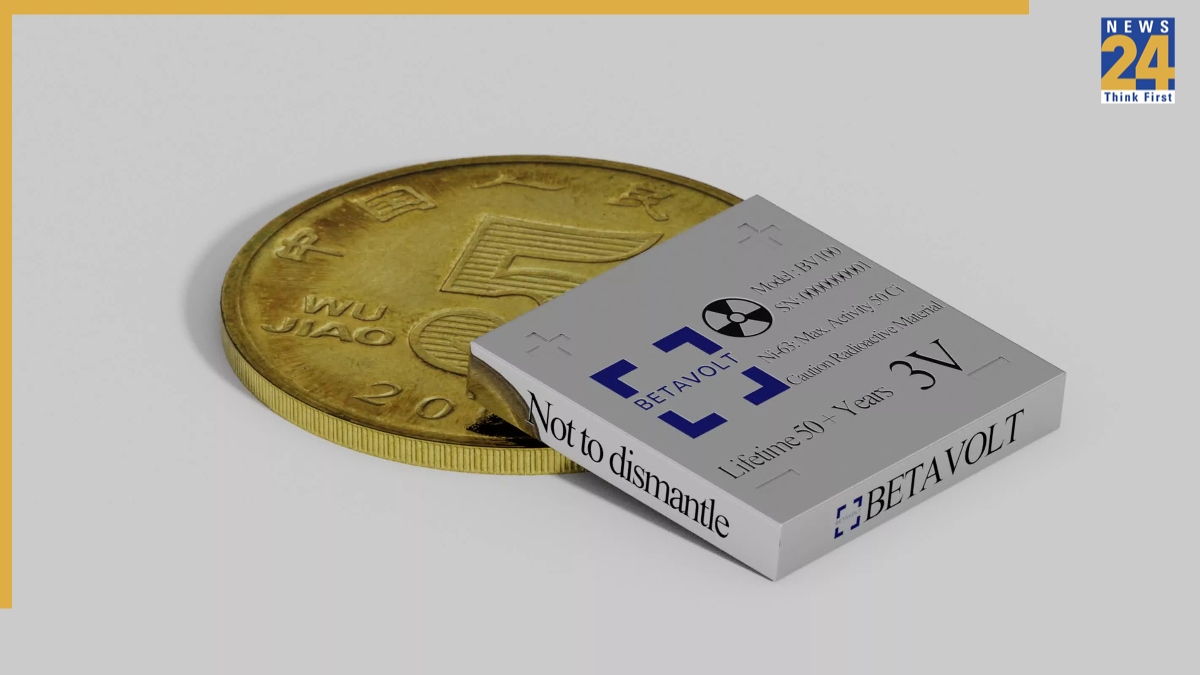


Technology has advanced rapidly over the past few decades, leading to the development of a coin-sized, eco-friendly nuclear battery that can work for decades. According to a report by TechSport, the battery has been developed by Beijing Betavolt New Energy Technology and is named the BV100. Its most notable feature is its ability to operate for up to 50 years without needing to be recharged, marking a major technology milestone for China.
Although the BV100 produces a relatively low amount of power and cannot charge devices like smartphones or cameras, it is not just a laboratory experiment. The company has already begun mass production of the battery for use in medical equipment and aerospace technology, where long-lasting and reliable power is essential.
How BV100 works
The BV100 uses a radioactive material called Nickel-63, which slowly decays into copper over time. During this process, it releases beta particles that are converted into electricity using China’s fourth-generation diamond semiconductor technology. At present, the battery delivers about 100 microwatts of power at 3 volts, enough to run small electronic devices. Betavolt has also announced plans to release a more powerful 1-watt version in the near future.
How BV100 is different from lithium batteries
Compared to conventional lithium batteries, the BV100 offers several advantages. It can store up to 100 times more energy, operate in extreme temperatures ranging from -60°C to 120°C, and poses no risk of fire or explosion. Unlike lithium batteries, it does not require recycling, as it naturally converts into copper. The battery is also compact, requires no maintenance, and is designed for long-term use.
Where Can This Battery Be Used?
Betavolt says the potential uses for this technology are vast. It is especially suitable for space missions, satellites, and aerospace systems that must operate continuously for decades. In the medical field, the battery could power devices such as pacemakers and artificial hearts, allowing them to function for a lifetime without replacement. The technology could also enable drones to fly for long periods without recharging.
The success of Betavolt has sparked global interest in nuclear battery technology. In China, Northwest Normal University is developing batteries using rare isotopes like carbon-14, while in the United States, City Labs is working on tritium-based batteries with funding from the National Institutes of Health. Experts believe such innovations could lead to a future where many devices no longer need regular charging and can run on long-lasting power sources for decades.