

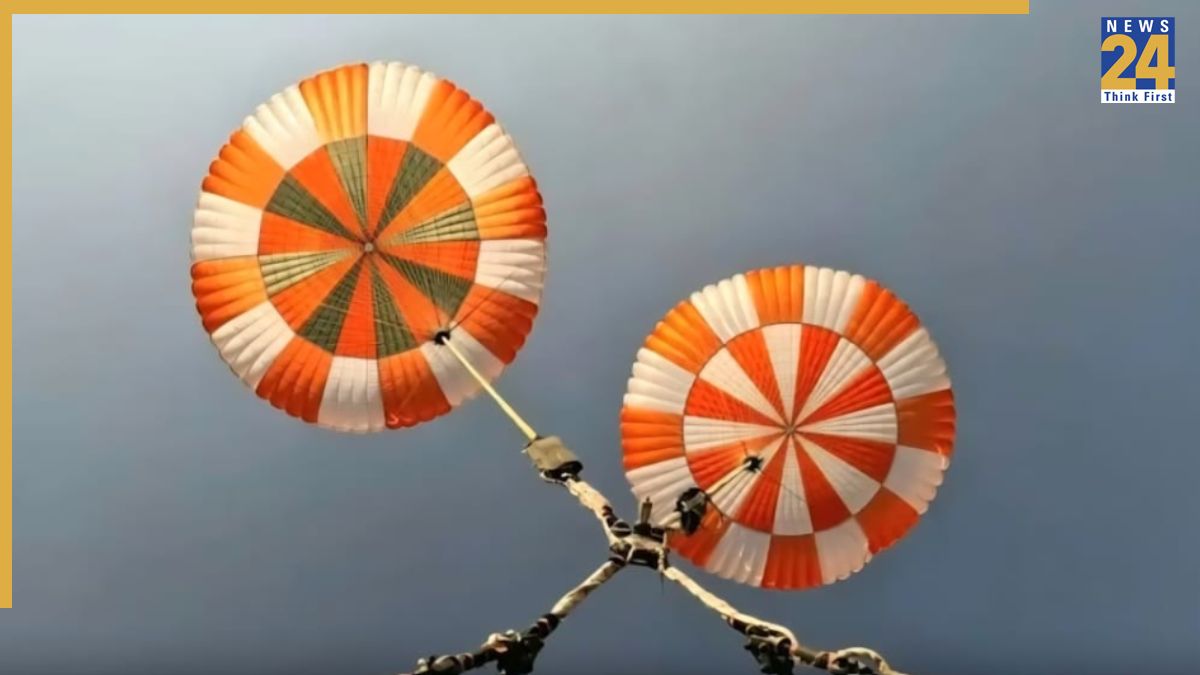


There’s something remarkable about an organisation that dares to test its limits by trying to break what it built. On November 3, 2025, at Babina Field Firing Range in Jhansi, ISRO did exactly that. It deliberately created a failure in one of the most critical systems of the Gaganyaan mission—the main parachutes that bring astronauts safely back to Earth. Yet, the system worked perfectly. This was not recklessness but a bold show of confidence and engineering brilliance.
The test was part of the Integrated Main Parachute Airdrop Test (IMAT) series—steps meant to ensure that when India sends its astronauts to space, not a single detail is left to chance. A dummy Crew Module, identical in weight and shape to the real one, was dropped from an Indian Air Force IL-76 aircraft from 2.5 km above the ground. Two of the main parachutes were deliberately delayed to see what would happen if things went wrong.
The result proved ISRO’s preparation. Even with two parachutes opening late, the system stabilised, slowed down, and landed safely. It was a triumph of redundancy—a design idea that means having backups for your backups. If two out of three main parachutes open fully, the astronauts will still land safely. That’s the kind of security ISRO has built in. It’s like winning a cricket match with only seven players.
The Gaganyaan Crew Module’s parachute system is teamwork at its best. Ten parachutes work together—two small drogue chutes open first to steady the fall, followed by two pilot chutes that pull out the main ones, and finally, three massive parachutes that slow the module for a soft landing. The logic is simple yet powerful: expect failure and be ready for it.
In space, Murphy’s Law always applies—if something can go wrong, it might. ISRO’s engineers have turned this risk into readiness. They used a clever system called reefed inflation, where parachutes open slowly in stages instead of all at once. Imagine opening a soda bottle gently rather than letting it burst open. It ensures a smooth and safe descent without violent jerks.
What stands out about this test is its spirit. ISRO wasn’t trying to show perfection—it was proving resilience. In a world where many avoid risk, India’s space agency took it head-on. That mindset sets apart true innovators. Testing systems in failure conditions is how space agencies build reliability. ISRO’s scientists could have done a normal drop test and moved on, but they went further—asking, “What if one parachute fails? What if two fail?” And they answered those questions with experiments, not assumptions.
This courage—to invite failure to strengthen success—is what defines great science. For India’s youth—especially those in Class X and PU—this is an example of how real science works. It’s not about everything going right; it’s about staying prepared when things go wrong. Failure isn’t the problem—being unready is. The Gaganyaan parachute test reflects how Indian scientists think, plan, and improve.
It also shows India’s growing maturity in space safety and human-rated systems. We’re no longer content with just reaching space. We’re building systems that bring our astronauts home safely. The Gaganyaan mission isn’t a race—it’s a statement that India can design and perfect advanced systems with complete self-reliance.
When the first Indian astronauts fly under the Gaganyaan banner, it will be because of such tough tests. Each experiment like the November 3 trial adds strength to India’s human spaceflight dream—from rockets once carried on bicycles to advanced capsules tested with the Indian Air Force.
This test wasn’t only about parachutes—it was about a nation’s mindset. ISRO’s readiness to “break it on purpose” to make it unbreakable reflects India’s bold scientific spirit. It shows that success isn’t about avoiding problems—it’s about mastering them.
For every student dreaming of space, ISRO has sent a clear message: excellence isn’t achieved by luck; it’s built through patience, testing, and courage. When Indian astronauts return safely from space, the sound of their parachutes opening will echo what ISRO proved that day—the sound of preparation, pride, and belief in Indian science.
When ISRO broke its own parachutes and still won, it didn’t just prove a design—it proved India’s destiny among the stars.