

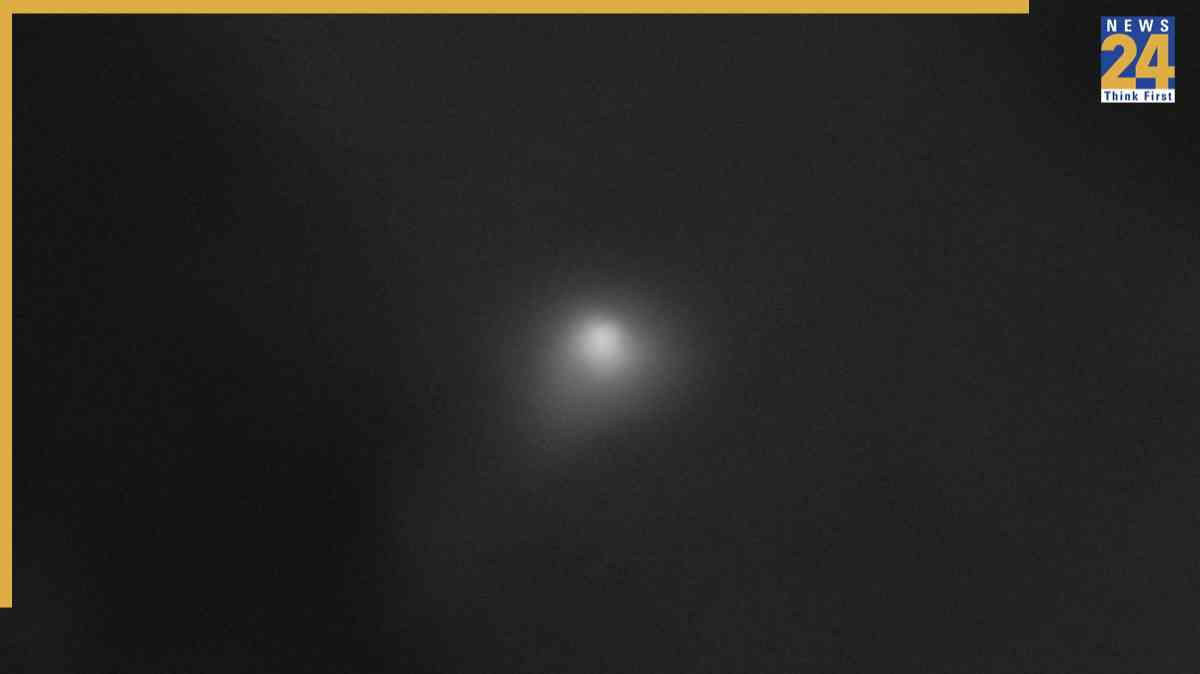


The National Aeronautics and Space Administration (NASA) has dismissed widespread rumours claiming that interstellar object 3I/ATLAS’s behaviour, including that it could be an alien spacecraft, confirming that the object is a natural comet from beyond our solar system.
Close Approach To Earth On…
In a blog post on Wednesday, the space agency stated that the comet, the third interstellar object ever detected, will fly closest to Earth on December 19 at a distance of about 170 million miles, nearly twice the distance from Earth to the Sun. The agency is currently closely monitoring the interstellar comet as it passes by Earth.
NASA Debunks Alien Rumours
Contrary to social media speculation linking the comet to alien spacecraft, NASA confirms it is a natural celestial object, currently being observed by a record number of spacecraft and telescopes.
Discovered on July 1 by NASA’s ATLAS (Asteroid Terrestrial-impact Last Alert System) telescope in Chile, 3I/ATLAS is being observed in an unprecedented solar system-wide campaign involving 12 NASA spacecraft and space telescopes.
Observations
Following its discovery, speculation among space conspiracy theorists and enthusiasts about the object’s behaviour created a lot of buzz that the “comet” could be a sign of extraterrestrial life. Observing the comet from multiple vantage points provides scientists a unique opportunity to study its composition and trajectory, offering insights into how interstellar objects differ from comets formed within our solar system.
NASA missions at Mars, including the Mars Reconnaissance Orbiter, MAVEN, and the Perseverance rover, captured some of the closest images of 3I/ATLAS when it passed 19 million miles from the Red Planet. Heliophysics missions such as STEREO, SOHO, and the newly launched PUNCH mission observed the comet as it passed behind the Sun, where Earth-based telescopes could not track it.
We've just released the latest images of the interstellar comet 3I/ATLAS, as observed by eight different spacecraft, satellites, and telescopes.
Here's what we've learned about the comet — and how we're studying it across the solar system: https://t.co/ZIt1Qq6DSp pic.twitter.com/ITD6BqVlGn
— NASA (@NASA) November 19, 2025
The Hubble Space Telescope, James Webb Space Telescope, and SPHEREx also captured detailed imagery of 3I/ATLAS in July and August. NASA’s Psyche and Lucy spacecraft, en route to study asteroids, provided additional observations, helping refine the comet’s trajectory and study its coma and tail from millions of miles away. The comet will continue its journey past the orbit of Jupiter in spring 2026, with NASA continuing to gather data to maximise understanding of this rare visitor from another solar system. (With ANI Inputs)