
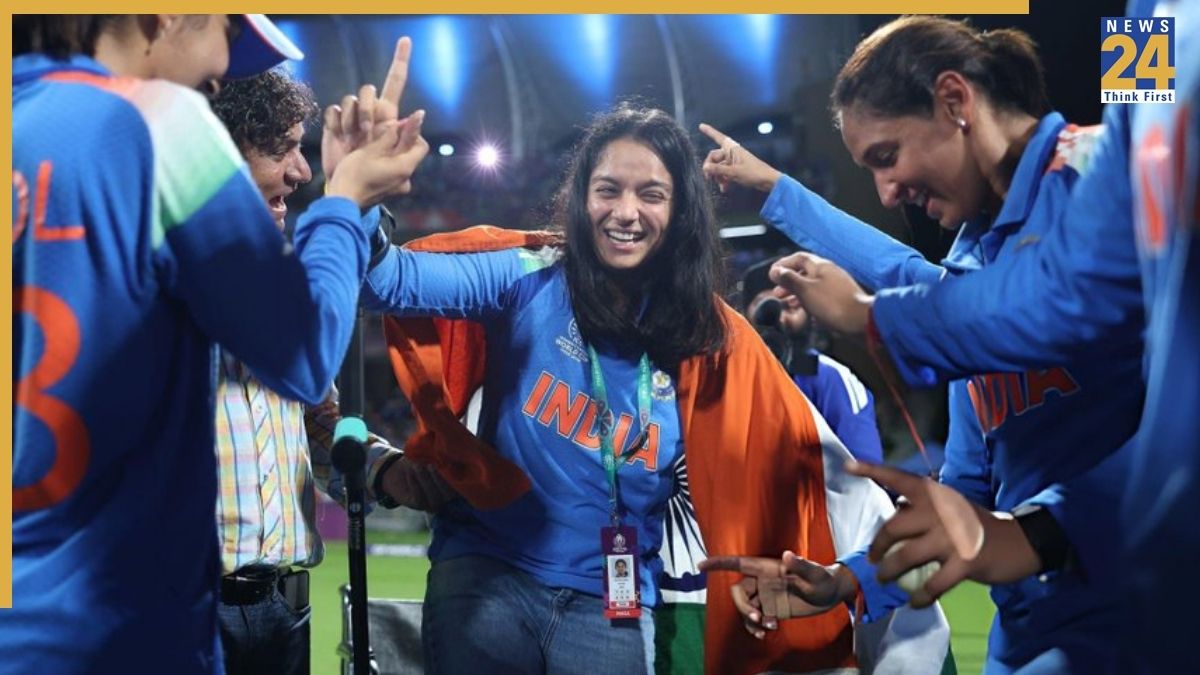


When Team India lifted the ICC Women’s ODI World Cup 2025 trophy under the brilliant lights of DY Patil Stadium in Navi Mumbai, it was a moment of triumph, joy, and pride for every player, fan, and supporter. But among the celebrations and confetti, there was one absence that left many confused and emotional – Pratika Rawal, one of the standout performers of India’s campaign, didn’t receive a winner’s medal.
It was a question that lingered in the air: How could a player who had been central to India’s World Cup run – scoring 308 runs, finishing as the fourth-highest run-scorer of the tournament be excluded from such a pivotal moment?
The answer lies in one of the ICC’s lesser-known tournament regulations, a rule that, while not often discussed, has a significant impact on players’ eligibility for medals if they’re replaced during the tournament.
Smriti Mandhana taking Pratika Rawal to the stage for the Trophy celebration time. 👌♥️
– This is Beautiful..!!!! pic.twitter.com/FovVFI2buI---Advertisement---— Tanuj (@ImTanujSingh) November 3, 2025
The Rule Behind the Medal Controversy
According to the ICC’s official playing conditions, any player who is replaced mid-tournament due to injury or other reasons is no longer considered an active member of the squad. The player who replaces them officially becomes part of the 15-member roster, while the injured player is deemed out of competition. This policy, though longstanding, has caused issues in the past, leaving out players who contributed substantially before their injury.
In Pratika Rawal’s case, the unfortunate injury came during India’s second group-stage match against New Zealand. A serious knee injury forced her to leave the field. Though she made attempts to recover and stayed with the team for a couple of more games, medical assessments soon confirmed she would not be able to participate in the remaining matches of the tournament.
Megha Bisht replaced Pratika in the squad, and under ICC’s rules, Pratika was no longer eligible for a winner’s medal despite her crucial contributions in getting India to the knockout stages.
Pratika’s Crucial Contribution
Before her injury, Pratika had been one of India’s most consistent and reliable batters. Batting at number four, she played an instrumental role in stabilizing the middle order and guiding India through tough situations. Her composed 87 runs against England and an unbeaten 72 against the West Indies were pivotal knocks that helped steer India to victory in key matches. Her ability to anchor the innings and build partnerships in high-pressure moments earned her praise from teammates, experts, and fans alike.
Pratika’s performances were a foundation on which India built their path to the final. Her injury was a devastating blow to the team, but even though she couldn’t take the field in the latter stages of the tournament, her teammates never forgot her contributions.
A Heartwarming Gesture: Smriti Mandhana’s Tribute
In the final, when the Indian team celebrated their historic win, the absence of Pratika Rawal from the medal ceremony was a glaring moment. However, Smriti Mandhana, one of India’s star players, made sure that Pratika was still part of the celebration. As the team paraded around the stadium with the World Cup trophy, Mandhana was seen pushing Pratika in a wheelchair across the field, with fans chanting Pratika’s name.
The image of Mandhana and Pratika, surrounded by the cheering crowd, quickly went viral. It became one of the most heartwarming moments of the World Cup, a powerful visual of how a team sticks together, no matter the circumstances. It was clear to all that Pratika, despite not being able to play in the final, was every bit a part of the team’s success.
The Debate Over ICC’s Rule
While the ICC’s regulations are clear, they have also sparked debate within the cricketing world. Why should a player who has been instrumental in a team’s success, but happens to be injured during the tournament, be excluded from receiving a medal?
Many former players, pundits, and fans have voiced their disappointment over this rule. They argue that a player’s contributions before an injury should be taken into account, especially if they’ve played a significant role in getting the team to the final stages. Some have suggested that a rule change is needed – perhaps any player who has participated in at least one match during the tournament should automatically be eligible for a winner’s medal, regardless of later injury or replacement.
This issue isn’t new. In 2003, during the Men’s World Cup, Jason Gillespie of Australia, who was ruled out early in the tournament due to injury, also did not receive a winner’s medal despite being part of the squad at the start.
Pratika’s Legacy: A Champion in Every Sense
Despite not receiving the official medal, Pratika Rawal’s legacy in the ICC Women’s World Cup 2025 is far from diminished. Her performances were nothing short of exceptional, and her presence in the middle order was crucial to India’s success. Captain Harmanpreet Kaur, in her post-match speech, dedicated the win to every player who had contributed to the team’s success, whether they played in the final or not. She specifically mentioned Pratika Rawal as one of the key players who helped India get to the final.
Even though the ICC rule may have prevented Pratika from receiving a medal, her teammates, fans, and the entire nation recognized her contribution. The memories of her outstanding innings and her role in India’s historic World Cup victory will remain cherished by all who watched the tournament.
A Champion Beyond the Medal
Pratika’s story is a bittersweet reminder of the complexities and technicalities of tournament rules. But it also highlights the deeper sense of teamwork, respect, and recognition that transcends official titles. No rule can ever erase her contribution to India’s journey, and no matter what the ICC says, Pratika will always hold a special place in Indian cricket history as a champion.
Also Read: Harmanpreet Kaur Joins Omaxe Ltd as Brand Ambassador Following Historic World Cup Win