

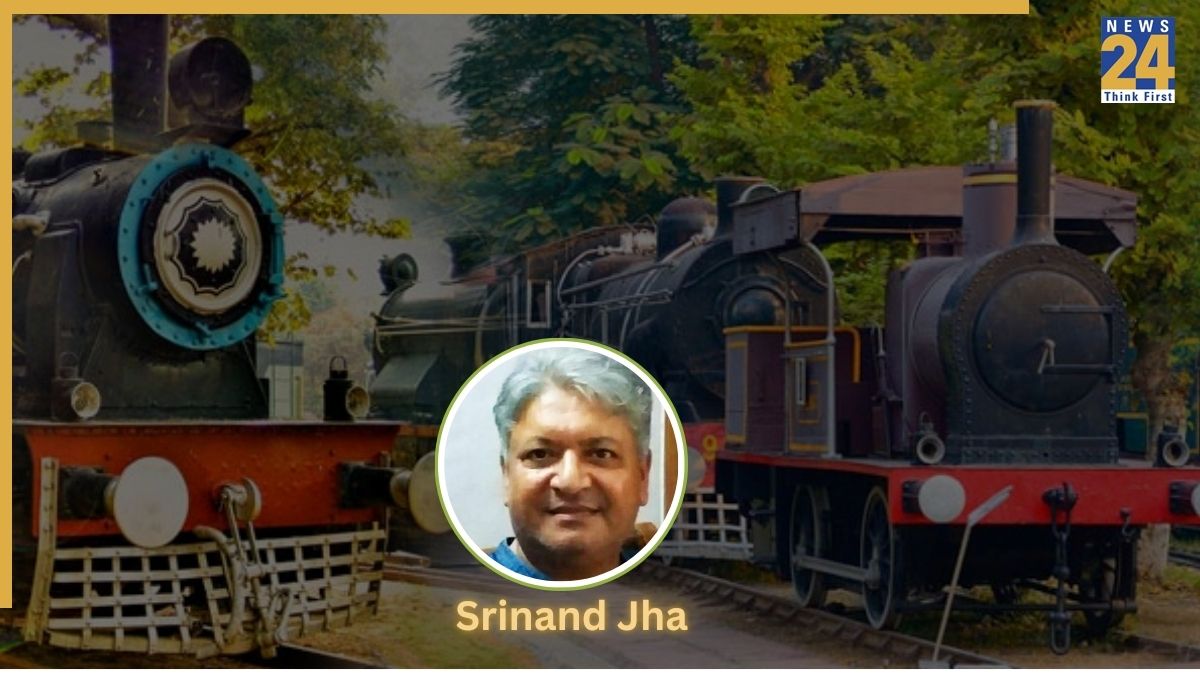


- By Srinand Jha
For generations, most boys dreamt of, becoming either a guard or an engine driver of a train used to be most fascinating ambition ever. Standing still, and speechless, staring the steam puffing locomotive engines and their drivers in awe and respect. Srinand Jha who has written extensively on trains, and Railways, takes us on a familiar journey that may take you back to your childhood. Enjoy the ride..
On occasions, one has been given to the absurd temptation of regressing in time to the wintry night at the Danapur station, where one, as a seven-year-old, would wait to be thrown in by the Coolie through the rod-less windows of the General Compartment of a Passenger train. The iron trunk of the boarding school would go in first, and – amidst the shrieks, wails, and howls of the earlier occupants – I would be pushed in. Thus, would begin my long and torturous – but adventurous – Winter Holiday journey to Dehradun.
Reliving The Golden Era Of Indian Railways
Life has come a full circle: Sleek and fast trains of the Vande Bharat variety today connect locations far and near. No longer does one need to undertake a bone-clanging road trip through crater-infested and unlit roads. Air travel has become accessible and even affordable. So, why does one feel nostalgic about a travel experience on a slow-moving train hauled by a steam engine?
From Steam Engines To Station Tales
The past has always held a puzzling hold on the human mind. Individuals and families collect scrapbooks, diaries, and photo albums. Narratives and events of a bygone era have – and are – being recreated through verse, poetry, and other art forms. Whether one is in their sixties or seventies, there is always that special thrill about reconnecting with a long-lost school friend on a social media site. The point is this: There is an insatiable desire to stay anchored in the past.
The question, however: Are we, as individuals – or as a Nation – doing enough to treasure our ancient and hoary past? The answer, tragically enough, swings to the negative. One example: Until 1969, the Indian Railways, in its inventory, had approximately 11,000 steam engines. If those used by the steel plants, port trusts, and sugar mills were to be included, the numbers would have risen to 12,000. Of these, only 300-odd remain, and only 40 of those are in either a working condition or in a state where they could be fired to run. The story about the remaining “Black Beauties” is more painful: Over the decades, they were cut up and sold off as scrap!
The Meter Gauge and the Small Gauge rail lines – as also the interesting locomotives and coaches used on them – met a similar fate. Of the 25,000 Km Meter Gauge lines that India inherited at Independence, just about 3000 km have remained, and approximately 1000 km of the Small Gauge lines (of the 5,000 km inherited from the British) have been retained.
ALSO READ: Rajiv Gandhi Assassination: An Explosion, A Flash, Darkness—Dead Bodies Strewn Everywhere
Puffing Billy, Big Boy And The Fairy Queen
The situation is best understood from a global perspective. The United Kingdom has retained about 1000 steam engines, with 300 of these in working condition and being used to run Heritage trains on approximately 100 identified routes. Australia has the “Puffing Billy”, the world’s best-known heritage train that is run in the Melbourne area, while an antiquated wooden bridge on the route has also been retained. The United States proudly runs the “Big Boy” – the world’s largest steam loco. Thailand has retained 200 steam engines and has continued to run four time-tabled heritage trains on four important dates: The King’s and the Queen’s birthdays, as well as on the Railway Foundation Day and the country’s National Day.
India’s rail heritage potential had been huge. A majority of the erstwhile Maharajas of pre-Independence India – from Junagarh to Jamnagar, Morbi, Jodhpur, Bhavnagar, or Darbangha – had operated their railway systems, all different and unique. The majority of these lines have either been uprooted, as was the 1862-built Miagam-Dabhoi Narrow Gauge line in the erstwhile Baroda-Nagpur Railway, considered amongst the World’s oldest lines. Fortunately, and largely because of initiatives taken by inspired individuals, the Fairy Queen has been retained. She has now been recognised in the Guinness Book of World Records as the world’s oldest steam locomotive.
Conserving Heritage
Each Indian Railway Station or a Yard held priceless items of heritage value: From the Station Master’s telephones to caps and uniforms, the ticketing machines, and the wooden signals that were manually operated. Over time, such objects have disappeared from even the “chor bazaars” (flea markets) of big cities. If one is extremely lucky, one might succeed in finding replicas of the British-built clocks that had been hung at railway platforms.
Now, it is not as if the establishment has not been serious about conserving rail heritage. The post of Executive Director (Heritage) has existed in the Railway Board, while all Zonal and Divisional headquarters have been mandated to set up Heritage Committees. Separate budgetary provisions for heritage preservation have also been made. The problem is this: Heritage departments are manned by service officers, a majority of whom have seemed to bide their time while waiting for a posting in operational activities. The Railway officialdom, to a large extent, has remained preoccupied – and rightly so – with tasks of ramping up operational efficiency and improving revenues. The tragedy is this: Blindsided in their overdrive to execute modernisation schemes, the rail establishment has often disregarded concerns on heritage conservation. Some examples: Under the station revamp plan called the “Amrit Bharat”, the old gabled structure of the Coonoor has been concealed behind a glass frontage. Similarly, the Indo-Saracenic structure of the Rampur Railway station has been left in a state of blemish.
The point is this: Rail heritage is not best served in official hands. The Darjeeling Himalayan Rail (DHR) society has been seeking autonomy in managing the affairs of the “Toy Train”. It might be in order to escalate the concept of de-linking heritage-related work from the operational functions across the network of the Indian Railways.