
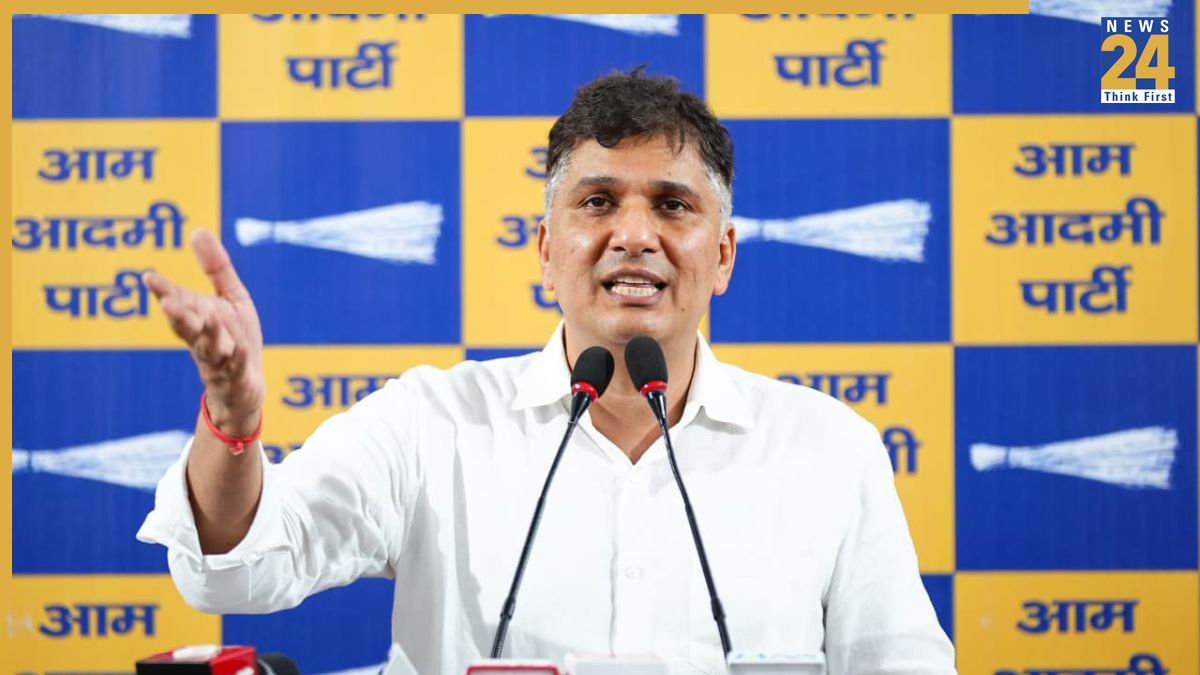


Fresh anxiety over Delhi’s drinking water quality erupted on Tuesday after the National Green Tribunal (NGT) questioned whether Haryana’s Diversion Drain No. 6, now found carrying sewage into DD-8, is even a genuine stormwater drain. In this backdrop, AAP Delhi State President Saurabh Bharadwaj said Delhi’s Water Treatment Plants (WTP) failed because Haryana allowed industrial waste to enter the capital’s freshwater supply, spiking ammonia to “poisonous” levels and confirming exactly what Arvind Kejriwal had warned about Yamuna contamination.
Sharing a news report highlighting the NGT’s demand for clarity from the Haryana Government on the freshwater drain, AAP Delhi State President Saurabh Bharadwaj took to ‘X’ and wrote: “This is exactly what Arvind Kejriwal said about Yamuna water contamination. Delhi’s Water treatment Plants failed to filter water because Haryana’s Industrial Waste entered the fresh water of Delhi. Industrial waste increased Ammonia levels in water making it poisonous. Earlier BJP & its LG called it false propaganda by AAP. Haryana Government had registered an FIR against Arvind Kejriwal.”
“Today, it’s acknowledged in NGT that sewage waste and Industrial waste from Haryana’s drain no 6 contaminates fresh water of Delhi. Delhi’s Lieutenant Governor and BJP must answer now,” the post concluded.
Saurabh Bharadwaj also shared on ‘X’ an old video from the period of the AAP government. In the video, he explains that the water reaching Delhi through the Yamuna from Haryana’s Tajewala was severely compromised because large-scale sand mining was taking place there. “We had shown live Google images of the site. We sent our teams on the ground, and they shared photographs with GPS coordinates, which clearly established that the water entering the Yamuna in Delhi was not river water at all, it was industrial waste flowing in from Haryana.”
Saurabh Bharadwaj said two drains, DD-8 and DD-2, bring industrial waste from areas such as Sonipat and Panipat, and that same contaminated water was reaching Delhi. “The investigation report showed ammonia levels higher than anything recorded in recent history. As far as our officials can recall, even 2 ppm or 2.5 ppm is considered extremely serious. But the ammonia level had crossed 6.5 ppm.”
He added that once ammonia rises to such extreme levels, the water becomes unusable for the city. “We cannot use it, and it cannot be treated. That is why the three plants at Wazirabad, Chandrawal and Okhla, all dependent on the Yamuna reservoir, had to be temporarily shut down.”