

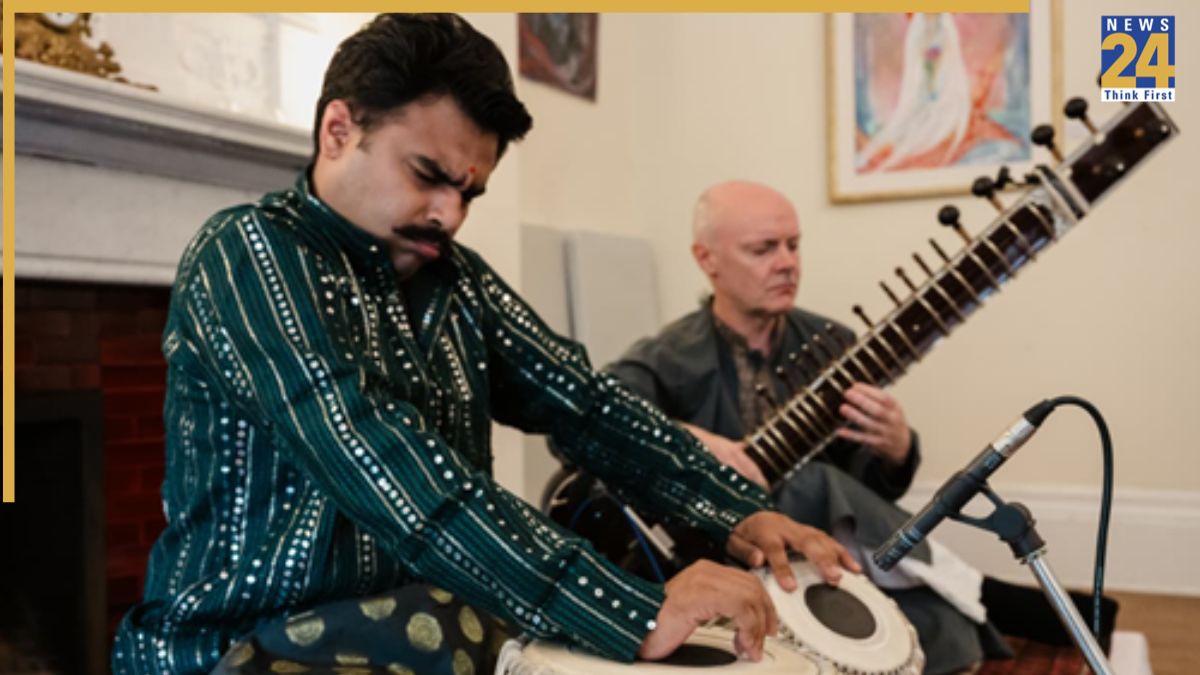


The stage is bare, except for a pair of tabla drums, their polished surfaces catching the dim light of the Edinburgh Festival Fringe. As Manmohan Dogra settles behind them, a hush falls over the audience, anticipation rising like the first note of a raga. His performance begins, and the tabla springs to life—a cascade of sound that is both a whisper and a roar, weaving the intricate rhythms of Hindustani music into a narrative that captivates from the first strike.
Dogra’s artistry, honed over two decades in the Banaras gharana with influences from Delhi, Ajrada and other styles, reveals a rare alchemy: technical precision fused with emotional depth, tradition elevated by innovation.
Dogra’s command of the tabla is immediately evident in his clarity of sound. Each dha, tun, and na (tabla syllables) rings with crystalline precision, a testament to his rigorous training under Pt. Vijay Shankar Mishra. His fingers move with a fluidity that belies the complexity of teen taal cycles, navigating kaidas, relas, tukdas, and chakradhaars (compositions of tabla) with an ease that transforms mathematical precision into expressive storytelling.
At the Edinburgh Fringe Festival 2025, his concert “Anhad: The Infinite Rhythm” unfolded like a sonic tapestry, its rhythmic patterns shifting from meditative to electrifying. The audience, a mix of classical connoisseurs and curious newcomers, leaned forward, drawn into the hypnotic pulse that seemed to transcend the stage.
What sets Dogra apart is his ability to make the tabla a lead voice rather than mere accompaniment. In his collaborations with sitarist David Beards, he redefines the instrument’s role, crafting dialogues where the tabla converses with the sitar’s melodies – at times challenging, at times complementing. His tabla solo was a masterclass in dynamics—moments of delicate restraint gave way to torrents of rhythmic virtuosity, his hands a blur as tihais resolved with breathtaking accuracy.
This versatility, blending the Banaras Baaj’s robust energy with the subtler flourishes of Delhi and Ajrada gharanas, allows him to bridge traditional purity with a global sensibility, making his performances accessible yet profoundly layered.
Dogra’s stage presence amplifies his technical prowess. There’s a quiet intensity in his posture, a focus that draws the audience into the rhythm’s inner world. His improvisations are not mere displays of skill but journeys—each rela a narrative arc, each kaida a conversation with the listener. This emotional resonance was palpable where his ability to shift from introspective phrases to explosive crescendos held the room in thrall, evoking gasps from those unaccustomed to the tabla’s expressive range. His performances invite both seasoned listeners and novices to discover the universality of rhythm, a language that speaks across cultural divides.
Beyond the stage, Dogra’s commitment to education and cultural exchange enriches his artistry. His workshops, observed in settings from Delhi schools to UK universities, reveal a performer as invested in teaching as in performing. He breaks down complex rhythms into accessible patterns, guiding participants to feel the tabla’s pulse. This dedication ensures his performances are not fleeting moments but part of a broader mission to sustain Hindustani music’s relevance. His international appearances, from Edinburgh to London, showcase a forward-looking vision, blending tradition with contemporary contexts, as seen in his plans for cross-cultural projects that promise to push the tabla into new sonic territories.
Dogra’s artistry is not without minor critique. At times, his improvisational flourishes, while dazzling, risk overshadowing the meditative restraint that defines classical tabla’s soul. Yet this boldness is also his strength, reflecting a performer unafraid to stretch boundaries while honouring lineage. As he concluded his Fringe performance, the final note lingered, a resonant echo of a tradition kept vibrantly alive. Manmohan Dogra’s tabla is more than music—it’s a bridge between past and future, a rhythmic revelation that leaves audiences transformed.
Also Read: Dil Madharaasi Review: After Sikandar, This Tamil Movie Is Even Worse