
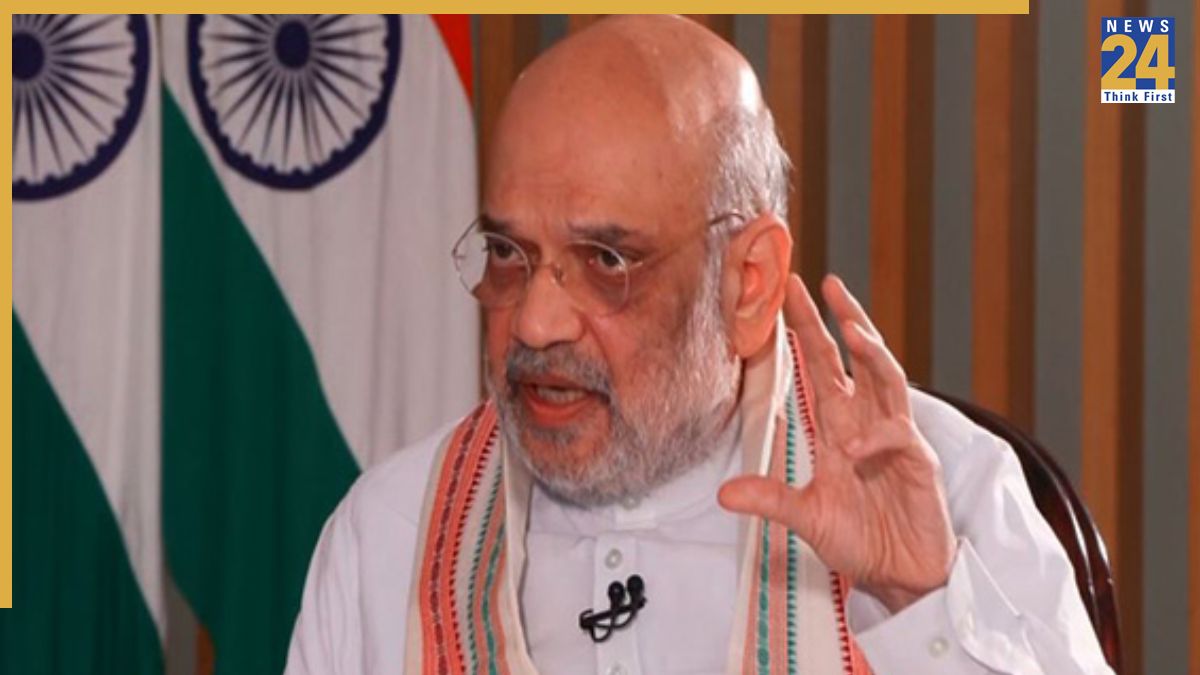


Union Home Minister Amit Shah launched a sharp attack on the INDIA bloc over its Vice Presidential candidate, B. Sudershan Reddy. He questioned the ideological basis behind his selection, while referring to Reddy’s past decisions as the Judge. Shah alleged that he rejected the Salwa Judum movement and took away the tribals’ right to self-defence, which, according to him, allowed Naxalism to persist in India for over two decades.
“He rejected Salwa Judum and ended the right of self-defence of tribals. Because of this, Naxalism lasted for more than two decades in this country… I believe leftist ideology must have been the criterion,” Shah stated in an interview with ANI.
He rejected Salwa Judum and ended the right of self-defence of tribals. Because of this, Naxalism lasted for more than two decades in this country… I believe leftist ideology must have been the criterion (for selecting Sudershan Reddy): Home Minister Amit Shah on INDIA… pic.twitter.com/B6SpPiP8Ct
— ANI (@ANI) August 25, 2025
---Advertisement---
Notably, in an interview to The Hindu on Sunday, retired Supreme Court Judge and INDIA Bloc VP candidate Reddy stated that he does not want to join the controversy surrounding Salwa Judum judgment and Shah’s statement. Reddy was replying to a question about Shah’s earlier accusation that he supported Naxalism and that had he not delivered the Salwa Judum judgment, Left-Wing Extremism would have been eradicated before 2020.
He said that since a Supreme Court judgment was not meant for public debate, he won’t join the discussion. “Whatever its merits may be, there are acceptable standards to review a judgment and make a comment upon that,” Reddy added.
Salwa Judum, which means “peace march” in the Gondi language was a movement that mobilised and deployed local tribal youth as part of counterinsurgency operations in Chhattisgarh. It aimed at countering Naxalite activities in the region. It was formed in 2005 and began as “Jan Jagran” march in Bijapur district of the state. However, it soon turned into Salwa Judum, a state-backed militia made up mostly of tribal youth. It was formed and armed to fight Maoist insurgents in the tribal areas of the Bastar region.
It was in practice until 2011, when the Supreme Court outlawed and banned it. On 5 July 2011, the Supreme Court of India, in response to a petition by Nandini Sundar and others, declared Salwa Judum illegal and unconstitutional, and ordered that it be disbanded. The court also directed the Chhattisgarh government to take back all weapons, ammunition, and equipment from the group. The government’s use of Salwa Judum in anti-Naxal operations had faced strong criticism due to human rights violations and the deployment of poorly trained tribal youth in dangerous counter-insurgency roles.
Justice B Sudershan Reddy was part of the Supreme Court Bench along with Justice S S Nijjar that disbanded Salwa Judum for being illegal and unconstitutional.
Also Read: ‘Don’t Stretch It Too Much’: Amit Shah On Former Vice President Jagdeep Dhankhar’s Resignation