

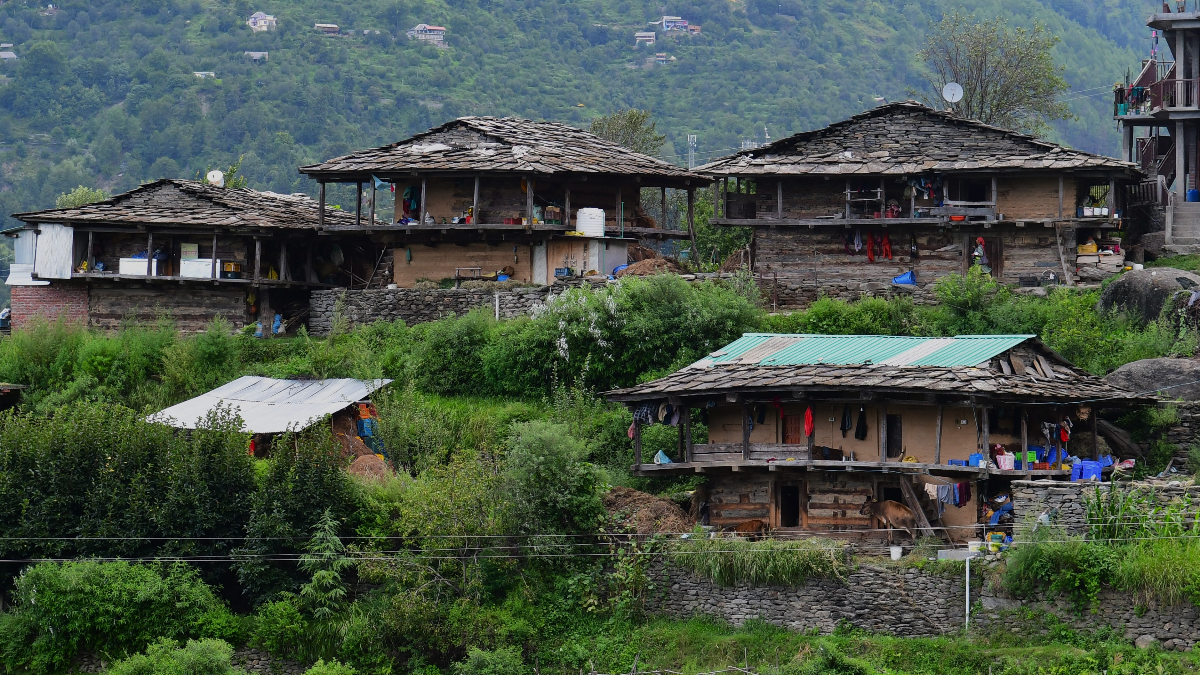


Penelope Chetwode, an English travel writer whose father, Field Marshal Lord Chetwode, was a commander-in-chief in India during the British Raj, called Kullu Valley “The End of the Habitable World.” Kullu was originally known as ‘Kulanthapitha,’ according to an ancient tradition, meaning the “end of the habitable world.” Kullu is a district in Himachal Pradesh, a northern state in the western Himalayas of India, and is renowned for its scenic beauty, ancient architecture, traditions, and rich cultural heritage.
Its ancient architecture, which is threatened now, is called Kathkuni. Kathkuni architecture is a traditional building style native to the Himalayan regions of India, particularly in Himachal Pradesh and parts of Uttarakhand. Known for its unique construction techniques and adaptation to the challenging mountainous terrain, Kathkuni architecture reflects the ingenuity and the cultural heritage of the people living in these high-altitude areas. This essay explores the historical development, distinctive features, and contemporary relevance of Kathkuni architecture.
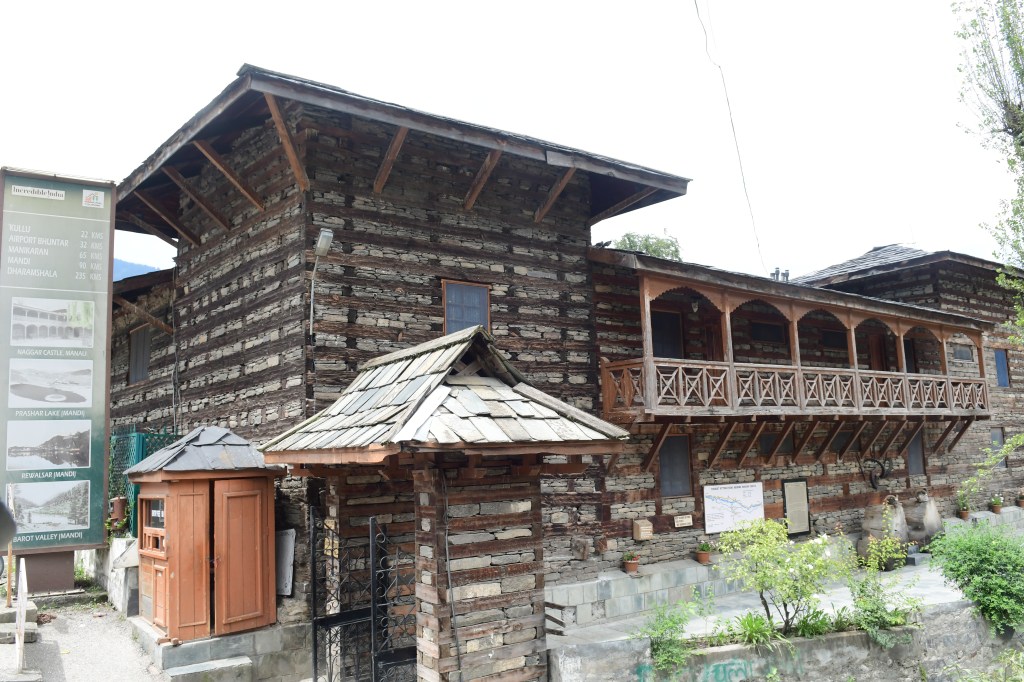
The origins of Kathkuni architecture are quite old and can be termed historic as some houses and castles go back to the 16th century. The architecture evolved in response to the harsh climatic conditions, including heavy snowfall, intense rainfall, and frequent seismic activities. This traditional building style emerged as a practical solution to these challenges, incorporating local materials well-suited to the region’s environment. A noteworthy observation about these houses is that their foundation or plinth is not very deep. It is not more than three feet in regular houses, and around six to seven feet in big houses and temples. A huge plank of cedar wood is laid on the four corners of the foundation and then heavy carved and chiseled stones are laid on top of that, without any cement or adhesive material. This frame is called ‘chakra nashi’ which means it can withstand seismic activity and natural disasters.
In her book, Chetwode described Naggar as the best place to study western Himalayan architecture. Naggar was where great Soviet Artist Nicholas Roerich settled. Later his son Svetoslav looked after this estate, which was turned into an art gallery. His wife, famous Indian film star Devika Rani, helped him in establishing this estate. Naggar Castle has stood tall and unfazed for centuries, and is taken over by Himachal Tourism and has been conserved and converted into a heritage hotel. It causes curiosity among the visitors for its architecture, a small temple, and a museum inside.
Kathkuni houses can be multi-storeys, from single-storey to four-storeys. The ground floor with a small door is generally used to house the livestock, which can include cows, sheep, and goats. The first floor is for storing food materials and is used as a store in case of emergency and adverse climatic conditions. The second floor is the living area and it has adjoining bedrooms. The top floor is generally the kitchen in most of the houses. Wooden balconies are created all around the house. The windows are made of wood and carved intricately with motifs, and on the top is an attic.
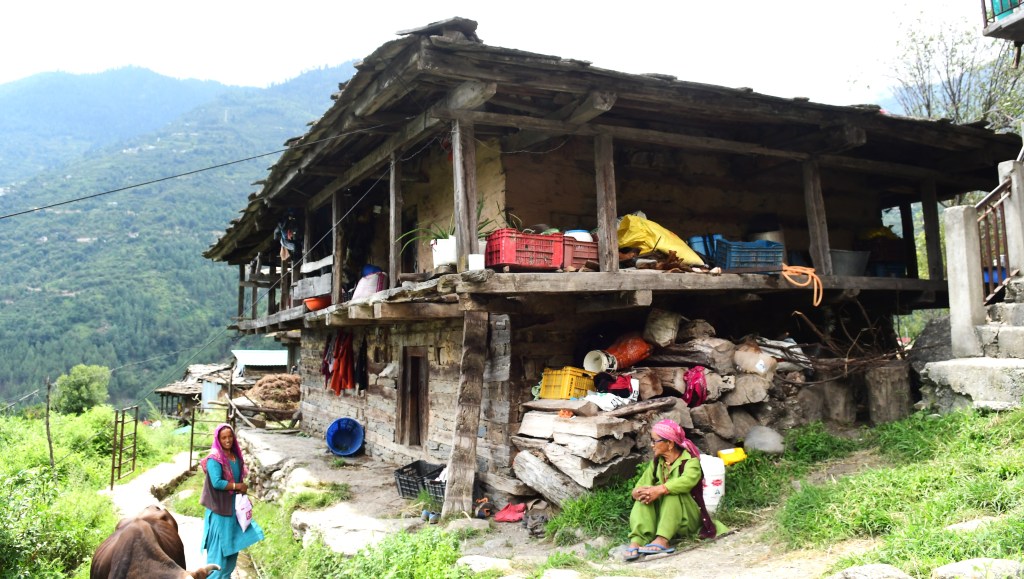
Kathkuni houses and temples are made of wood and stone without any cementing adhesive. This architecture mainly uses huge logs of deodar and stones that are cut and chiseled from the bigger rocks, which are then shaped into rectangular blocks. This method provides both strength and flexibility, which are essential for surviving the region’s seismic activity as this region is hugely earthquake-prone. The huge logs provide strength and elasticity in case of an earthquake.
One of the defining features of Kathkuni architecture is the interlocking timber frame construction, which is fixed with huge wooden nails called ‘keela.’ The technique involves creating a network of wooden beams and rafters that interlock with each other, creating a stable framework. This method enhances the building’s ability to withstand earthquakes, as the interlocking timber can absorb and dissipate seismic energy effectively.
The lower portions of Kathkuni buildings are typically constructed from large stone blocks, providing stability and protection from the elements. Above these stone walls, the structure is made of timber, with mud plaster used to seal gaps and insulate the building. The mud plaster also helps in maintaining a comfortable indoor temperature by insulating against extreme cold and heat, as there are no windows and ventilators on the ground floor.
Kathkuni roofs are designed to handle heavy snowfall and rain. The roofs are steeply pitched to allow snow and rain to slide off easily. The roof’s construction often involves wooden shingles or slate tiles, which provide durability and insulation. The slate tiles are so heavy that no storm can take them off. These slate tiles are still available in some parts of Himachal Pradesh.
Traditional Kathkuni buildings often feature intricate wooden carvings and decorative elements. These carvings, usually found on doors, windows, and eaves, are not only aesthetically pleasing but also reflect the cultural and artistic heritage of the region. These carvings are on temple doors and thresholds.
Kathkuni architecture is more than just a construction style; it is a cultural expression and an environmental adaptation. The use of local materials and techniques reflects a deep understanding of the natural environment and its challenges. This architecture is also a testament to the cultural traditions and craftsmanship of the Himalayan communities, who have maintained these practices for centuries.
This kind of house could be found on the silk route in ancient times In England this kind of construction is called Half Timbered. As you move towards the British countryside you will see almost similar houses built with similar technology with different designs. In Germany, they are called Fachwrek. This kind of stone, wood, style of housing can be seen in many European countries. Himis’s construction style of housing also involves enough use of wood and stone in Turkey.
The environmental significance of Kathkuni architecture lies in its sustainability. By using locally sourced materials and traditional construction methods, Kathkuni buildings have a minimal ecological footprint. The use of timber and stone reduces the need for transportation of materials, while the energy-efficient design minimizes the need for additional heating or cooling. There is no use of metal girders or any other beams.
In recent years, there has been a renewed interest in traditional architecture, including Kathkuni, as people seek sustainable and culturally resonant building practices. Efforts are being made to preserve and promote Kathkuni architecture, both for its historical value and its practical benefits in contemporary construction. By integrating traditional methods with modern innovations, architects, and builders aim to create structures that honour the past while addressing current needs.
Most of these houses, which withstood the test of time and natural calamities, are being replaced by modern housing brick and mortar in most parts of Himachal Pradesh, including Shimla, Kullu, Kinnaur, Mandi, Kangra, and some other places. The massive earthquake in 1905, left most of Himachal in complete devastation. However, the Kathkuni houses endured the jolts, staying completely unfazed. The best examples of these houses are in the village of Malana, known for its unique democratic setup. Although in a dilapidated state, there are several Kathkuni houses.In Naggar Castle, a few villages in the Manali region, and Bajnar Valley. Bheemakali temple at Sarahan in Shimla District and Hidimba Devi temple in Manali are the finest examples of the Kathkuni style of architecture. A huge multi-storey structure at Chehni Kothi in Banjar Valley is another prominent example of this architecture. Few houses in Kais village still stand tall despite all the wear and tear.
Despite its advantages, Kathkuni architecture faces challenges in the modern era. Urbanization, climate change, and the availability of traditional materials pose threats to its preservation. Efforts to maintain and restore Kathkuni buildings are crucial to preserving this architectural heritage. Educational initiatives and government support are essential to ensure that traditional techniques and knowledge are passed down to future generations.
Kathkuni architecture stands as a remarkable example of traditional building techniques that harmonize with the natural environment. Its unique construction methods, use of local materials, and cultural significance make it a valuable part of Himalayan heritage. With modern brick-and-mortar houses, this tradition is facing a huge threat. According to people, these houses are not cost-effective and not modern. The cost of timber has gone up and there are restrictions on the timber as it is against the forest laws to cut the grown-up trees. In recent times though these Kathkuni houses have gone out of vogue, but still some people want to go back to sustainable Kathkuni houses in Himachal. As we move forward, preserving and adapting Kathkuni architecture can offer valuable insights into sustainable building practices and cultural preservation.