
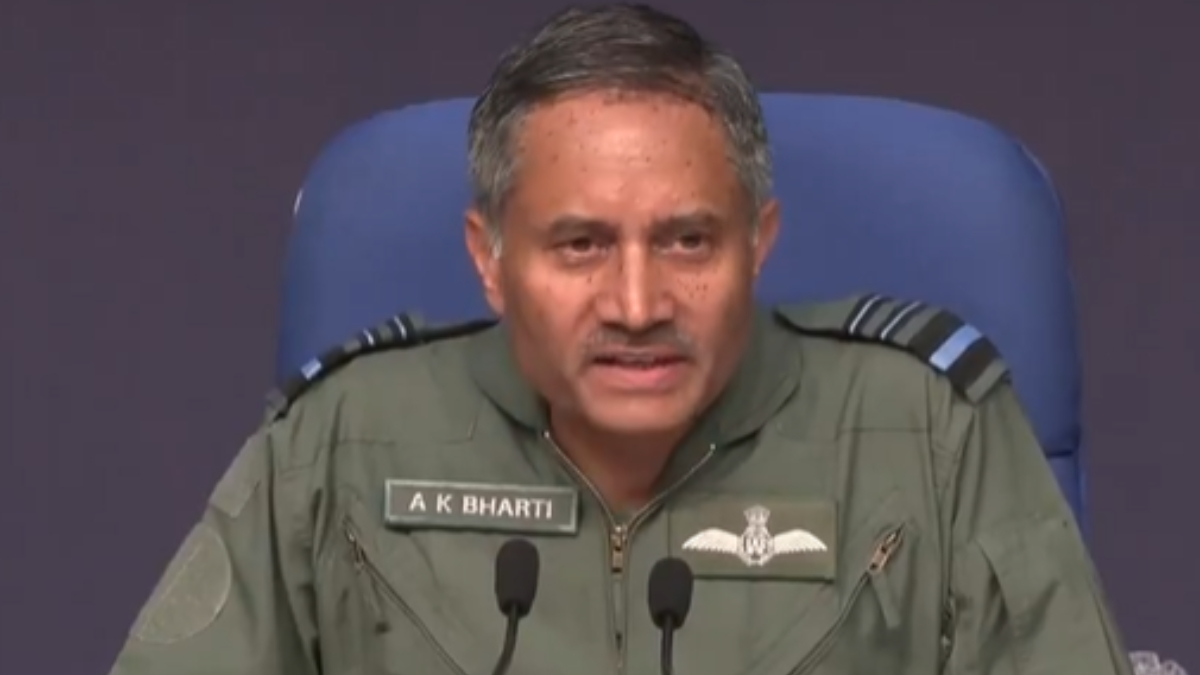


The Armed forces on Monday displayed a video that showed the destruction to Pakistani ordinance in the strikes. Director General Air Operations (DGAO) Air Marshal AK Bharti detailed the success of the Indian Armed Forces’ Operation Sindoor, launched on May 7, targeting nine terrorist infrastructure sites in Pakistan and Pakistan-occupied Jammu and Kashmir (PoK).
While addressing a press conference, Air Marshal AK Bharti emphasised that the Indian Armed Forces’ fight was solely against terrorists and their support networks, not the Pakistani military.
“We had a detailed brief on the successful joint operations to destroy the terror operation in Pakistan-occupied Kashmir and Pakistan itself… We reiterated that our fight was with terrorists and their support infrastructure and not with the Pakistani military. However, it is a pity that the Pakistani military chose to intervene and back the terrorists, which compelled us to respond, and whatever loss they suffered, it was their own responsibility,” he stated.
#WATCH | Delhi | #OperationSindoor | Air Marshal AK Bharti says, "…It is a pity that the Pakistani military chose to intervene and that for terrorists, and hence we chose to respond…" pic.twitter.com/c3sHHKaRKI
— ANI (@ANI) May 12, 2025
The Indian Army put out a tweet on from its X account, stating: “Destroy the Enemy in the Sky.”
आकाशे शत्रुन् जहि I
— ADG PI – INDIAN ARMY (@adgpi) May 12, 2025
Destroy the Enemy in the Sky.#PahalgamTerrorAttack #OperationSindoor#JusticeServed #IndianArmy@IAF_MCC @indiannavy pic.twitter.com/vO28RS0IdE
Highlighting the efficacy of India’s layered and intricate air defence (AD) system, Air Marshal AK Bharti described how the air defence system played a key role in thwarting multiple waves of Pakistani drones and unmanned aerial vehicles (UAVs).
The DGAO explained the robust AD environment, comprising assets from the Indian Army, Navy, and Air Force, included multilayered sensors and weapon systems, indigenously developed soft and hard-kill counter-UAV systems, and highly trained personnel. The Integrated Air Command and Control System (IACCS) of the Indian Air Force (IAF) was instrumental in coordinating this defence network.
Air Marshal Bharti attributed the success of India’s air defence capabilities to a decade of unwavering budgetary support from the Government of India, which enabled the development and deployment of advanced systems.
“All these were brought together as an effective AD environment by the IACCS of the IAF. The performance demonstrated by the older battle system also took them (drones) head-on… Another highlight was the stellar indigenous AD, like the Akash System… This AD environment was possible over the last decade because of the unwavering budget allocated by the Government of India,” he stated.
“Numerous waves of drones and unmanned combat aerial vehicles employed by Pakistan were also thwarted by the indigenously developed soft and hard kill counter-UAS systems and the well-trained Indian Air Defence personnel,” he added.
#WATCH | Delhi: Air Marshal AK Bharti says, "… Numerous waves of drones and unmanned combat aerial vehicles employed by Pakistan were also thwarted by the indigenously developed soft and hard kill counter-UAS systems and the well-trained Indian Air Defence personnel." pic.twitter.com/pHonAflNAq
— ANI (@ANI) May 12, 2025