

India is preparing to strengthen its air-combat capability with one of the world’s most powerful long-range air-to-air missiles the Russian R-37M. The deal between India and Russia for nearly 300 R-37M missiles is now at an advanced stage, and deliveries are expected to begin within 12–18 months once both sides sign the final agreement.
This move comes at a time when India faces growing security challenges on multiple fronts. From Pakistan on the West to China in the North and East the country is preparing for the possibility of simultaneous conflicts. Strengthening the Indian Air Force (IAF) with long-range precision weapons is a key part of this strategy.
Why India is Rushing for R-37M Missiles
The R-37M became a priority after the 2025 Operation Sindur, during which IAF’s Su-30MKI fighters came up against Pakistan’s J-10CE jets armed with China’s PL-15 missiles. With a 180–200 km range, the PL-15 could strike first, while India lacked an equivalent long-range missile.Because of this disadvantage, IAF jets had to retreat from certain engagements.
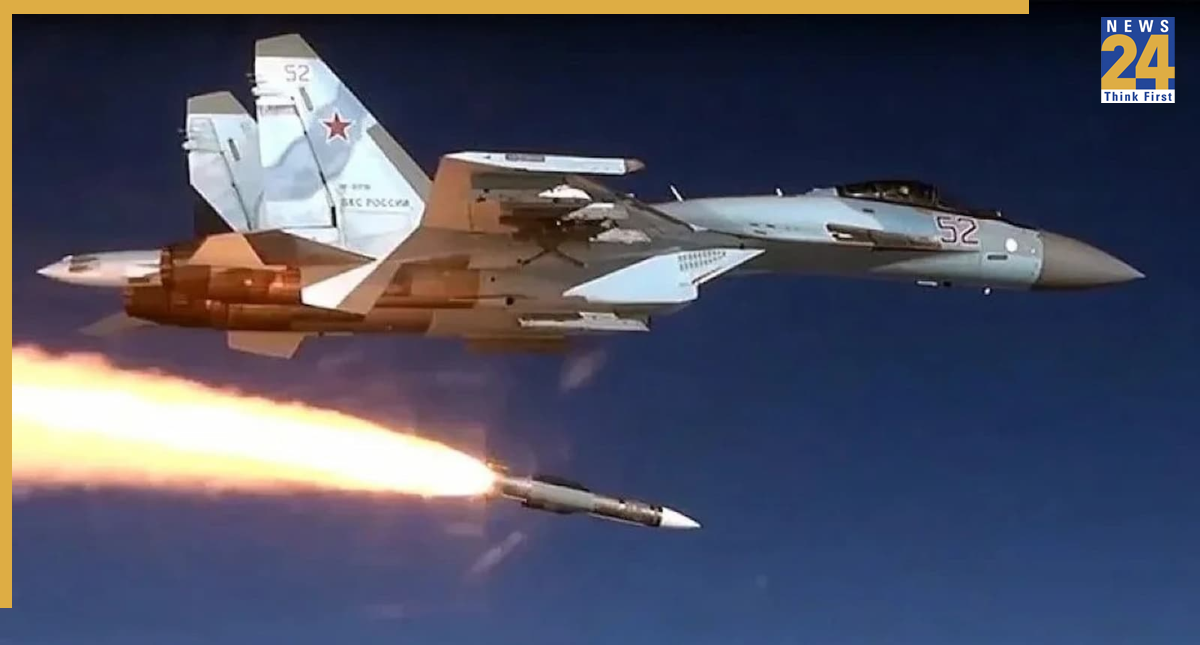
The R-37M completely changes this equation. With the ability to hit targets beyond 300 km, it ensures the IAF can strike first and strike deep well before enemy aircraft or surveillance systems threaten Indian airspace.
What Is the R-37M Long-Range Missile?
The R-37M is considered the world’s longest-range active air-to-air missile currently in service. It can engage targets like:
- AWACS aircraft
- Aerial refuelling tankers
- Electronic warfare platforms
- Enemy fighters
- Low-flying cruise missiles
The missile is designed for high-speed interceptions at long distances. It can fly at Mach 6 (six times the speed of sound), allowing it to cover huge distances in seconds.
Because Russia already operates the R-37M on Su-30SM and Su-35 aircraft, integrating it with India’s Su-30MKI jets is expected to be relatively smooth. Only minor software upgrades to the N011M Bars radar and mission computer are needed.
How Is It More Dangerous Than BrahMos?
BrahMos is one of India’s most powerful weapons but it is a surface-to-surface or air-to-surface missile, designed to strike ground or sea targets.
The R-37M serves a completely different purpose, but in its domain, it is even more dangerous because:
- BrahMos cannot shoot down aircraft – R-37M can.
- R-37M travels faster than BrahMos in the final phase of attack.
- It allows India to destroy enemy surveillance aircraft hundreds of kilometres away, long before they come close.
- By neutralising AWACS and tankers, it blinds the enemy’s entire air force.
- The missile gives India the ability to dominate the skies long before a dogfight even begins.
In long-range aerial warfare, the R-37M offers a strategic advantage that BrahMos cannot provide.
India Is Also Developing Astra MK-3 Missile
India is developing the Astra Mk-3, an SFDR-based missile expected to exceed 300 km in range. But it may only enter production around 2030–2032. Until then, the R-37M fills a crucial operational gap.
Each Su-30MKI will carry two R-37M missiles under the fuselage, while shorter-range missiles like Astra Mk-1, Mk-2 and R-77-1 will remain on the wings.
This combination gives the IAF unmatched reach. Experts believe this acquisition will make the Su-30MKI one of Asia’s most formidable air-combat platforms.
With the R-37M deal nearing completion, India is set to significantly expand its control over the skies and gain a decisive edge in long-range air warfare.