
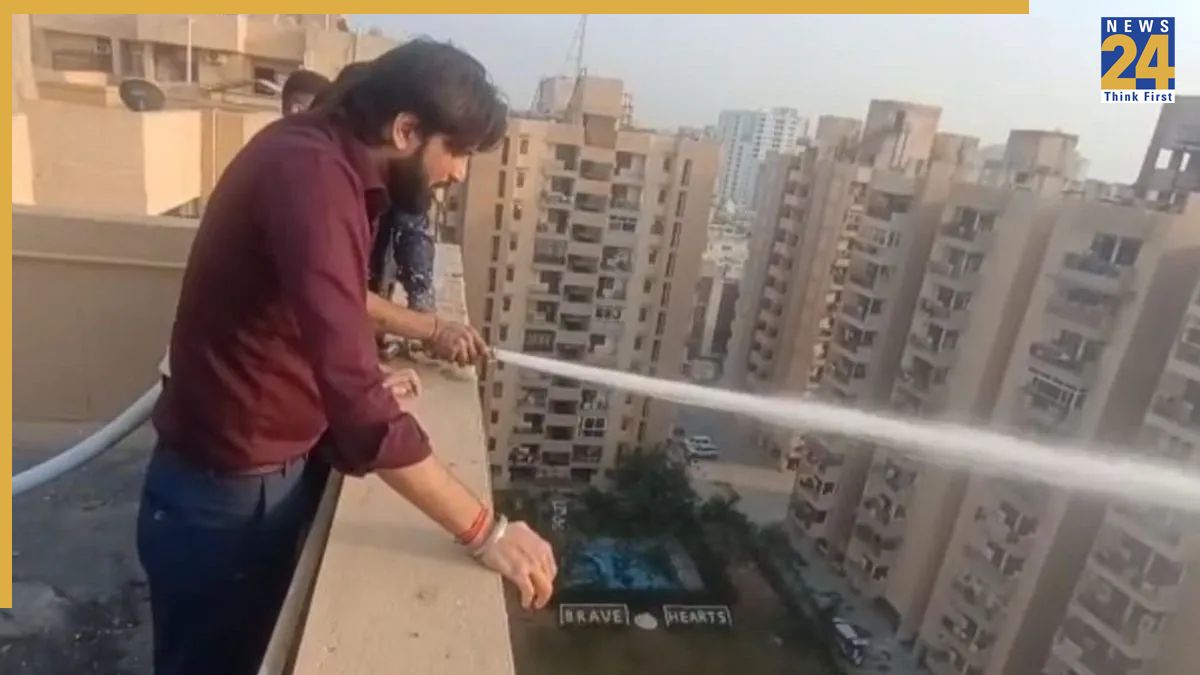


Residents of the Brave Hearts Society in Rajnagar Extension, Ghaziabad, were left stunned after a brief ‘artificial rain’ experiment instantly freshened the air and reduced visible dust in the housing complex. At a time when Delhi-NCR is battling severe pollution, this unexpected initiative by the society’s AOA offered quick relief and has now become the talk of the city.
How the ‘artificial rain’ worked
To tackle the heavy smog and flying dust, the society installed pipes on the top floors of its towers and released fine water droplets over the open spaces. As the water fell, it trapped the dust particles suspended in the air, forcing them to settle on the ground. Within minutes, residents noticed clearer visibility, reduced irritation in the eyes and a noticeably fresher environment. Plants and pathways appeared cleaner as the dust settled.
AOA President Advocate Lavish Tyagi explained that the goal was to create a quick, low-cost method to bring immediate relief to residents struggling with pollution. The experiment, though simple, made a surprisingly big impact in a short time.
Small idea with a big buzz
Videos and photos of the artificial rainfall circulated widely on social media, drawing attention from nearby residential societies. Many residents across Ghaziabad and Noida appreciated the idea and called it a smart, practical step to fight local pollution.
Experts, however, note that while such artificial rain can temporarily reduce dust and improve air quality in a limited area, it is not a permanent or large-scale solution. Still, in a season where pollution levels remain high for weeks, community-driven ideas like this can offer much-needed comfort.
The Brave Hearts Society’s initiative has sparked a wider conversation about what local communities can do to improve liveability, even if for a few hours, when pollution hits its worst levels.