
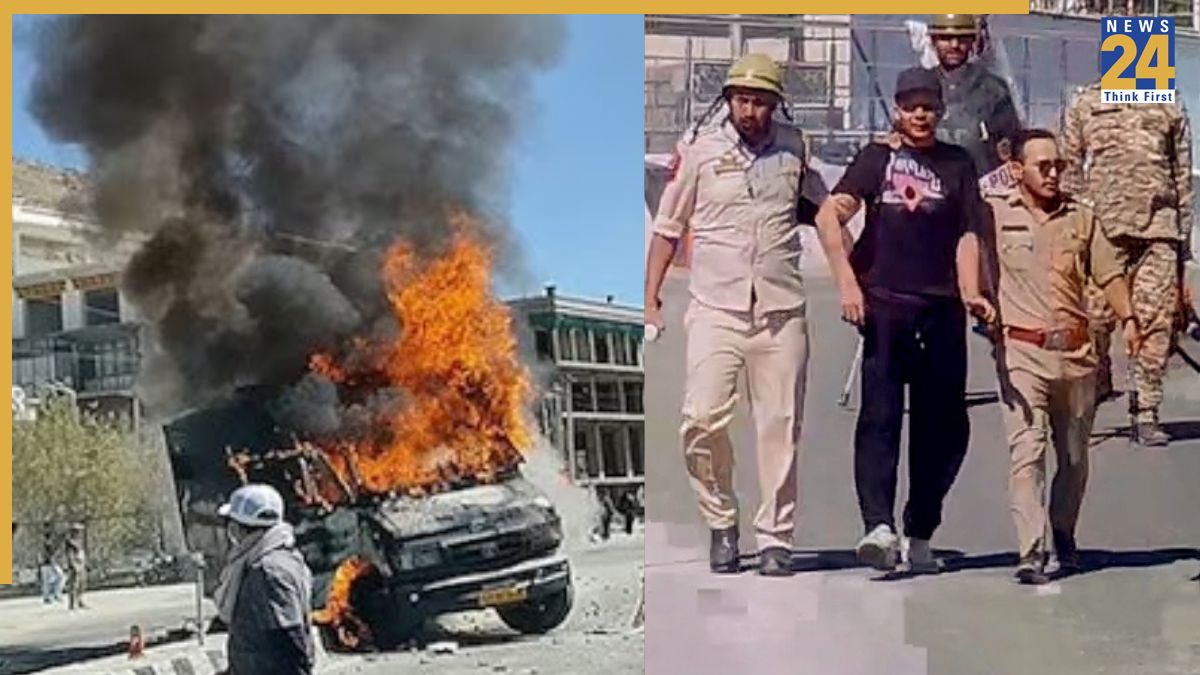


Violence erupted in Leh on September 24 when protesters set fire to the Bharatiya Janata Party (BJP) office and a CRPF van in Ladakh’s capital. At least four people were killed, and more than 70 were injured during the clashes, leading authorities to impose a curfew in Leh. Who was behind the violence, and what was the motive? Was there any involvement of Gen Z in the Ladakh protests, similar to what happened in Nepal? The climate activist Sonam Wangchuk, who was on a hunger strike demanding separate statehood, was the first to state and announce the ‘Gen Z’ involvement.
“outburst of the young generation that brought them onto the streets… This was a Gen-Z revolution,” Wangchuk said after calling off his hunger strike on Wednesday. The term ‘Gen Z protests’ has gained currency after recent demonstrations in Nepal that led to a change of government in India’s neighbouring country. 7 Key points that you should know about Ladakh Protest.
Why the Ladakh Protest?
A group of people, led by climate activist Sonam Wangchuk, have been on a hunger strike since September 10. They were seeking talks with the Centre on the inclusion of Ladakh in the Sixth Schedule as well as for statehood. However, he welcomed the UT status for Ladakh, after a few months, Wangchuk said that there exists a political vacuum under the administration of the Lieutenant Governor. The growing discontent in Ladakh over statehood aspirations led to to large-scale protests and hunger strikes
What is Sixth Schedule of the Indian Constitution that Ladakh wants to be included?
The Sixth Schedule of the Indian Constitution gives special powers to tribal areas in Assam, Meghalaya, Tripura, and Mizoram. It allows these regions to govern themselves through Autonomous District Councils, making laws on land, forests, and local administration. This aims to protect tribal rights, traditions, and self-rule.
In Ladakh, about 97% of the population belongs to Scheduled Tribes. The breakdown is 66.8% in Leh, 73.35% in Nubra, 97.05% in Khalsti, 83.49% in Kargil, 89.96% in Sanku, and 99.16% in Zanskar, according to the Ministry of Tribal Affairs.
Who led the Ladakh protests
The Leh protests in Ladakh were led by the Leh Apex Body (LAB), a coalition of different religious, social, and political organisations. The protests is over the demand for statehood and inclusion under the Sixth Schedule. Various news reports suggest that, Climate Activist Sonam Wangchuk has been a long advocate for the rights and development of Ladakh.
Wangchuk was leading the protests and joined a hunger strike with other members. They were demanding the central government hold talks to address Ladakh’s pending issues. The movement also saw participation from the Kargil Democratic Alliance (KDA), which supported the LAB’s demands and called for solidarity actions across the Union Territory, including a shutdown on September 25.
Are Gen Z among the Ladakh Protestors?
Yes, Several people claimed that Gen Z was involved in the protests in Ladakh. Videos and posts on social media suggested that young protesters set fire to the BJP office and caused chaos, with some comparing it to the recent Nepal uprising. At least two other verified accounts also linked the protests in Leh to Ladakh Gen Z.
Another user, who identifies as an entrepreneur, alleged: “Gen Z protestors in Ladakh set BJP office on fire, complete chaos”
Some even drew parallels with the recent Nepal uprising, where Gen Z demonstrators toppled the Oli government. A verified account named The Protagonist wrote: “This isn’t Nepal. This is Ladakh”
Activist Sonam Wangchuk expressed concern, urging the youth to stop the violence, saying it only harms their cause. A person on X, shared a video from Leh with the caption: “Gen Z is out on the streets of Ladakh.”