
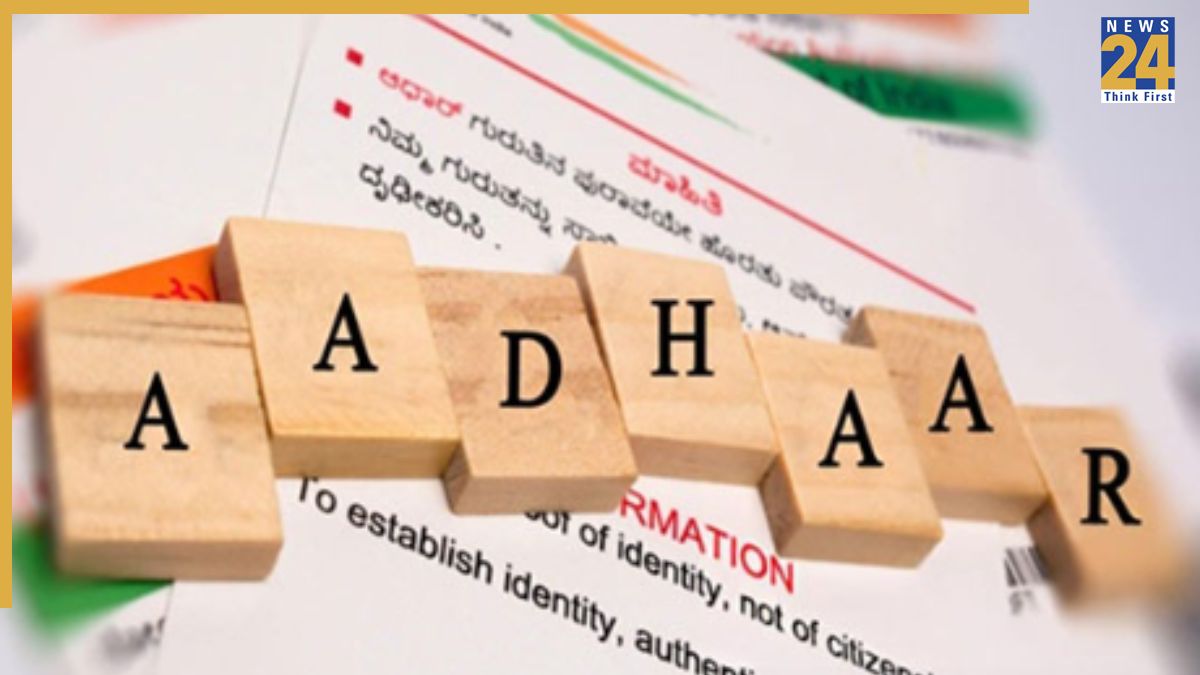


The Centre has asked all schools across the country to complete Aadhaar biometric updates of children aged between 5 and 15 without any delay.
An official release stated that schools have been directed to organise special camps to clear the backlog.
According to PTI, UIDAI CEO Bhuvnesh Kumar has written to all states and union territories to complete the mandatory Aadhaar biometric updates.
“UIDAI has joined hands with the Department of School Education and Literacy, to provide the Mandatory Biometric Update (MBU) status pertaining to Aadhaar of school children on the Unified District Information System for Education Plus (UDISE+) application a move that will facilitate MBU in Aadhaar for crores of students,” the release said.
The authority stressed that biometrics must be updated twice once when a child turns five, and again at 15 years to maintain accuracy and reliability of data. Mandatory biometric updates are pending in nearly 17 crore Aadhaar numbers, UIDAI said.
The release said that if a student fails to update biometrics, he or she will not be able to avail the benefits of government schemes, and it would also create obstacles for students in appearing for competitive exams like JEE, NEET, and CUET.
Last week, the Unique Identification Authority of India (UIDAI) rolled out a new framework to onboard Cooperative Banks and enable them to deliver Aadhaar-based authentication services, giving a strong push to last-mile banking and digital inclusion, Ministry of Electronics & IT said in a release on August 21.
The framework has been developed in close consultation with the Ministry of Cooperation, NABARD, NPCI and cooperative banks. It will cover all 34 State Cooperative Banks (SCBs) and 352 District Central Cooperative Banks (DCCBs) across the country.
Under the new system, the process of adopting Aadhaar services has been made simpler and cost-effective. Only the State Cooperative Banks will be registered with UIDAI as Authentication User Agencies (AUA) and eKYC User Agencies (KUA). The DCCBs can seamlessly use the Aadhaar authentication application and IT infrastructure of their respective SCBs. This eliminates the need for DCCBs to develop or maintain separate IT systems, saving costs and ensuring smoother operations.