

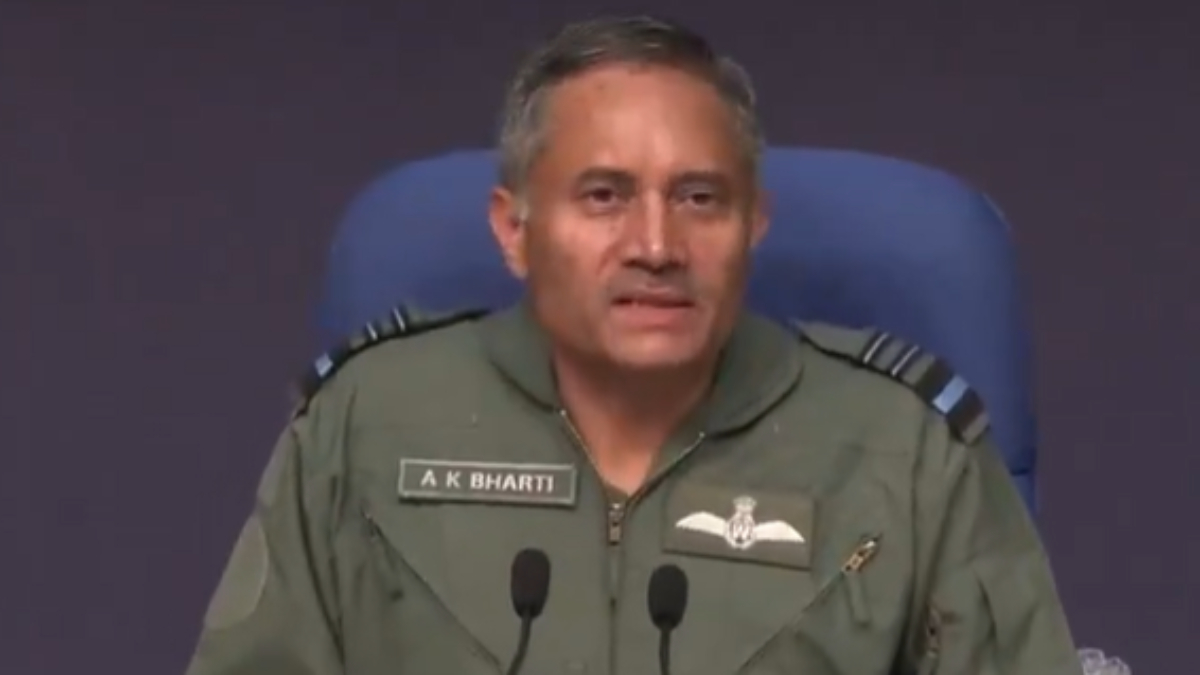


Director General Air Operations Air Marshal AK Bharti on Monday shared a detailed information of success of “Operation Sindoor” on May 7 n which nine terror sites deep inside Pakistan were destroyed in retaliation for the Pahalgam terror attack in which 26 innocents were killed.
Air Marshal AK Bharti said, “All our military bases, all our systems continue to remain fully operational and ready to undertake any future missions should the need so arise.”
#WATCH | Delhi: Air Marshal AK Bharti says, "All our military bases, all our systems continue to remain fully operational and ready to undertake any future missions should the need so arise." pic.twitter.com/HWQwP5ol6Q
---Advertisement---— ANI (@ANI) May 12, 2025
‘Indian Armed Forces’ fight was solely against terrorists’
The operation, a response to the April 22, Pahalgam, terror attack, was executed with precision to minimize damage to civilian and military infrastructure despite intervention by the Pakistani military.
Addressing a press briefing, Air Marshal Bharti emphasised that the Indian Armed Forces’ fight was solely against terrorists and their support networks, not the Pakistani military. The Armed forces also displayed a video that showed the destruction to Pakistani ordinance in the strikes.
He noted that the Pakistan military chose to intervene, and thus any loss from their side was their sole responsibility.
“We had a detailed brief on the successful joint operations to destroy the terror operation in Pakistan-occupied Kashmir and Pakistan itself… We reiterated that our fight was with terrorists and their support infrastructure and not with the Pakistani military. However, it is a pity that the Pakistani military chose to intervene and back the terrorists, which compelled us to respond, and whatever loss they suffered, it was their own responsibility,” he stated.
A Stern Warning Delivered❗️
— PIB India (@PIB_India) May 12, 2025
A Line Redrawn❗️
The Director General Military Operations of all three services; Indian Army, Navy, and Air Force come together to brief the nation on #OperationSindoor
Watch the bold, clear message from our military leadership!📽️@MIB_India… pic.twitter.com/FRcUdXUJ2c
‘IAF’S IACCS was instrumental in coordinating defence network’
The Air Marshal highlighted the effectiveness of India’s layered and intricate air defence (AD) system, which played a pivotal role in thwarting multiple waves of Pakistani drones and unmanned aerial vehicles (UAVs). The robust AD environment, comprising assets from the Indian Army, Navy, and Air Force, included multilayered sensors and weapon systems, indigenously developed soft and hard-kill counter-UAV systems, and highly trained personnel. The Integrated Air Command and Control System (IACCS) of the Indian Air Force (IAF) was instrumental in coordinating this defence network.
Drones and UAVS deployed by Pak were thwarted
“This brings me to the point of how the Indian Forces brought minimum damage to both civilian and military infrastructures in spite of Pakistan’s unrelenting forces… The majority populace has a lot to say about the layered and intricate air defence system put in place by the Indian Armed Forces, which includes assets of the Indian Army, Navy and Air Force… This robust AD system comprises a large variety of multilayer AD sensors and weapon systems… Numerous waves of drones and UAVS deployed by Pakistan were also thwarted by the indigenously developed soft and hard kill counter-UAV systems and the well-trained Indian personnel,” Air Marshal Bharti noted.