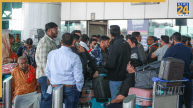




As IndiGo continues to cancel flights across the country, many frustrated passengers are asking a simple question: If Indian Railways can reliably serve millions every day, why doesn’t India have a strong government airline too?
The answer lies in the rise and fall of India’s early national carriers and how the aviation sector took a very different path from the railways.
Indian Airlines: The country’s first government carrier
India’s first fully government-run domestic airline, Indian Airlines, was created in 1953 after the nationalisation of Tata Airlines and several small private carriers. Its mission was to connect the nation by air, especially remote and far-flung regions.
In the early years, the airline operated aircraft like the Douglas DC-3, Vickers Viscount, Caravelle, and later the Fokker F-27. Through the 1960s and 70s, it expanded its fleet with Boeing 737, Airbus A300 and eventually the widely used Airbus A320.
Indian Airlines built a strong domestic network from hubs in Delhi, Mumbai, Kolkata and Chennai. It also flew to nearby countries such as Sri Lanka, Nepal, Bangladesh, Maldives and Pakistan.
However, the landscape changed in the 1990s. Private airlines like Jet Airways, Sahara and East-West entered the market and Indian Airlines began losing ground. With ageing planes, mounting losses, labour disputes and political interference, the airline struggled to survive.
In 2007, the government merged Indian Airlines with Air India and by 2011, the Indian Airlines name vanished completely.
Air India’s journey and the role of Alliance Air
India’s aviation story actually began much earlier, in 1932, when JRD Tata flew the country’s first commercial flight from Karachi to Mumbai. Tata Airlines later became Air India in 1946, was partly nationalised in 1948 and fully nationalised in 1953 to serve as India’s international flag carrier.
Air India introduced modern aircraft like the Boeing 707 and 747, and its mascot, the ‘Maharaja’, became iconic around the world. But from the 1990s onwards, rising competition from private airlines like Jet, Kingfisher and IndiGo pushed Air India deep into debt. By 2021, the airline owed more than Rs 60,000 crore.
In January 2022, Air India returned to the Tata Group, 90 years after it was founded.
Alliance Air: The only government airline still flying
Today, the only government-run airline left in India is Alliance Air. Established in 1996, it was designed to connect smaller cities and regions where bigger airlines didn’t operate. With a fleet of 21 aircraft, it serves 59 domestic routes and one international route, Chennai to Jaffna. It is also a key operator of the government’s UDAN regional connectivity scheme.
Alliance Air is not profitable, but it continues to fly because it fulfills an essential public service role. It remains 100% owned by the Government of India.