

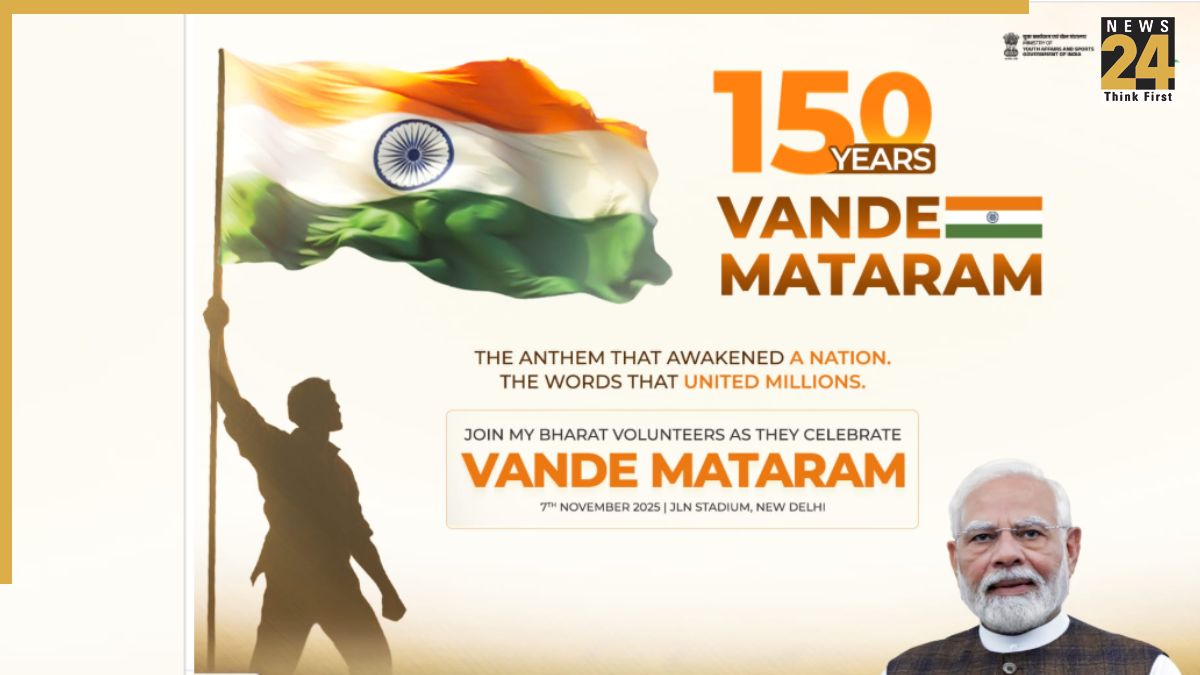


vande mataram 150 years: It was on this day, 150 years ago, that India’s national song Vande Mataram was first published in the literary journal Bangadarshan. Literally meaning “Mother, I bow to thee,” the song was composed by Bankim Chandra Chatterjee and published in 1875. Chatterjee incorporated the hymn in his immortal novel ‘Anandamath,’ in 1882. It was the renowned poet Rabindranath Tagore who gave music to India’s heartbeat.’ He also sang the song at the 1896 Congress Session in Calcutta. When did India start to use this as the country’s national song? The Swadeshi movement to the British’s imposition of a Rs 5 fine for chanting the song – Must know facts about the National song.
Vande Mataram, as a political slogan, was first used on 7 August 1905, but it wasn’t until 1950 that it was adopted as India’s national song.
vande mataram 150 years: 7 Key Facts about Vande Mataram
- In August 1906, an English newspaper called Bande Mataram was started by Bipin Chandra Pal, and later Sri Aurobindo joined as the joint editor. The paper’s strong and inspiring editorials played a big role in awakening the people of India. It spread the message of self-reliance, unity, and political awareness across the country
- As Vande Mataram gained influence, both as a song and a slogan, the British administration adopted stringent measures to curb its spread
- In November 1905, the British held 200 students of a school in Rangpur, guilty of chanting Vande Mataram. A fine of ₹5 was imposed on each
- In 1907, when Bhikaji Cama raised the tricolour flag for the first time outside India in Stuttgart, Berlin, the words Vande Mataram were written on it
- In 1908, in Belgaum, Karnataka, when Lokmanya Tilak was being sent to Mandalay in Burma, the police beat up several boys and arrested many people for shouting Vande Mataram, which had been banned by a verbal order
- On 24 January 1950, while Dr Rajendra Prasad was addressing the Constituent Assembly, he stated that Vande Mataram should have the same status as the National Anthem, Jana Gana Mana. He also said in the assembly that Vande Mataram should be honoured equally due to its significant role in India’s freedom movement
- His proposal was accepted, with Rabindranath Tagore’s Jana Gana Mana adopted as the national anthem of independent India, and Bankim Chandra Chatterjee’s Vande Mataram declared the national song, holding equal status with Jana Gana Mana