

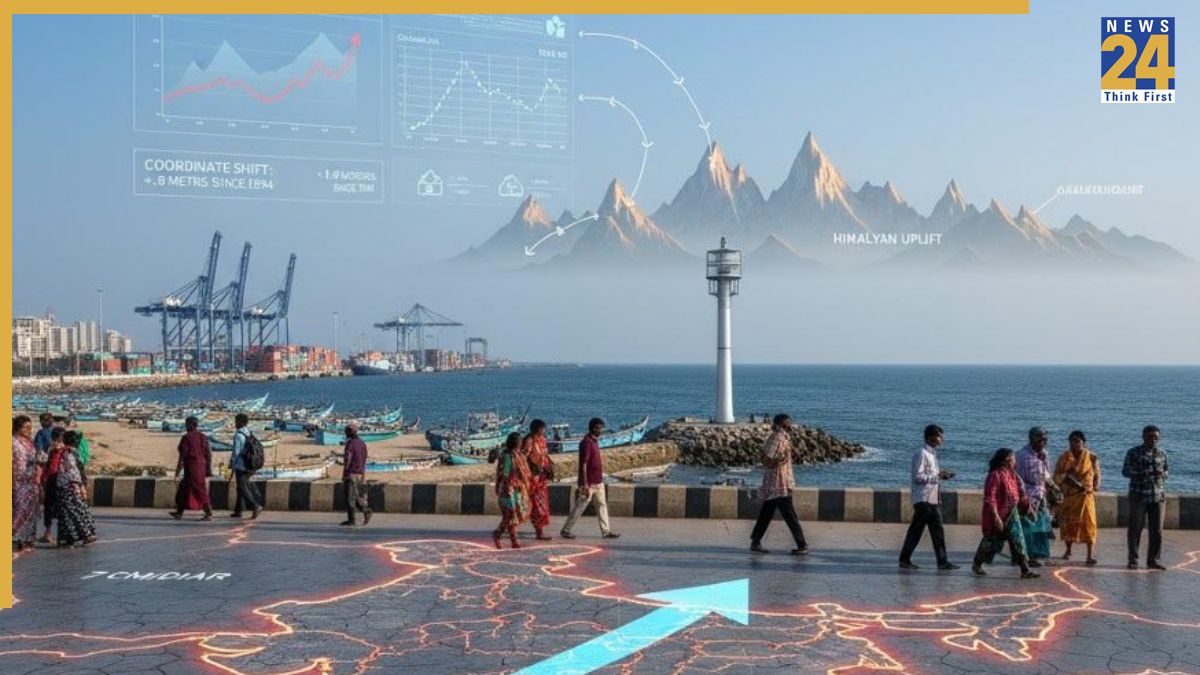


Australia is moving north by roughly 6.9 to 7.2 centimetres every single year—a shift so powerful it is rewriting GPS coordinates and reshaping seismic risks.
If someone told you that an entire continent is quietly sliding northward every year, you might dismiss it as internet exaggeration. Yet one of the most scientifically verified facts about our planet is this: Australia is moving north by roughly 6.9 to 7.2 centimetres every single year.
This is not a metaphor. It is measurable, predictable, and powerful enough that the country had to officially correct its geographic coordinates in 2017 because GPS instruments were slowly becoming wrong.
Continental drift often feels like a chapter from an old school textbook, but the truth is simple: Earth’s crust is alive, breathing and shifting beneath our feet even as we go to work, send children to school or stand on a beach staring at the ocean.
For India, this movement is not a distant curiosity. It is a warning signal. A slow-moving but relentless force shaping the Indian Ocean, influencing earthquakes, tsunamis, coastal planning, offshore energy, and the long-term safety of more than 250 million Indians living near the coast.
This is the story of a continent that is drifting, an ocean that is evolving, and a region that must prepare.
Continents are not still: the real science behind the drift.
Australia sits on the Indo-Australian Plate, one of the fastest moving plates on Earth. According to Geoscience Australia and the Journal of Geophysical Research, the continent moves:
• 6.9 to 7.2 cm a year northward
• Approximately 1.8 meters every 25 years
It is so precise and so steady that in 2017, Australia shifted its national coordinate system by
1.8 meters to realign with where GPS satellites assumed the continent should be. Without this correction, automated port cranes, self-driving tractors, and defence navigation systems
would have been off by nearly two meters.
This drift is not new. Geological studies show that for nearly 45 million years, the Australian side of the Indo-Australian Plate has been pushing north, diving under Southeast Asia and feeding some of the most powerful geological forces on the planet.
The eastern portion of the plate (beneath Australia) moves slightly faster than the western portion (beneath India), creating internal strain that scientists believe contributed to major earthquakes in the Indian Ocean.
Where is Australia heading? Toward Asia, but not in human timelines
The dramatic headlines about “Australia crashing into Asia” exaggerate the timescale but not the direction.
Yes, Australia is converging toward Southeast Asia.
No, it is not happening in years or centuries. The realistic timeline is millions of years.
Think of it as two glaciers approaching each other: slow, steady, unstoppable. A future supercontinent is possible, but none of us will witness it.
The real impact for India is not a future continental collision. It is what this drift is doing right now, deep under the Indian Ocean.
The Indian Ocean is the real zone of action.
Most Indians remember 26 December 2004 as a day carved into national memory. A
magnitude 9.1 to 9.3 earthquake ruptured near Sumatra along the Sunda Trench, unleashing a
tsunami that killed about 2.3 lakh people across 14 countries. India lost over 16,000 lives across Tamil Nadu, Andhra Pradesh, Kerala, Puducherry, and the Andaman and Nicobar Islands.
What caused this catastrophe?
The same force that pushes Australia northward.
The Indian-Australian Plate dives under the Eurasian-Burma Plate near Sumatra at 4 to 5 cm a year. This is a classic megathrust subduction zone. The strain accumulates silently over decades and, when released, triggers giant earthquakes and tsunamis. Scientists have mapped this zone thoroughly:
• One of the world’s most active subduction systems
• Capable of quakes above magnitude 8
• Stress building again after 2004
• Long-term risk for all Indian coastal states
The movement of Australia is not an isolated event. It is part of a system that India lives with every day.
Why India must pay attention: the real implications.
1. Tsunami and earthquake exposure: this is not hypothetical
More than 250 million Indians live in coastal districts.
Over 1,300 kilometres of coastline are classified as high-risk for tsunamis by INCOIS.
If the 2004 tsunami struck today, economic damage would exceed 2.5 lakh crore rupees, according to UNDRR estimates.
India must integrate tectonic science into:
• Coastal construction rules
• City planning
• Port, refinery, and LNG infrastructure design
• Undersea internet cable protection
• Offshore wind and deep-sea mining frameworks
• Ocean-based tourism safety norms
Most Indian states still have outdated coastal hazard maps. Many have zero tsunami evacuation routes.
Australia’s drift is not entertainment. It is a reminder that the Indian Ocean is restless.
2. Technology and navigation quietly depend on tectonics
Australia’s 1.8-meter coordinate shift shows how tectonic movement can break:
• Autonomous vehicles
• Drone delivery networks
• Smart agriculture
• Precision shipping
• Robotics in ports
• National mapping systems
As India expands NavIC and builds smart cities, it will need periodic recalibration of mapping systems.
A drifting planet means mapping errors grow faster than we expect.
Ignoring this can make drones, farm machinery, or automated logistics systems accumulate metre-scale positional mistakes.
3. The Himalayas are the opposite face of the same plate
The Indo-Australian Plate not only dives under Indonesia, it also slams into Eurasia from the south, pushing up the Himalayas. The same deep force responsible for Australia moving north also drives:
• Himalayan uplift
• Frequent quakes in Uttarakhand, Himachal, and Nepal
• Strain accumulation near Delhi NCR
• Long-term seismic hazard across north India
India cannot treat coastal seismic risk and Himalayan seismic risk separately. They are two faces of one tectonic engine.
How invisible motion affects real lives.
Continental drift feels distant, but its impact is painfully human.
In 2004, thousands of children lost parents in minutes. Over 4,000 fishing boats were destroyed in Tamil Nadu alone. Entire hamlets in Nagapattinam were erased.
The science behind Australia’s northward drift is not just geology. It is about:
• Whether a fisherman in Odisha receives a timely SMS alert
• Whether a pregnant woman in a coastal hospital has a clear evacuation route
• Whether a school in Andaman has a practiced tsunami drill
• Whether early-warning sirens actually work when needed
The Earth moves slowly. But disasters strike suddenly. Human preparedness must be faster than geology.
The ground is moving, so must our imagination.
Australia drifting north at 7 cm a year will not cause a continental crash in our lifetime. But it is already reshaping the Indian Ocean.
It is already influencing seismic risk.
It is already changing how nations must design infrastructure, cities, and safety systems.
The real question is not whether continents move. They always have.
The real question is whether India can move fast enough in policy, science, and preparedness to match a living planet.
Earth never stops shifting under our feet. It is time our planning shifts with it.