

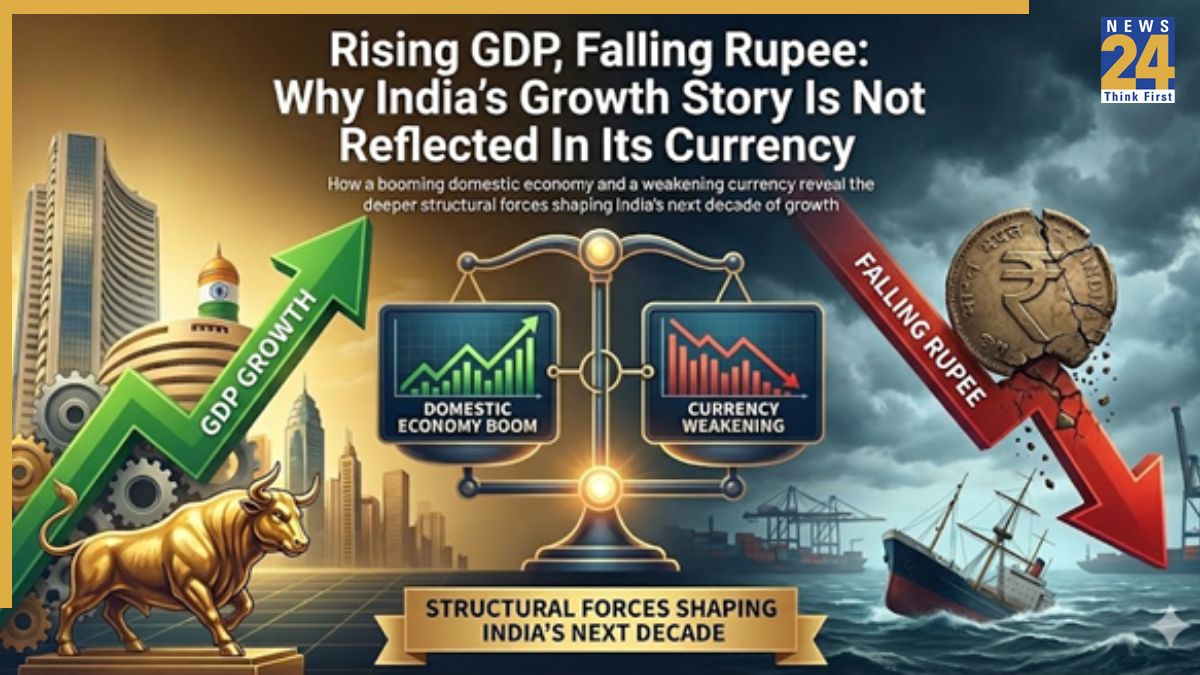


India’s macroeconomic dashboard flashes two contrasting lights at the same moment. The green signal: real GDP growth soared to 8.2 percent in Q2 FY26, the fastest in six quarters and far above expectations. The red signal: the rupee slipped past 90 per US dollar in December 2025, losing almost 8 to 9 percent of its value since July.
For many citizens, this contradiction feels personal. People hear that the economy is booming, yet imported medicines and electronics are getting costlier. Investors see upbeat growth forecasts but a currency that behaves like a stressed emerging market. And policymakers face a world where domestic strength is overshadowed by external fragility.
The truth is that there is no contradiction. India’s rising GDP and falling rupee are two sides of the same structural transition. To understand this, we must unpack the forces reshaping India’s external sector, capital flows, monetary strategy and long-term growth model.
1. The GDP-Rupee Disconnect Is Real, and It Is Structural
Economic textbooks suggest strong growth should attract foreign investment and strengthen the currency. India is proving that this relationship no longer works in a world dominated by global interest rate cycles, geopolitics and capital mobility.
GDP expanded 8.2 percent in Q2 FY26 and 7.8 percent in the previous quarter, making India the fastest growing major economy. Yet the rupee breached 90. This is not an Indian anomaly. It is a reflection of a global system where exchange rates respond less to growth and more to external balances, interest rate differentials and risk sentiment.
Nominal GDP growth of 8.7 percent in the September quarter also fell below the government’s expected 10.1 percent, partly due to currency depreciation raising input costs and pressuring margins. The rupee’s decline has become a silent tax on nominal growth.
This is the heart of India’s paradox. The economy is strong at home, but the currency mirrors India’s external vulnerabilities.
2. External Sector Pressures Are Driving the Currency Slide
A currency prices a country’s external position, not its domestic performance. And India’s external sector is under stress despite high GDP growth.
The merchandise trade deficit remains large at 87.4 billion dollars in Q2 FY26. The current account deficit has narrowed to 1.3 percent of GDP, but this improvement is due to services exports and remittances, not a structural rebalancing of merchandise trade.
Capital flows are amplifying the pressure. Foreign portfolio flows reversed sharply. After receiving 20.8 billion dollars of inflows in early FY25, India faced net outflows of over 4 billion dollars in H1 FY26. Tighter US monetary policy and a globally strong dollar created a risk-off environment.
The rupee became Asia’s worst performing currency of 2025. This is not because India’s fundamentals are collapsing. It is because global investors use the rupee as a hedge against emerging market volatility, and because India relies heavily on imported energy whose prices are denominated in dollars.
Gold imports spiked during the festive season, partly as a hedge against further depreciation. Ironically, demand for gold increases when the rupee weakens, which then widens the trade deficit and weakens the rupee further. It is a feedback loop India knows too well.
3. India Is Caught in the Monetary Policy Trilemma
India cannot simultaneously have all three:
- Free capital mobility
- A stable exchange rate
- Independent monetary policy
It must choose two. India prioritises monetary autonomy and open capital markets, so the exchange rate becomes the shock absorber.
The US Federal Reserve continues to hold higher real interest rates. This strengthens the dollar globally and widens the interest differential. The RBI cannot match US rates or risk choking domestic investment. So it allows the rupee to adjust gradually.
The RBI reportedly intervened using over 10 billion dollars in Q2 FY26, but only to smooth volatility, not defend a line in the sand. Reserves fell by 6.4 billion dollars in the first half of the fiscal year. This is a strategic signal: India prefers stability, not rigidity.
A flexible rupee is not a failure; it is a policy choice.
4. Winners and Losers in a Weak Rupee Economy
Depreciation reshapes the economy in uneven ways.
Winners:
- IT and business services exporters: Their dollar revenues inflate in rupee terms, contributing to a services surplus above 50 billion dollars.
- Pharma exporters: Cost structures are rupee-heavy, revenues dollar-heavy.
- Families receiving remittances: More rupees per dollar soften real income pressures in many states.
- Manufacturing sectors competing with imports: A weaker currency improves competitiveness.
Losers:
- Oil refiners, airlines, chemicals: Higher dollar prices raise costs and reduce margins.
- Consumers: Import-intensive goods and medical equipment become costlier.
- Firms with foreign currency loans: Unhedged exposures worsen balance sheets.
- Government finances: Higher fertiliser and energy import bills stress the fiscal deficit.
Yet inflation is surprisingly mild due to soft global commodity prices, GST redesign, and productivity improvements. This has prevented a weaker rupee from turning into a cost-of-living crisis.
5. India’s Growth Model Is Quietly Changing
Behind the GDP numbers is a subtle but profound realignment.
Growth is shifting from consumption-led to investment-driven. Gross fixed capital formation has held strong for several quarters. Manufacturing output is resilient despite currency headwinds. Public capital expenditure continues to drive infrastructure build-out.
The real-nominal growth pattern also reveals something unusual. Real GDP grew 8.2 percent, while nominal growth was only 8.7 percent. Normally, currency depreciation and imported inflation widen this gap. Instead, it narrowed, suggesting productivity gains and sectoral efficiencies are offsetting inflationary impulses.
This marks India’s movement toward a more mature, supply-driven growth cycle rather than pure consumption momentum.
6. The RBI Is Letting the Rupee Find a New Equilibrium
Gone are the days when India defended arbitrary exchange rate levels. After learning hard lessons from past crises, the RBI now:
- Intervenes only to prevent disorderly markets
- Maintains forward cover to avoid sudden reserve depletion
- Prioritises inflation stability over currency optics
- Views the rupee as a macro stabiliser
Forex reserves remain robust, but the RBI is signalling that exchange rate flexibility is part of India’s economic maturity, not a sign of fragility.
A market-determined rupee is healthier for exporters, budget planning and investment decisions. It also creates discipline by forcing India to strengthen its export base and reduce import intensity.
7. What the Rupee Is Really Saying About India’s Economy
A falling rupee is not an indictment of India’s growth story. It is a message from markets:
- India’s domestic growth is strong, but its external sector is its weakest muscle.
- Energy dependence remains a chronic vulnerability.
- Capital flows are volatile in a world where the dollar is king.
- India’s economic transition is outpacing its export transformation.
GDP is rising because domestic demand, infrastructure investment and services exports are booming. The rupee is falling because imports are heavy, global interest rates high and portfolio flows fickle.
Both can happen together, and both are logical outcomes of India’s development stage.
8. Policy Priorities for a High Growth, Soft Currency India
India’s task is not to chase a “strong” rupee, but a “credible” rupee aligned with fundamentals.
Short term priorities:
- Maintain inflation control while allowing currency flexibility
- Support exporters through logistics and trade facilitation
- Manage gold imports through calibrated tariffs
- Ensure adequate reserves without over-intervention
Structural imperatives:
- Reduce import intensity in electronics, energy and capital goods
- Strengthen manufacturing export capabilities
- Deepen domestic bond markets to reduce portfolio dependence
- Diversify energy sources and invest in storage, renewables and efficiency
- Expand trade partnerships to reduce geopolitical vulnerability
India does not need a 70 rupee dollar to thrive. It needs export strength, capital depth and energy security.
The Paradox Is Not a Bug, It Is the New Design
India’s rapid GDP growth with a falling rupee is not a crisis. It is a transition. A maturing emerging economy integrated into global markets will show this pattern precisely.
GDP captures India’s internal confidence.
The rupee reflects its external exposure.
One tells the story of India rising.
The other reminds us of the work still to be done.
India is approaching the 4 trillion dollar threshold with a flexible currency, rising investment, strong services exports and improving productivity. The rupee may be softer, but the economy beneath it is becoming more resilient, diversified and globally aligned.
If policymakers remain focused on structural reforms and external resilience, the currency will not define India’s trajectory. The fundamentals will.
“The rupee may waver in the storm, but the direction of India’s rise is unmistakable and irreversible.”