

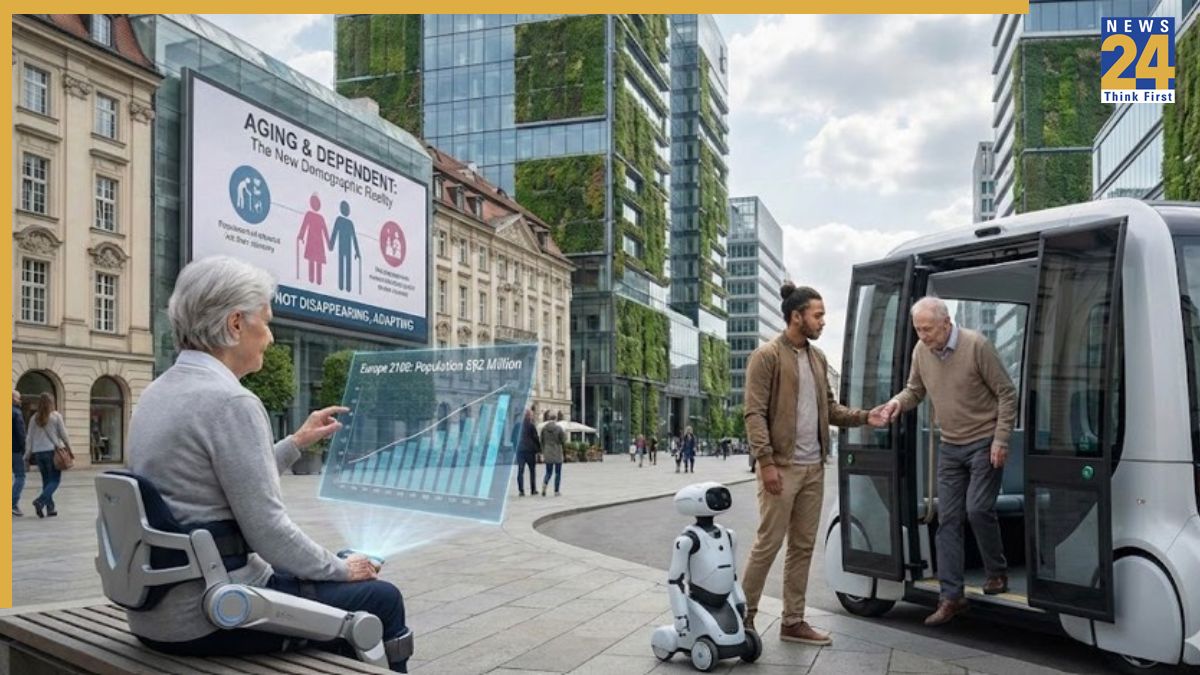


A powerful demographic reality check for a world that keeps misreading Europe
Scroll through social media and you will find dramatic claims that Europe will “empty out” by the end of the century. Some say it will become a quiet museum; others predict a demographic collapse on the scale of extinction. The truth, backed by data, is serious yet far less sensational. Europe is not vanishing. It is undergoing a slow but profound demographic squeeze that will redefine its economy, power, and identity.
This is the kind of slow-moving shift that analysts treat as a structural reality, not a temporary trend.
What do the facts actually show?
Europe today has roughly 744 million people, around 9 percent of the global population. The newest UN World Population Prospects 2024 medium variant shows a clear trend: Europe’s population is expected to decline from about 744 million in 2025 to roughly 592 million in 2100. That is a fall of about 150 million people, close to a 20 percent decline over 75 years.
This is not a collapse. It is a gradual contraction.
Inside the European Union, the picture is slightly milder but follows the same direction. The EU has about 449 to 450 million people as of 2024. Eurostat projects that the EU population will peak around 453 million by the mid-2020s before slipping to nearly 420 million by 2100. This is a decline of around 6 percent.
What is striking is how dependent this stability is on immigration. Eurostat’s no-migration scenario shows that the EU would fall to about 295 million by 2100, shrinking by more than one third.
Migration is acting like a demographic safety valve.
Europe’s core challenge is ageing and ultra-low fertility.
Europe’s fertility rate has been below replacement since the 1970s. New data shows the trend worsening. In 2023, the EU fertility rate fell to 1.38 births per woman, down from 1.46 in 2022. Only 3.67 million babies were born in 2023, the lowest number ever recorded in the Eurostat series that began in 1961.
Europe as a whole has a fertility rate near 1.4, which is almost half of Africa’s average and far below the global average of about 2.4.
Meanwhile, life expectancy keeps rising. As of January 2024, the median age in the EU was 44.7 years. Italy is near 49 years, one of the oldest countries on Earth, while Ireland remains the youngest at 39.4.
The share of people aged 65 and above stands at about 21 percent today and is projected to rise to nearly 32 percent by 2100. The share of those above 80 is expected to jump from around 6 percent to roughly 15 percent.
The old-age dependency ratio, which measures how many workers support each retiree, will almost double by 2100. In several Southern and Eastern European countries, there will likely be fewer than two working-age adults for every person above 65.
The real “collapse” is the collapse of the age pyramid.
Deaths exceed births everywhere, except on immigration charts.
Since 2012, the EU has seen more deaths than births every single year. Natural population growth is negative and the only thing keeping populations stable is migration.
In 2024, the EU recorded 3.56 million births and 4.82 million deaths. That is a natural decline of nearly 1.3 million. Yet net migration of about 2.3 million pushed the EU population slightly upward to 450.4 million.
This is why immigration is no longer just a political issue. It is a demographic necessity.
Eurostat projections show:
• With typical migration, the EU shrinks gently by around 6 percent by 2100
• With very low or zero migration, the shrinkage accelerates to between 17 and 33 percent
Europe has quietly become dependent on migrants simply to slow demographic decline.
A divided continent: the shrinking south and east, the stabilising northwest
Europe is not one demographic story. It is a patchwork of divergent futures.
UN and Eurostat projections show that Bulgaria, Romania, Serbia, Croatia, Greece, Italy, Spain, and Baltic countries will see the steepest declines by 2100. Many of these countries could lose between 20 percent and 35 percent of their population depending on migration trends.
Rural Europe is emptying out fastest. Between 2014 and 2024, rural EU regions lost about 8 million people, while cities gained more than 10 million. This imbalance is already reshaping local economies, housing markets, and political dynamics.
Some countries like France, the United Kingdom, Sweden, and a few microstates are on track to maintain or even slightly expand their populations by 2100. The reason is simple: sustained immigration and better labour market integration.
Governments across Europe are experimenting with ways to reverse the slide: one-euro houses in Italy, baby bonuses in Hungary, tax incentives for families in France, and digital nomad visas in Portugal and Croatia. The impact so far has been marginal.
Economic and geopolitical consequences of a shrinking Europe
Demography is destiny, especially for economies and geopolitical influence.
- Lower potential growth: As the working-age population shrinks, Europe’s potential GDP growth naturally slows. Without a large influx of working-age migrants or major productivity gains, many economies will face a stagnation trap.
- Pressure on welfare states: Ageing will stretch pension systems and healthcare budgets to the limit. Countries will have to rethink retirement ages, social contributions, and medical infrastructure.
- Falling global weight: Europe already accounts for about 9 % of the world’s population, the EU alone for around 6 %. According to current projections, the EU’s share is likely to fall to around 4 % by 2100. Even if per-capita wealth remains high, this means its overall share of global economic weight and influence is likely to shrink.
- Competition for young talent: North America, the Gulf, and Asia will compete aggressively for skilled workers from Africa and South Asia. Europe’s ability to attract and integrate this talent will determine whether it can stabilise economically.
- Security and rural resilience: Depopulating border regions in Eastern and Southern Europe, especially near Russia and the Balkans, raise red flags for food security, military readiness, and regional stability.
Can Europe change its demographic destiny?
The projections are not fixed outcomes. They are scenario-based. Europe can still change course.
A combination of factors could shift the trajectory:
• Moderately higher fertility supported by strong childcare systems, affordable housing, and gender-equal workplaces
• Predictable, skill-focused migration policy
• High investment in AI, robotics, and productivity to compensate for fewer workers
• Revitalisation of smaller towns through digital infrastructure and new industries
These solutions are long-term, not overnight fixes. But the earlier they begin, the more they change.
The clear analytical conclusion
So, is the viral claim that “Europe could collapse by 2100” accurate?
Yes, Europe will shrink significantly.
Yes, its age structure will become sharply inverted.
Yes, its share of the world economy and population will fall.
But no, Europe is not disappearing. Even in 2100, it will still have close to 600 million people and remain one of the wealthiest regions on Earth.
The real story is not extinction; it is adjustment.
Europe is becoming older, smaller, and more dependent. To remain dynamic in a younger world, it must choose between higher migration, higher productivity, and higher reform. The next 75 years will test which path it is willing to commit to.