

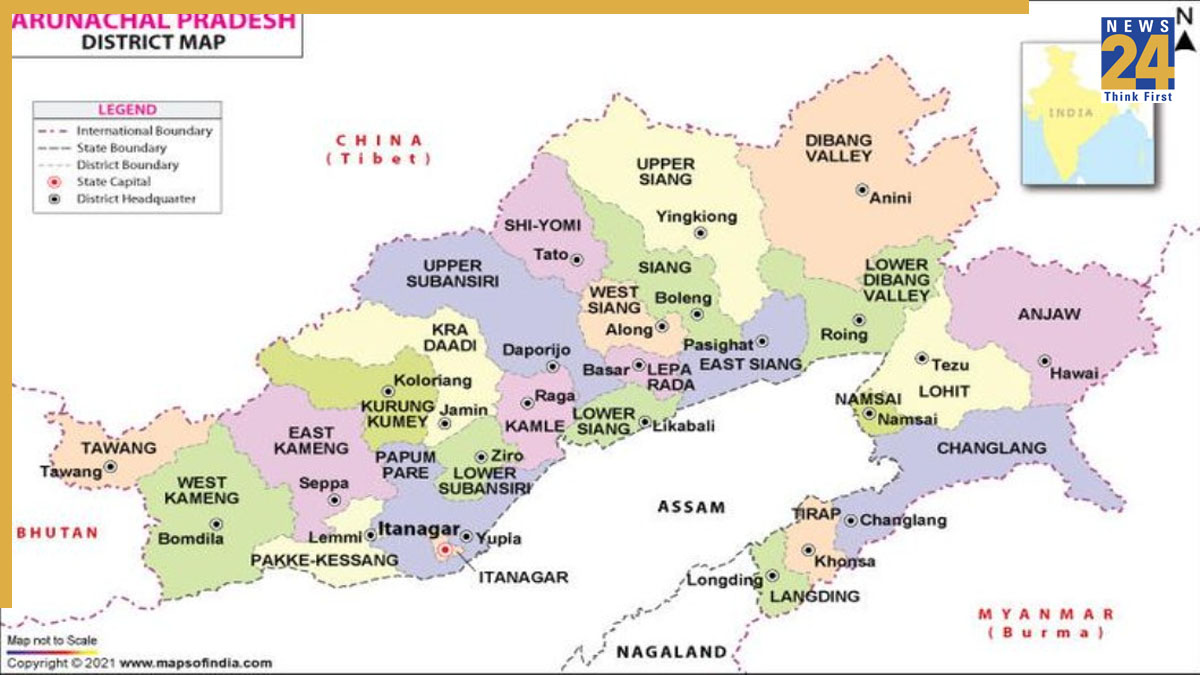


India and China are now arguing again after months of calm because a woman from Arunachal Pradesh says she was harassed by Chinese authorities.
China says Arunachal Pradesh belongs to them and calls it “southern Tibet” or Zangnan.
Here is what happened, why Arunachal Pradesh is disputed, and why the new tension matters.
What exactly took place?
Prema Wangjom Thongdok was flying from the UK to Japan on her Indian passport. She had a three-hour stop at Shanghai Pudong International Airport in China.
Thongdok says the airport staff detained and harassed her for 18 hours because her passport shows she was born in Arunachal Pradesh.
She said Chinese officials told her that her Indian passport was “invalid” because they claim Arunachal Pradesh is part of China.
She had already passed the immigration e-gate by scanning her passport and was heading to the security check, she told India Today during a video call from Bangkok.
She said one officer started shouting “India! India!” with her name and pulled her aside.
When she asked why she was stopped, the officer said her Indian passport was not valid since she was born in Arunachal Pradesh, adding, “Arunachal is part of China. Your passport is invalid.”
Thongdok replied, “Arunachal is part of India. I’ve never heard it being part of China.”
She said she was kept at the airport without being told how long she would be held.
Reports said she was pressured to buy a new China Eastern ticket, and she felt her passport would be returned only if she agreed. Because of this, she lost money on missed flights and hotel bookings.
A friend in the UK helped her reach the Indian consulate in Shanghai, after which Indian officials escorted her onto a late-night flight so she could leave safely.
The Indian Express reported that she had travelled through Shanghai Pudong Airport in October without any problems. No one knows why things changed this time.
Has this kind of incident happened earlier?
Since 2005, China has been giving stapled visas (a visa attached with a staple instead of being stamped) to people from Arunachal Pradesh, while other Indians get regular stamped visas.
China says it cannot give regular visas to people from Arunachal Pradesh because it claims they are Chinese citizens.
But India has never accepted stapled visas, saying it would mean agreeing that people from Arunachal Pradesh are not Indian.
In 2013, two archers from Arunachal Pradesh were given stapled visas to visit Wuxi, China for a championship. India stopped them from travelling.
In July 2023, three martial arts athletes from Arunachal Pradesh got stapled visas for the World University Games in Chengdu, so the entire Indian wushu team skipped the event.
In September 2023, the same athletes could not join the Hangzhou Asian Games because they could not download their accreditation cards, the entry passes that act as visas.
India’s Sports Minister Anurag Thakur cancelled his trip to Hangzhou to protest.
What is the dispute over Arunachal Pradesh really about?
The India-China dispute over Arunachal Pradesh goes back to the British era.
In March 1914, the McMahon Line was drawn during the Simla Convention between Tibet, China, and the British. It was named after Henry McMahon.
China’s delegates attended but did not sign and did not accept the McMahon Line.
McMahon still finalised the border with Tibet, but China argues Tibet had no right to decide India’s border, especially after China took control of Tibet in 1951.
Since 1947, India has accepted the McMahon Line as its border with China.
China says India and China should redraw the border together, instead of relying on the British-era line.
For decades, China claimed only Tawang, but recently it has started claiming the whole state.
Tensions increased after Xi Jinping came to power in 2012, as China became more aggressive.
In 2018, Xi said China would “not give up even an inch” of land it believes is its own.
In India, Prime Minister Narendra Modi (in power since 2014) also took a stronger stand, once saying he would show “red eyes” — meaning strength and firmness.
Why does Arunachal Pradesh matter?
Arunachal Pradesh is the largest northeastern state and is strategically important because it connects India to Southeast Asia (Myanmar, Thailand, Vietnam, Malaysia) and is also a military district.
It borders Myanmar in the southeast and is close to Bhutan in the west. From Myanmar, India can connect to Thailand, Laos, and other Southeast Asian nations through the India-Myanmar-Thailand Highway.
China says Arunachal is part of Tibet, a long-standing sensitive issue. In 1959, India sheltered the 14th Dalai Lama (Tenzin Gyatso) when he fled Lhasa, which China still sees as a provocation.
In September 2024, India named an unnamed peak in Arunachal after the sixth Dalai Lama.
China’s main interest is Tawang, a district in northwestern Arunachal bordering Bhutan and Tibet.
Tawang gives a strategic entry point into India’s northeast and lies on a key route between Tibet and the Brahmaputra Valley.
It hosts the Tawang Ganden Namgyal Lhatse, the second-largest Tibetan Buddhist monastery in the world, founded in 1680–81 by Merag Lodroe Gyamtso under the wishes of the fifth Dalai Lama.
China says this monastery shows Tawang once belonged to Tibet, pointing to its ties with the Lhasa Monastery.
Tawang is a major Tibetan Buddhist centre, and tribes like the Monpa, who follow Tibetan Buddhism, live in both Arunachal and Tibet.
Experts say China fears these groups could support a pro-democracy Tibetan movement someday.
The Bhutan Factor
If China controlled Arunachal Pradesh, Bhutan would have China as its neighbour on both sides.
China has already built big motorable roads near Bhutan’s western side and wants to extend them from Doka La to Gamochin, an area guarded by the Indian Army.
China moving closer to the Siliguri Corridor — India’s narrow link to the Northeast — is seen as a major security threat to India and Bhutan.
China is also expanding railway lines in the region, giving its military more advantage.
Arunachal’s key strategic position
Arunachal Pradesh is India’s closest point to target China with missiles and the best place to install a multi-layer air defence system.
If China controlled it, it would gain a huge strategic edge.
Water power
China controls much of the water flow into India’s northeast. Its dams can be used as a geo-strategic weapon to cause floods or droughts.
The Tsangpo River starts in Tibet, becomes the Siang in Arunachal, and then the Brahmaputra.
According to the Times of India, in 2000, a dam breach in Tibet caused floods in northeast India, killing 30 people and leaving over 100 missing.