


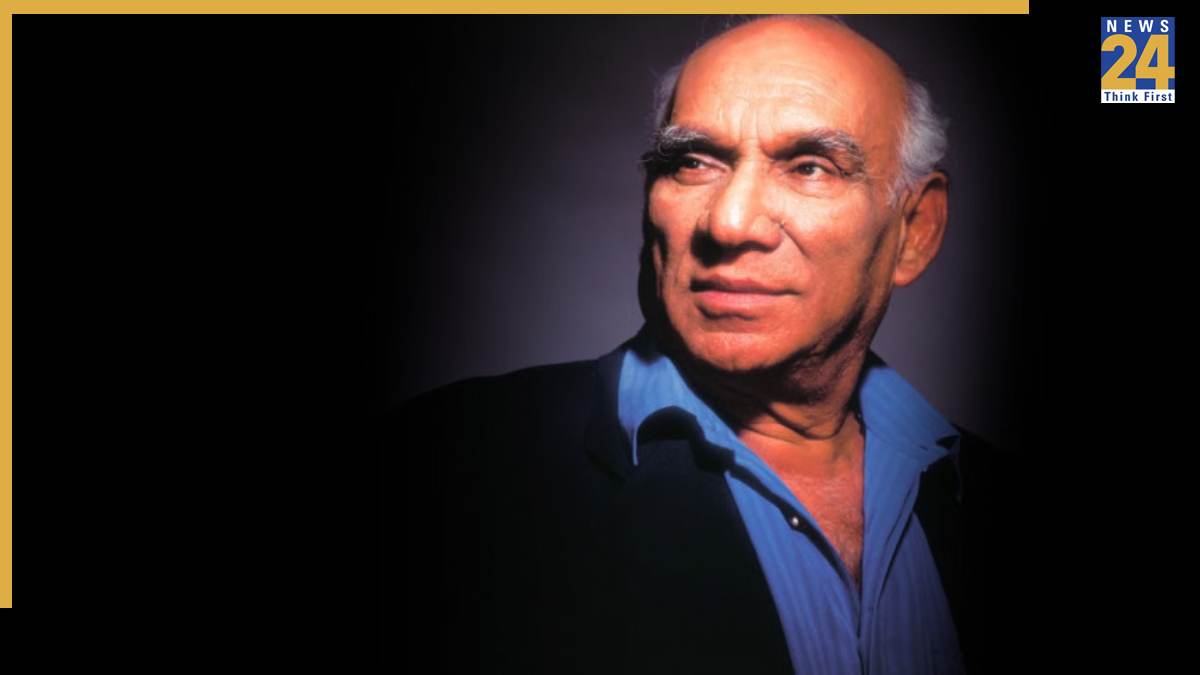


All these years we have regarded Raj Kapoor as the true showman of the Hindi cinema. And rightly so. But look at Yash Chopra! My God! This man is a phenomenon beyond all phenomena. Let me cite one example: Yash Chopra is the only filmmaker in India, and any part of the world, to have made successful films in every decade since Partition.
If we compound Yashji’s contributions as a mainstream moviemaker with that of his elder brother B.R. Chopra — a doyen and a dynamo in his own right for most part of the 1950s, 60s and early 70s — then we have Indian cinema’s First Family right here at our doorstep.
The Jalandhar-born 69-year-old director started as an assistant and later a full-fledged director for his elder brother B.R. Chopra’s company. Like Vijay Anand, Yash Chopra felt the need to move away to blossom as an individual. He did so after his marriage in 1973 when he formed his own production company Yashraj Films to make the smash hit Daag.
The first film that Yash Chopra directed was Dhool Ka Phool in 1959 for his elder brother. Released in 1959, its social consciousness (illegitimacy and paternity rights) reflected more on the elder Chopra’s cinematic concerns than Yash Chopra.
Very frankly Yash prefers cinema to entertain rather than inform audiences. But even his second film, the volatile Dharmputra, which dwelled on the sensitive theme of Hindu-Muslim relations in post-Partition India, was a socially conscious theme. The film caused riots to erupt all over India and had to be hastily pulled out of theatres.
It was with Waqt in 1965 that Yash Chopra finally found his cinematic voice. Fluffy, flamboyant, tasteful and trendsetting, the film featuring Balraj Sahni, Sunil Dutt, Shashi Kapoor, Raj Kumar, Sadhana and Sharmila Tagore (phew!) is regarded as the first full-fledged multi-starrer of Mumbai. It introduced audiences to an elitist chiffon-and-champagne lifestyle that was to become Yash Chopra’s patented style. Every heroine from Sadhana (Waqt) to Raakhee (Kabhi Kabhie), to Juhi Chawla (Darr), Sridevi (Chandni) and Karisma Kapoor (Dil To Pagal Hai) was born anew by starring in Yash Chopra’s films.
Yash Chopra laughingly explains, “If you don’t love your heroine how can the audience fall in love with her? If you aren’t fascinated by your heroine how will you make her look beautiful? I feel a woman is the most beautiful creation of God. I’m an Indian at heart, a very orthodox man. I am not too enamoured of Western clothes, thoughts and lifestyles.”
The elitist Indianness showed up in gloriously subdued colours. Through Yash Chopra’s cinema audiences learnt to appreciate the finer, more aesthetic things of life. In Aadmi Aur Insaan, which he made immediately after Waqt, Yash again exhibited a penchant for subtle high-living. Mumtaz dancing to Asha Bhosle’s Zindagi ittefaq hai seemed to pre-empt Karisma Kapoor in Dil To Pagal Hai. The song also announced Yash Chopra’s next directorial venture, the songless suspense thriller Ittefaq, featuring Nanda in a never-before avatar as a scheming murderess and Rajesh Khanna as the inmate-on-the-run. The film, made to counter the losses suffered by Aadmi Aur Insaan, was a surprise hit. But it wasn’t Yash Chopra’s style.
Also Read: Amitabh Bachchan recalls Yash Chopra on his 93rd birth anniversary
Daag was. Featuring his then-buddy Rajesh Khanna with Sharmila Tagore (who was to earlier do Saira Banu’s role in Aadmi Aur Insaan) and Raakhee, the film gained from the media-war between its two heroines and the unusual triangular solution whereby the male protagonist settled down amicably with both the women in his life.
Exclaims Yash, “Daag was even more controversial than my Lamhe which came twenty years later! I got married while Daag was being scripted. When I returned from my honeymoon I decided to branch off from my brother. Since I was like a man coming out of an ivory tower there was so much speculation within the film industry. Before Daag eight of Rajesh Khanna’s films had flopped. Everyone was sceptical about the ending. But it became a superhit! After that I decided not to show any of my films to anyone. You should live and die with your own convictions.”
Out of these kaleidoscopic convictions came Deewaar in 1975. The earlier fiasco Joshila, that came months after Daag, was forgotten. Joshila was a proposal thrust into Yash Chopra’s lap by producer Gulshan Rai who wanted to cash in on the success of his Johnny Mera Naam. Deewaar, again produced by Gulshan Rai, was originally planned with Rajesh Khanna. But Yash Chopra and writers Salim-Javed were sure only Amitabh Bachchan fitted the bill. The film was a raging hit, further consolidating Amitabh Bachchan’s Zanjeer-borne superstardom.
The year after Deewaar, Yash Chopra and the Big B teamed up for the intensely romantic Kabhi Kabhie for which the astute and far-sighted movie moghul coaxed Raakhee out of Gulzar’s kitchen. There was no going back. The romantic musical which gave Khayyam a belated chance at stardom started badly with trade pundits declaring it “storyless,” just like Mohabbatein, which is like a teen version of Kabhi Kabhie. But the game of romantic musical chairs paid off.
In 1978, Yash Chopra reverted to the Deewaar mood of social rebellion. In many ways Trishul (again produced by Gulshan Rai) was a better-scripted film. Salim-Javed certainly thought so. The film pitched the mighty Sanjeev Kumar against the Bachchan, with Raakhee, Hema Malini and Shashi Kapoor supporting the central conflict. Trishul and its follow-up Kala Patthar in 1979 were both moolah-rakers, though the latter less than the former.
The lean and mean season in Yash Chopra’s career began with the advent of the 1980s. Silsila — a marital triangle dignifying the spoofy triangle that B.R. Chopra made as Pati Patni Aur Woh five years earlier — became a victim of slander-transference. Audiences saw a real-life triangle in the on-screen relationship shared among Amitabh Bachchan, Rekha and Jaya Bachchan. Yash Chopra denied that the film had any real-life resemblances. To his dying day he felt Silsila and Lamhe (1991) were films ahead of their times, and he’s probably right.
The 1980s and Yash Chopra’s bitter harvest of non-successes (Mashaal, Faasle, Vijay) ended with Chandni — the surprise hit that reinvented Sridevi’s career as a screen-queen and resurrected Yash Chopra’s fortunes. At a time when action was at its peak, Chandni’s pastel passions came as gust of virgin winds blowing all competition away. Yash Chopra re-teamed with Sridevi to do the better, bolder but alas, less successful Lamhe in 1991.
The director regretted its failure. “I was disheartened by the non-success of Lamhe. People advised me to change the ending. I refused. Ultimately I, and not the audience, failed.”
The multi-starrer mish-mash Parampara (introducing Saif Ali Khan) in 1992, which is best forgotten, was followed by the stunning Darr. The role of the obsessive loverboy, rejected by Aamir Khan and Ajay Devgan, turned Shah Rukh Khan into a raging icon. Even Mr. Chopra admitted he never thought the psycho with a heart of coal would win the audiences’ sympathy. But it did.
In 1995, son Aditya Chopra made his papa proud — and rich — with Dilwale Dulhaniya Le Jayenge. “With this one film we made more money than I had seen in 45 years of my career. This film taught young NRIs to love their country. People would tell me my son made a socially relevant film while I make out-and-out romantic films. I agreed with them.”
Dil To Pagal Hai in 1997 saw the return of Yash Chopra to the director’s seat. The Shah Rukh Khan-Madhuri Dixit-Karisma Kapoor love triangle changed the course of Karisma’s career and made Yash Chopra even wiser.
“I feel love can never go out of fashion. It isn’t tied to any trend,” Yash Chopra revealed feelingly. Fifty years after depicting unwed motherhood in Dhool Ka Phool, Mohabbatein, directed by the doyen’s son, showed six trendy men and women of the new millennium indulging in love and romance without sex. Yash Chopra’s career came a full circle.
Also Read: Tu Meri Poori Kahani review: A sweet tender film that will touch your heart