



Directed by Priyadarshan
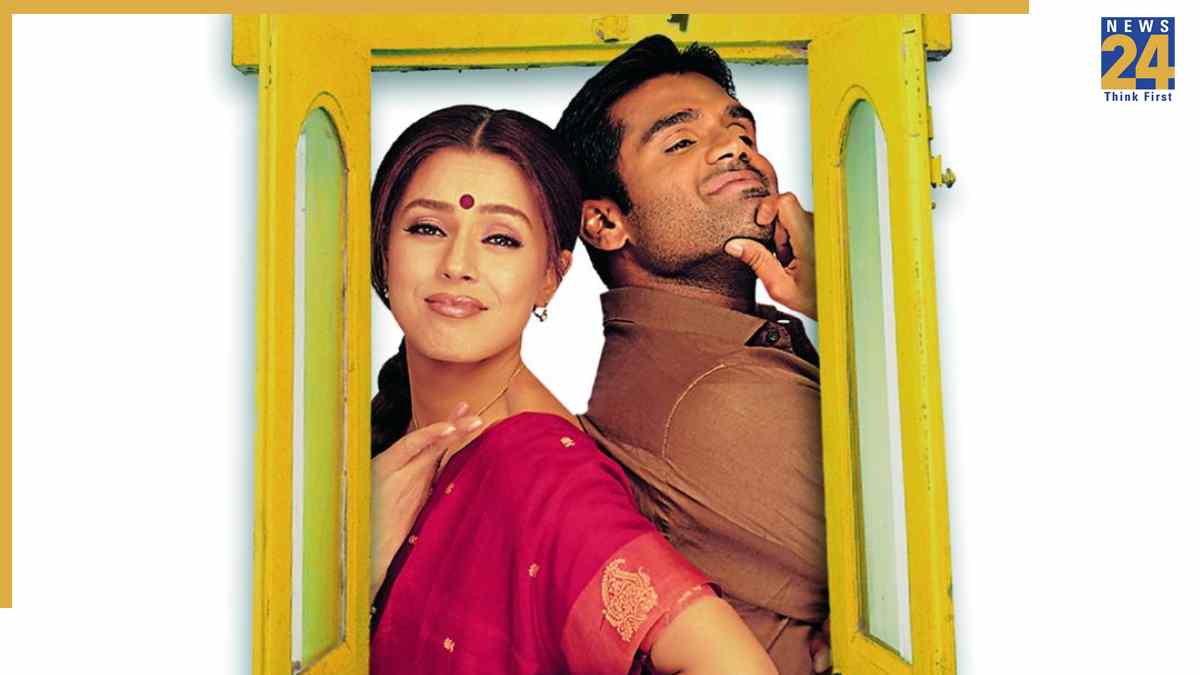
Starring Sunil Shetty, Mahima Chaudhary, Paresh Rawal
Do we applaud director Priyadarshan for his proletariat spirit? For the sharply witty and pungent comments on street-level existence? Or do we frown at the sheer tediousness of the comedy of ‘arrears’ regarding a good-natured landlord and his petite and saucy tenant?
At some point in the comedy, Daya Shankar (Sunil Shetty), who wants his firebrand tenant Saraswati (Mahima Chowdhary) and her family evicted from his home, screams, “Capitalism or Socialism, nothing can be done about this country.” Such throwaway lines happily remind us of the grim reality under the grin-reality.
Priyadarshan earlier strolled on the comic side of life in the successful Mumbai-centric comedy Hera Pheri. In spite of its localized lingo and flavourful humour, Hera Pheri was a wonderfully effortless working-class comedy. In Yeh Tera Ghar… the effort to piggyride on the earlier film’s success shows up in almost every frame. Even the characters are, at best, carryovers from the earlier film.
The dialogues are clever. Sample this: when Paresh Rawail’s sister (Suhasini Mulay, in a thankless, listless, redundant role) comes to meet Mahima’s old, frail, and disoriented mother with a marriage proposal for her brother, she introduces herself as ‘Aaj Ki Nari.’
“I’m not today’s woman. I’m a woman from day-before-yesterday,” the old lady replies lamely.
Lame is the name of the game, in spite of such patently clever exchanges. The effort to be street smart shows up in all the wrong places. Nonetheless, the first half, when Daya Shankar tries every trick in the book, from threats to seduction, to get his tenants out of his home, is underscored by some wonderful confrontational moments between Sunil Shetty and Mahima Chowdhary, who, we might add, has never looked prettier and never acted more spiritedly.
Sunil Shetty has been gradually expanding his repertoire with bravely non-heroic parts. This is a commendable effort in that direction. Sunil’s performance is underlined by sincerity. But the film finally lets his intentions down.
By the second half, Priyadarshan runs out of steam. Every trick in the book to keep this working-class version of the Tom and Jerry cartoons on its feet has been exhausted. A new character of ‘Jerry,’ Mahima Chowdhary’s menacing uncle (played by Saurabh Shukla), is introduced in the second half (a la Om Puri in Hera Pheri) to counter-threaten Sunil Shetty into leaving his tenants alone.
By now, the working-class hero has insinuated himself into the working-class heroine’s home. It’s only a matter of time before he moves into her heart as well. The monotonously mirthful manner in which the movie manoeuvres this love–union (replete with a clichéd love-confession-at-a-railway-station climax) leaves audiences with a heavy feeling of disappointment in a comedy where the punchline goes for a toss.
Is this really a follow-up to the sparkling ‘chawl-chala-chal’ comedy in Hera Pheri? Paresh Rawail, who won numerous awards as the myopic, abrasive but good-hearted landlord in Hera Pheri (obviously Shetty’s role in Yeh Tera Ghar… is designed in continuation to Rawail’s role in the earlier film), is, as usual, a scene-stealer. But there just isn’t enough of him, or the Hera Pheri humour, to keep the proceedings from collapsing midway.
The ‘serious’ mode towards the end completely defeats the comic intentions of the work. After a while, the toilet jokes, Mahima’s starched cotton saris, Sunil Shetty’s ubiquitous umbrella tucked to the back of his shirt, cop Paresh Rawail’s pathetic unrequited love for the spunky Mahima, and all the other symptoms and symbols of middle-classiness begin to get wearisome and redundant. A couple of horribly choreographed and composed song and dance sequences notwithstanding, the absence of ‘glamour’ in this working-class comedy cannot be a virtue by itself.
Somewhere down the line, we can see the actors getting together with the director to be clever at the expense of the low-income middle class in Mumbai. Providentially, there are memorable little moments tucked into the comedy. When the hard-up Daya Shankar sees his cop-friend Paresh Rawal leaving behind a large tip for the waiter at a restaurant, he quickly pockets the banknote and puts a coin in its place.
If we compare Priyadarshan’s two back-to-back working-class comedies, Hera Pheri was the banknote, Yeh Tera Ghar Yeh Mera Ghar is the coin. Can’t you hear the clang?