
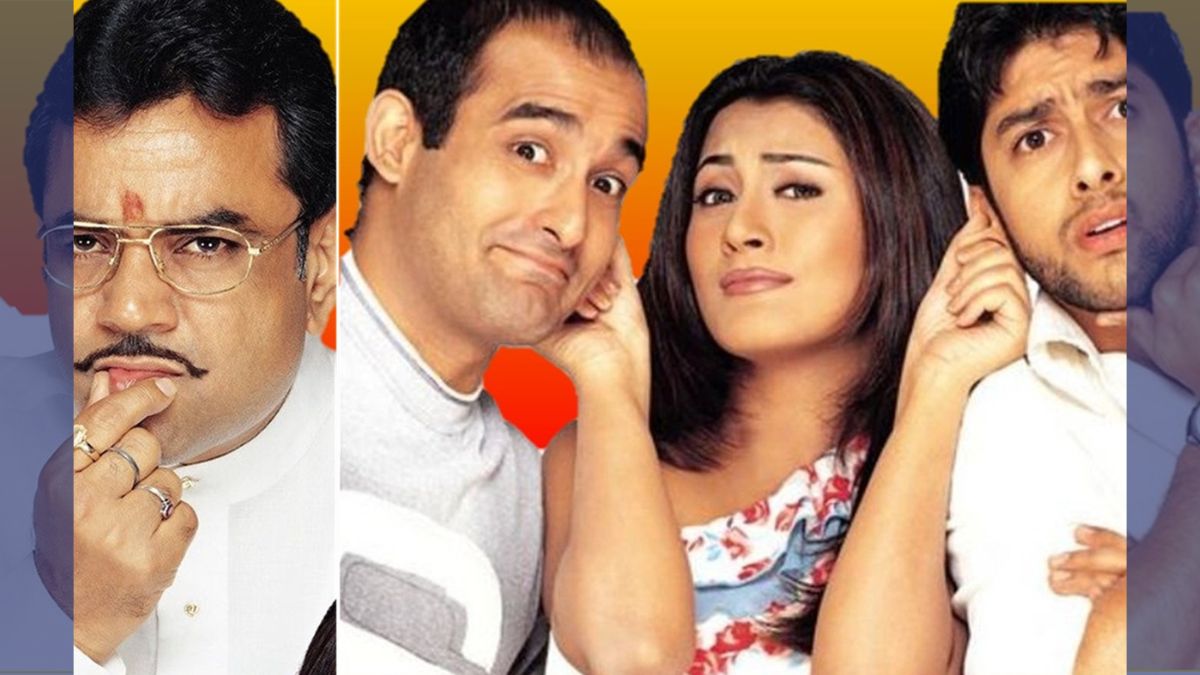


The order of actors’ names in the credit titles needs serious altering. Paresh Rawal, and not the two conventional leading men, is the hero of Priyadarshan’s third working-class comedy in Hindi. Like Hera Pheri, and not so much Yeh Teraa Ghar Yeh Meraa Ghar, the comic efficacy of the wonderfully versatile and creatively flexible director (whose range stretches from the feudal drama Viraasat to the period epic Kala Pani) hinges heftily on Rawal.
Rawal, with the spirited connivance of Khanna and Shivdasani, simply takes over the show almost completely. As a village-based industrial tycoon whose life is thrown asunder after he moves to the city with his upwardly mobile wife (Shoma Anand), Rawal throws in a giggly gauntlet that keeps the narration safely removed from damnation.
The laughter tends to get disturbingly persuasive and ribald towards the second half. Uncharacteristically, there’s a quality of panicky parody pervading the plot. As the distant strands of the comedy converge at the end, characters get seriously frantic and physical. Jokes about seemingly crazy people getting thrashed repeatedly and characters being collectively electrocuted in cartoon-strip fashion aren’t what you expect from the director of the poignantly comic Hera Pheri.
Who says comedies don’t work in Hindi? Priyadarshan’s Hera Pheri did. Yeh Teraa Ghar Yeh Meraa Ghar and subsequent giggle fests didn’t. This time the director has got to succeed with the laughter. In Hungama, Priyadarshan does away with the theme of urban angst that underlined his earlier comic outings. The only serious subtext from the earlier two comedies is the housing problem in Mumbai. Like Akshay Kumar and Suniel Shetty in Hera Pheri and Mahima Chaudhry and Suniel Shetty in Yeh Tera Ghar Yeh Mera Ghar, Aftab Shivdasani and debutante Rimi Sen must reluctantly share the same (leaky) roof
Intermittent interruptions by Nadeem Shravan’s romantic songs accentuate the very ‘filminess’ that Priyadarshan otherwise dodges with a sniggering relish.
The ‘filmy’ love triangle among the reluctant chawl-mates Nandu (Aftab), Anjali (Rimi Sen), and the electronic-goods salesperson Jeetu (Akshaye Khanna) is peppered with genuine bursts of humour. Especially memorable are the sequence where Aftab and Akshaye battle over the girl at a eatery in self-defeating verbal circles and the sequence where Rawal, suspecting his wife (Shoma Anand) is seeing someone, sends goondas to beat up the suspected lover (Akshaye Khanna).
This comedy seems to be designed for large-scale mass acceptance. There’s a constant sexual undercurrent to the laughter. A sequence such as the one where Rawal’s wife sees him emerging from the bushes with his dhoti dishevelled is humour at its most basic.
And yet Priyadarshan never crosses the line of decency. As characters get progressively aggressive in their courtship games (Aftab’s landlord’s wife, played by the seriously comic Upaasna Singh, wants to elope with the boy and enlists the help of a raunchy cop to bring about the elopement), the plot simply surrenders to the chaos of the moment, allowing the characters to become accomplices in the rites of comic anarchy.
What diminishes the impact of the humour is the glut of characters who surface in linear leaps all across the lengthy comedy, willingly creating a distance between the audience and the laughter that they embody. There are some very fine comic actors in the film, like Rajpal Yadav (playing a bullied, beaten, and crazed migrant into the city) and Sanjay Narvekar (as a fraud wannabe in the city who wants to marry into wealth). They add to the pandemonium without creating any grave diversions. The film’s distending dimensions are almost singlehandedly controlled by Paresh Rawal. This brilliant actor doesn’t only hold the comedy together, he reduces many of its crimes of excess to negligible slipups.
Rawal gets substantial support from Neeraj Vora’s dialogues, which sustain the sparkle of satire without getting overly vulgar. Among the principal players, Akshaye Khanna and Aftab Shivdasani don’t share the satirical synergy of Akshay Kumar and Suniel Shetty in Hera Pheri. But they’re in fine farcical fettle. Akshaye’s performance is no surprise. But Aftab, as the sweet, wide-eyed ingenue, shows considerable control in his performance, though why he plays a singer is a mystery to us all.
Rimi Sen is faintly echoic of Sushmita Sen and Shilpa Shetty and a more promising debutante than last month’s Neha Dhupia. Is that a comment on the rise in cinematic standards or a rapid decline in audiences’ expectations?
A word about Sabu Cyril’s art direction and S. Tirru’s cinematography. They capture the glitter and glamour of Mumbai without trivializing the middle class. Though it goes way over-the-top, Hungama works as working-class comedy.
Also Read: Ajay Devgn And Rani Mukerji’s Listless Love Story ‘Chori Chori’ Turns 22