

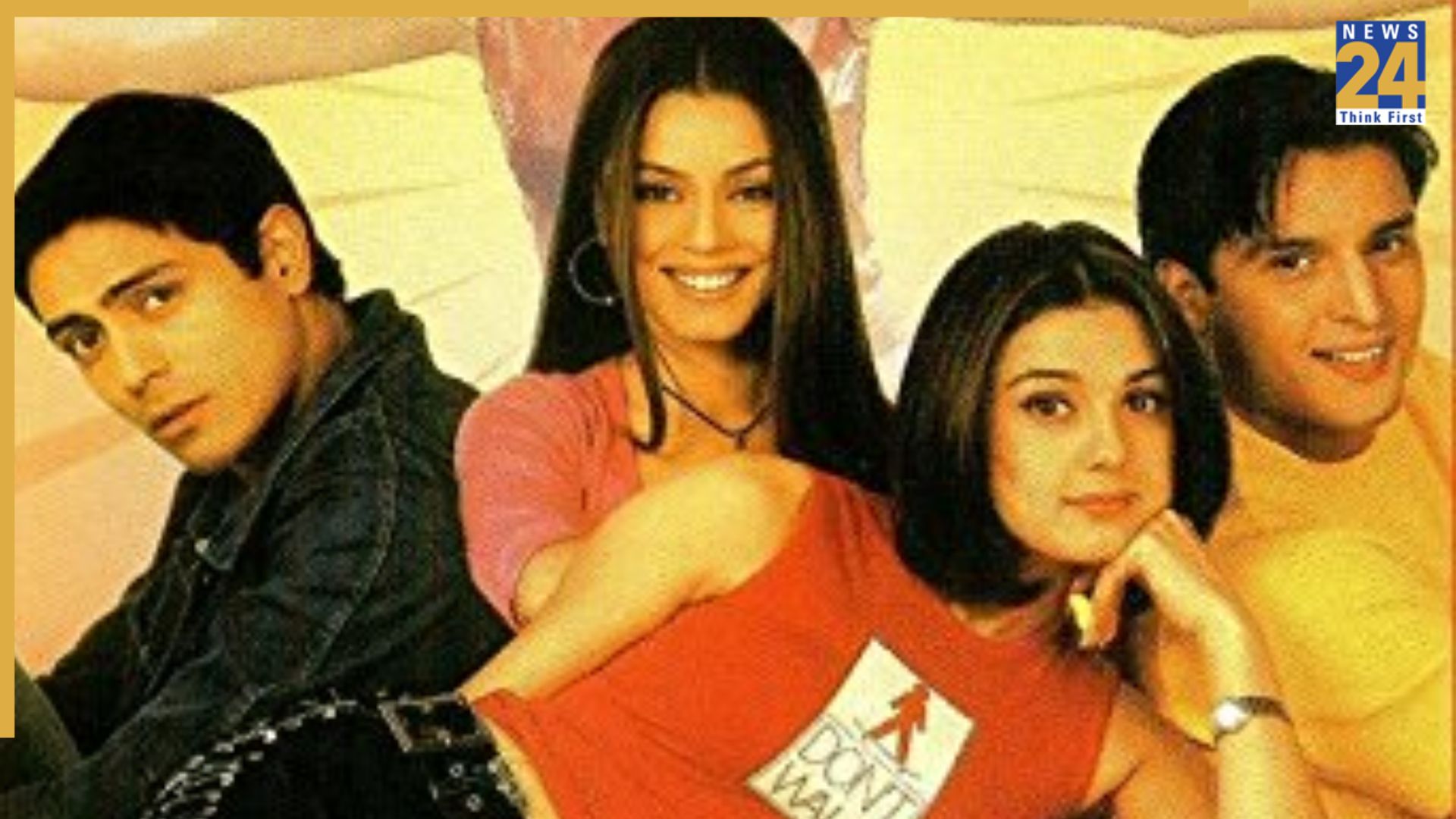


From Jaane Bhi Do Yaaron to Dil Hai Tumhara, is such a long journey?
Jaane Bhi… was made with a lot of creative freedom for NFDC. Dil Hai Tumhara is a commitment I made to Tips. I don’t think any sensitive director can make a film convincingly unless he sees himself in the work. Dil Hai Tumhara and my previous film Kya Kehna may not be my metier. But you’ll find me somewhere in these films. Kya Kehna wasn’t my script. My other recent film, a comedy called Hum To Mohabbat Karega was my script. But it didn’t work. I take full responsibility. It got bogged by certain emotional tracks instead of flying freely.
So what bogs down a filmmaker like you down?
Finances, what else? I’ve so many subjects that I really want to make. I want to make a film about a gangster who ends up being the Home Minister. There’s this other film about a hardcore prostitute in Pune who’s on the run after her brothel is raided and who gets caught in the vortex of a by-election in Satara and ends up being a Chief Minister. I can’t make this film. Though I can make films for the market like Kabhi Han Kabhi Na, Hum To Mohabbat Karega and Dil Hai Tumhara, my heart belongs to the comedy of an individual trying to make his own or her own place in society. I want to make an hour-long film on the Shivani murder case for a budget of only a crore rupees. But who’ll let me? There’re so many angles to the case. Somewhere her murder is a comment on the quality of life and politics in our times. I’ve to make films like Dil Hai Tumhara to get the clout that would allow me to make films I believe in.
But Kya Kehna was commercially successful. Yet after that you’ve made Dil Hai Tumhara?
I’ve ruled out every other producer in my career and signed an exclusive contract for five years and five films with Tips. They seem to be much less of a devil. The pre-condition is that all my films will be made out of my own scripts. Dil Hai Tumhara was supposed to be made for Tips by Raj Kumar Santoshi. I took his story and made it entirely my own. You’ll see a reflection of my sensibilities in the film. There’s no getting away from that. As you know a filmmaker basically makes the same film over and over again.
But then he has to be clever enough to conceal the sameness?
I don’t think filmmaking is about being clever. That’s something I’d rather not be. Take Guru Dutt’s works. No matter what he made his protagonist was always a tortured soul. In his most commercial film Chaudhvin Ka Chand, he was the tortured lover. Every individual has a vision and personality. And they’re bound to be reflected in his work. Dostoevsky wrote a book called Insulted & Humiliated in the early part of his career. The same love triangle repeated itself in his last novel The Brothers Karamazov. I believe a filmmaker matures as he makes his films. There’s a filtering process that every creative person must go through. Unfortunately, I haven’t had the opportunity.
Finances?
See, just making a film is no longer enough. I don’t require gigantic amounts of money. I can no longer make a film with the budgets provided by the NFDC. But today even a film like Agnivarsha has to get its audience in the first Friday. Today promoting and marketing a film sometimes costs as much as producing a small film. Having spent roughly 10 crores in production, we spent another 2 crores on the promotion of Dil Hai Tumhara. Even if I made a film for 2 crores I’d need 1.5 crores for promotion.
But is Dil Hai Tumhara made with conviction?
Yes, I feel this will be my most successful film to date. I may be totally wrong. I haven’t signed any other film. I’m working on my subjects hoping that Tips would now allow me to make a film on my own terms. My next film for Tips is slightly experimental. It’s a comedy done in the musical format with a sutradhar, something like Ghasiram Kotwal. Of course, every Hindi film including my new one Dil Hai Tumhara is a musical because it has songs. But the entire credit for the music in Dil Hai Tumhara goes to my producers. I had very little to do with it. But they gave me the freedom to picturize the songs the way I wanted.
How isolated do you feel as a committed filmmaker grappling with commercial cinema?
Very isolated. When a journalist asked me where are all the filmmakers with the heart, I told him they’re all sitting at home. The whole economics of filmmaking has changed. Still, I’ve tried to make a departure from the normal commercial cinema in Dil Hai Tumhara. I’ve revised the whole screenplay according to my vision. In Raj Kumar Santoshi’s script the love relationships were dominant. In my film the mother-daughter relationship is dominant. The climax is devoted entirely to Rekha’s character. It’s a ten-minute climax where she doesn’t speak at all.
What’s it like working within the star system?
But I haven’t worked with big stars. Preity Zinta’s first film Kya Kehna was with me. None of Arjun Rampal’s films was released when we signed him. As for Rekha, we needed her to do the mother’s role. She was our first and last choice. Even Shah Rukh Khan wasn’t a star when I worked with him in Kabhi Han Kabhi Na.
This was your first feature film in ten years after Jaane Bhi Do Yaaron?
Yeah, during that period I was doing television. I did serials like Yeh Jo Hai Zindagi and Nukkad. Even when I made my first film Jaane Bhi… I had difficulty selling it. At one point the late producer Gul Anand was going to buy it. After seeing the film he said if I had gone to him with the script he’d have thrown it out of the window. He couldn’t see the screenplay on screen. So the whole credit for Jaane Bhi Do… goes to the NFDC.
When do we get to see another comedy like that from you?
You know the entire impact of a comedy depends on the star cast. No director, not even Charlie Chaplin, can make a comedy work without the right actors. He did a film Countess From Hong Kong and cast Marlon Brando who doesn’t have a comic aptitude. So the stars can be a hindrance to your vision. If in my film about the prostitute who becomes a politician I cast known faces the impact would be lost. I can’t make this film at a 10-crore budget even if I’m offered that kind of money.
I think the stars spoilt your comedy Hum To Mohabbat Karega.
I take the blame for its failures. To cast stars was my decision. If I felt they weren’t right I should’ve walked out of the film. Now I’ve learnt to put my foot down. There’s a comedy of mine which is ready for release. It’s in the style of Jaane Bhi Do Yaaron. But again it isn’t my story. It doesn’t have a proper base. It may work on some level. But it doesn’t say anything.
But is a comedy always supposed to say something?
Not necessarily. But it should entertain. That’s such an art! If you make an entertaining film you’ve done more than enough.
So you’re saying you aren’t happy with your film?
Not entirely. I don’t agree with the basic premise. I was trapped into making it. But it must be released. I think every film should get a release.
Is Dil Hai Tumhara your biggest film to date?
Budget-wise, yes. The whole soul of the film is the mother’s character played by Rekha. It may be a 10-crore film. But the climax, which is the crux of the film, cost only 2 lakhs. Audiences are going to be happy with the film. But if you look for Guru Dutt’s Pyaasa in Chaudhvin Ka Chand you won’t find it. The difference between Jaane Bhi Do Yaaron and Dil Hai Tumhara is even more pronounced. Because Guru Dutt himself produced Chaudhvin Ka Chand. I didn’t produce Dil Hai Tumhara.
Guru Dutt had to make this film to cut the losses suffered by Kaagaz Ke Phool.
That’s it. It’s all about survival. There was a director named Amiya Chakravarty who made Patita and Seema. They were made within the commercial format. But they touched the heart. See, my biggest success to date Kya Kehna wasn’t meant to be the film that it was. I couldn’t understand why the 18-year-old heroine would fall in love with a renowned philanderer. My second problem was with her illegitimate child. In today’s day and age every local train in Mumbai announces abortions for Rs 70 only. Why did she want to become an unwed mother? We make films not for the elite but the masses to whom Kya Kehna had to be answerable about its protagonist’s unorthodox decision. My producers argued back. I had the choice of either making the film or staying jobless at home. Then I read Oriana Fallaci’s Letters To A Child Never Born. That gave me some answers. The producers gave me the freedom to incorporate those answers in Kya Kehna. But I still wish the main issue in the film wasn’t pregnancy. I read about three impoverished sisters in Kanpur committing suicide for the lack of dowry money. I wanted Kya Kehna to offer a glimmer of hope for such girls. I’m proud of the film. Mothers took their daughters to see the film, not to teach them to get pregnant before marriage, but how to cope with a crisis in their lives.
What kind of success do you expect from Dil Hai Tumhara?
Everyone says it’s a good film. I say it will run in every corner of the country because of the mother Rekha’s character. What I liked in Raj Santoshi’s original script was the relationship between the two sisters. I’ve focussed on the daughters and mother. The film’s youthful aspect is being projected in the television promotions. It’s an important part of the film. But it isn’t the most important part.
You don’t seem very happy with the situation?
No filmmaker is happy. You can’t be. I’d be lying if I said I’m very proud of Dil Hai Tumhara. But there’re lots of beautiful moments in the film. My gut feeling is that the audiences will identify with the cathartic emotions of the film. Whether it’s the Ramayan or Jaane Bhi Do Yaaron, aapko catharsis to chahiye Hindustan mein. It’s part of our life. I feel that organic quality is missing from my later works. Even Kabhi Han Kabhi Na was made for a mass audience and was organic. My recent works have been a mixed bag. Now I hope I can make the films I want to. The script I’m writing now has to be accepted wholesale. Either the whole package or nothing at all.
Also Read: 17 Years Of ‘A Wednesday’: Neeraj Pandey’s Gripping Thriller