
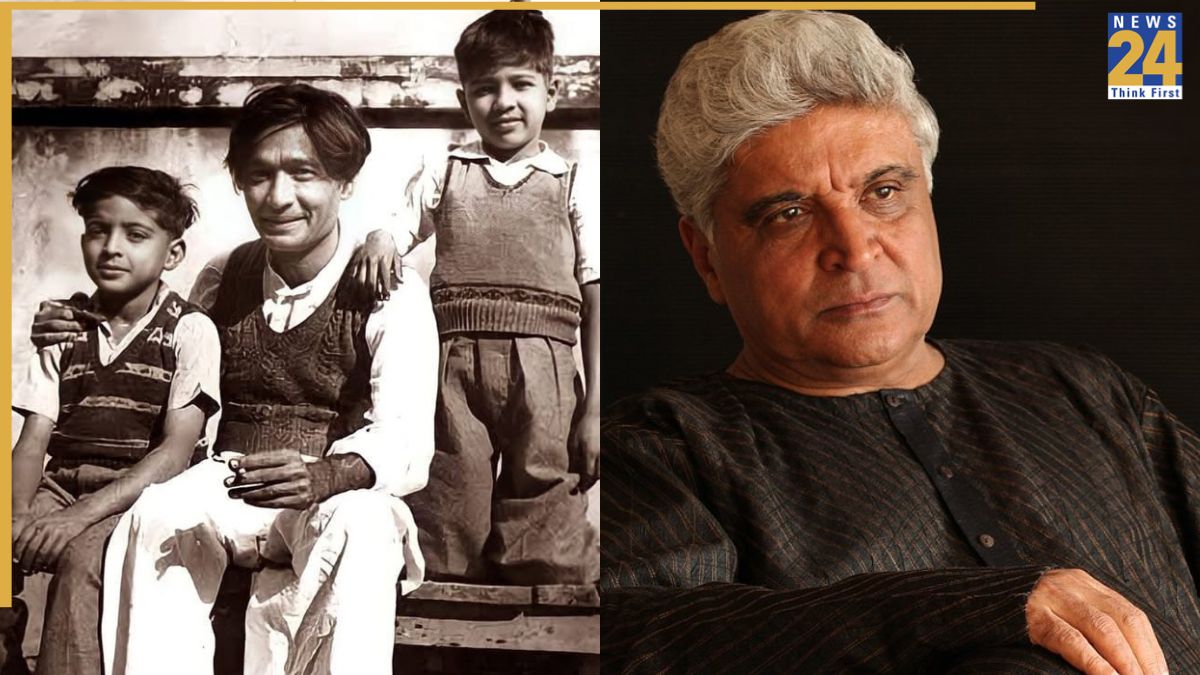


Some of the most memorable Hindi songs were written by your father?
He is known for his sharply uncomplicated film lyrics like ‘Ae dil-e-nadaan’ (‘Razia Sultan’), ‘Yeh dil unki aur nigahon ke saaye’ (‘Prem Parbat’), ‘Gham ki andheri raat mein dil ko na beqaraar kar’ (‘Sushila’), ‘Behkudi hadd se jab guzar jaaye’ (‘Kalpana’). My father wrote meagrely for movies, not because he was not prolific but because he didn’t know how to sell himself to the film industry.
Jaan Nisar Saab was not very market savvy?
My father belonged to the old school. He didn’t believe in peddling his poetry to producers. He belonged to the old school of thought, gentle, humble, modest and self-respecting. He considered it beneath his dignity to approach people for work. He only spoke to people he was comfortable with. His poetry was revered but not marketed properly. Maybe if he was alive today, we’d have persuaded him to hire a business manager, ha ha.
Your relationship with your father was strained?
My relationship with my father went through very troubled times. He was of Communist ideology. An arrest warrant was issued against him and my father went underground in Mumbai while my mother was left behind to look after two very small children. I must have been 10-year-old when this happened. She was ill and bed-ridden in Lucknow, while my father was living as a paying-guest in Mumbai. So after our mother’s death, my brother and I couldn’t be taken to join him in Mumbai….Whatever little work he got in Hindi cinema was not enough to look after us children.
Your mother’s death triggered a complete estrangement with your father?
Some time after my mother’s death, my father re-married. I am sorry to say my stepmother lived up to every stereotypical image of a stepmother. Compared to her, Cinderella’s stepmother was Mother Teresa. It was a pretty bad situation for me and my brother. When I came to Mumbai, I didn’t stay with my father. Not that we didn’t meet cordially. In fact, we bonded over poetry.
What brought on a father-son reconciliation?
When I was 18, he recognised the poet in me and encouraged me to write. He would recite what he wrote to me and we’d discuss his poetry. He took my criticism seriously. And we spoke poetry like equals. I learnt a lot from me. But he was too timid to take a stand. Now, when I look back, I realise my father’s shortcomings were understandable and excusable. Over the period of time, I’ve come to terms with the person that he was. I’ve washed away my bitterness.
Your father wanted to make Urdu accessible to the common man through his lyrics?
There is a difference between the Lucknow and Delhi school of Urdu expression. The Delhi school uses a lot of Arabic and Persian words. But Lucknow, because of its proximity to the Awadhi culture, didn’t allow the Urdu to be influenced by Arabic and Persian. The Luknow Urdu poets like my father avoided Arabic and Persian words. In fact, before my father there was very famous Lucknow poet named Arzoo Lucknowi. Somebody challenged him saying, ‘What’s Urdu without Arabic and Persian?’ Arzoo took up the challenge of writing a whole book of Urdu poetry entitled Sureeli Basuri without using a single word of Arabic or Persian. My father too assumed the same style. His poetry was pure simple and very Indian.
You have inherited your father’s transparency of expression?
If you say I’ve inherited the same transparency of expression, then I’d say I’m blessed. I learnt how to write lucid poetry from my father. He would say, ‘It’s very easy to write in difficult language and very difficult to write in simple language’. His collection of poems entitled ‘Ghar Aangan’ is about middle-class married life when, as you know, there is no poetry in married life. I didn’t get much wealth as inheritance from my father. But I inherited his poetic talent. I learnt about the transparency of literature. He wrote not only ghazals but also thumris and folk songs. Like my father, my poetry was rooted to the ‘mitti’ of the land,” he said. In fact, his grandfather Muztar Khairabadi wrote innumerable thumris.
You carry Jan Nisar Saab’s legacy forward?
I am collecting his poems for publication. He had tremendous control over his craft. And that was why he couldn’t become iconic. It is only the specialised skill that makes you an icon. When I read his complete work, I realised he wasn’t an icon because he didn’t repeat himself in his work. Woh Balraj Sahni, Sanjeev Kumar aur Naseeruddin Shah bann sakte hain. Rajesh Khanna ya Amitabh Bachchan nahin. My father was too versatile to establish a poetic identity. Wordsworth was associated with poems on Nature, Shelley and Keats with poetry on romance. And they wrote repeatedly on their chosen theme. My father couldn’t develop a specific identity….I would like to think I’ve the same ability to slip in and out various styles. I think, my father would have been proud of me.