
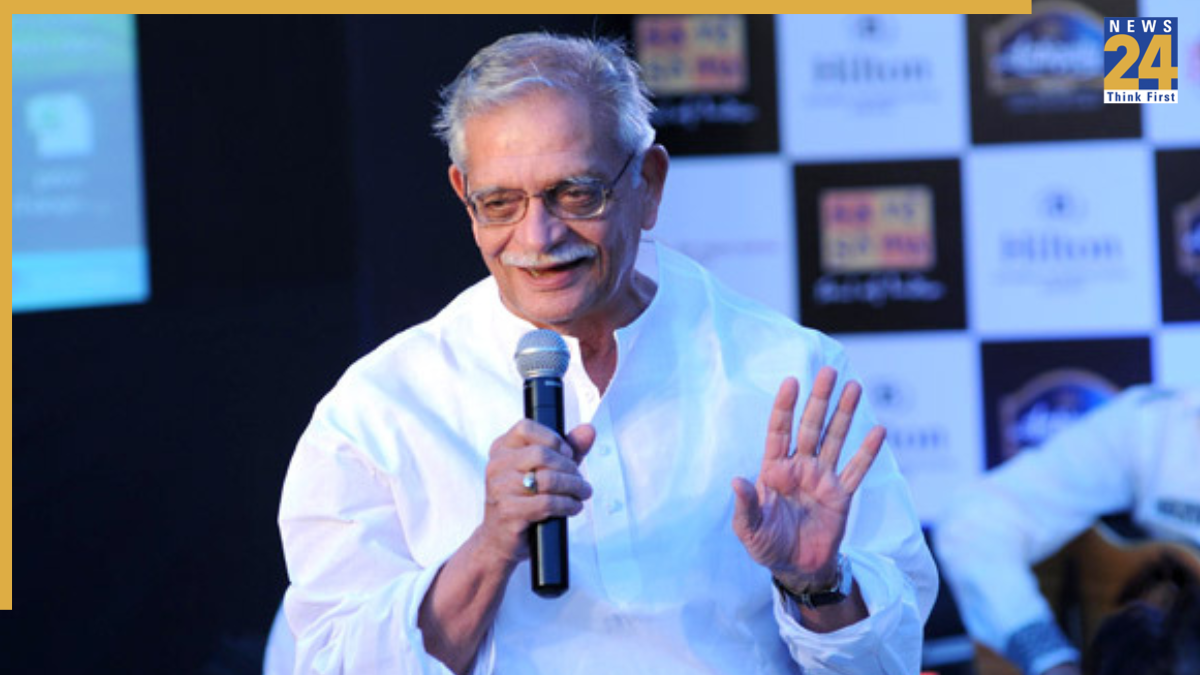


It’s hard to believe that Gulzar Saab is 91. His wit and poetic perceptions still remain as sharp today as the time when he wrote his first film lyric Mora gora ang lai le for Bimal Roy’s Bandini. And he still plays tennis every morning to ensure that he stays fit enough to keep pace with his grandson Samay.
It’s easy to love the poetry of Gulzar. But it isn’t easy to understand, let alone know the mind which wrote some of the finest film lyrics ever and made films that have in several vital ways re-defined the way we look at human relationships in the context of aesthetic cinema.
I still recall how easy it was to get through to the mythically elusive Gulzar Saab. At that time I was just another eager-beaver with a dream waiting to spill out of my pen. Gulzar Saab had read some of my comments on his imperishable poetry. He knew I was an ardent admirer. We had exchanged perfunctory thoughts on the language of the heart (a.k.a. poetry) when I had reviewed his superb songs in the non-film album Dil Padosi Hai where he had collaborated with Asha Bhosle and his favourite music director R.D. Burman.
I had misconstrued his use of the word joothe (used/soiled) for jhoothe (deceitful).
He explained the difference to me. I was enriched by his unfathomable knowledge and by his willingness to share his wisdom with someone whom he considered a kindred spirit.
To this day I ask the relevance of the strange stirring and sensuous words he uses in his songs. I was puzzled by the line Apne Sali ve appee uthaye… in the song Din ja rahe hain ke raaton ke saaye in the film Doosri Sita.
He was avidly watching a cricket match with his assistants when I phoned to ask. “Yeh kya tum pooch baithe abhi?” he grumbled good-naturedly. Then explained that sali was the cross that Jesus Christ carried all the way to the hill where he was crucified. And appee instead of aap hi (by oneself) was a term he had absorbed from litterateur Rajinder Singh Bedi.
Who but Gulzar Saab could imbue so many deep and reverberant influences in one zigzagging line of lyrical vision signifying the pained and profound pilgrimage of a poet from poetry to film lyrics?
Today Gulzar Saab is pained by the onslaught of mediocrity in all walks of life. He misses the composing maestro R.D. Burman who did all the enchanting melodies in the films of Gulzar.
In an unguarded moment he said, “Pancham and I were very close friends and creative partners. He’s irreplaceable in my art. Isn’t that evident from what you see and hear in my films after his death? My house is filled with his memories. I keep writing poems about him. Beyond that I don’t need to declare my feelings for him… My lyrics used to drive Pancham to despair. ‘Arrey yaar, tu phir aa gaya!’ Remember the phrase Tinkon ke nasheman tak in Aandhi? Pancham wanted to know the location of the place called ‘Nasheman.’ But it was mutual. He’d sometimes use strange phrases which I’d incorporate in my lyrics. Things are just not the same without Pancham. He was so integral to my cinema… Pancham’s loss is irreparable in my life. Pancham is Pancham.”
And then he cheers up. “I do miss Pancham. But I enjoy working with A.R. Rahman, Anu Malik, Shankar-Ehsan Loy and Vishal Bhardwaj. They represent the new sound, and I’m happy to be part of it.”
I don’t claim to be as vital to Gulzar’s life as his pyara Pancham. But I feel he gives a place to me that only a favourite son can get. Gulzar Saab has an ability to swathe you in specialness. You hear the same music of concordance in his lyrics too.
Listen to Humne dekhi hai un aankhon ki mehekti khushboo haath se chooke issey rishton ka ilzaam na do. These are probably the best lines I’ve ever heard defining the indestructible, indefinable, intangibility of the human relationships.
Also Read: As Gulzar Turns 91, A Look Back At His Brief Stint As An Actor
I once overheard a fellow-lyricist make fun of those lines. “How can you see the mehekti khushboo in the eyes… and what’s geela-geela pani? Isn’t paani meant to be wet?”
I feel sorry for the pedantic and excessively pragmatic people of the world who can’t see the beauty of a fragrance as Lataji sings Humne dekhi hai or feel the flapping of a fragile wing against a cloud as Ashaji sings Phir se aiyo badra bidesi tere pankh mein moti jadungi.
Gulzar took me under his wings… and my wings became studded with the moti (pearls) of his knowledge. He’s known as a poet, lyricist, writer and director. But he’s a lot more. He’s a visionary and an artiste who can see to the very core of humanity and extract the most cherishable juices out of the driest images of life.
Among the many things that he has taught me through his art and personality the one lesson I’ve learnt is to value human bonding above professional allegiances. “Don’t write any and everything in your columns. Withhold information. It’s always preferable to not give away everything.”
Poetry flows from Gulzar Saab’s entire sensibility. Ever since he entered the portals of Hindi cinema with the lyric Mora gora ang lai le in Bimal Roy’s Bandini his words and images have made a lasting impact over moviegoers’ hearts and minds. His dialogues and scripts for films like Hrishikesh Mukherjee’s Ashirwaad and Asit Sen’s Khamoshi and directorial ventures like Mere Apne, Khushboo, Mausam, Maachis and Hu-tu-tu have constantly broken barriers between the mainstream and realistic cinema.
Gulzar Saab has not directed any film. He sighed, “I guess one reason for this is the changed atmosphere in the film industry. I feel like a discordant note in the present-day cacophony.”
As a lyricist which has been the most difficult song Gulzar Saab has written? He ponders. “One of the most difficult songs I wrote was Ek tha bachpan for Hrishikesh Mukherjee’s Aashirwad. There I had to look at the memory of a father through the eyes of a woman and a child. To get that double vision into one song wasn’t easy. But then who said life was simple? It’s as simple or as complicated as we may like to make it.”
Some such sincerity of purpose shines through in his cinematic poetry. Each nugget flows out with the inevitability of a spring flower blossoming in the early morning as the dew gathers around the garden of the human condition.
Even outwardly light-hearted lyrics like Chand churake laya hoon, Dakiya daak laya and Dhanno ki aankhon mein secrete a wealth of understated meanings simmering to swim to the surface at full tide.
It’s interesting to note how Gulzar Saab’s first lyrical opportunity came his way. Recalled the poet-extraordinaire, “It was for Bimal-da (Roy’s) Bandini. Shailendra was supposed to do all the lyrics. But then something happened between them. I was given the chance to write a lyric. That was how Mora gora ang in Bandini came to me and a motor mechanic became a film lyricist.”
Gulzar Saab gets nostalgic about the past. “How I miss those greats from the past with whom I had the privilege to work, like Burman Dada (S.D. Burman), Hemant Kumar, Salilda (Chowdhary) and directors like Bimalda and Hrishikesh Mukherjee. They made such a difference to cinema.”
He lamented the rapidly falling standards of film music. “Suddenly the standard of lyrics has been drastically lowered. Something very tragic is happening to the music market. The level of writing has come down drastically. Even when there’s an opportunity to write aesthetic lyrics the words to be used are severely restricted. As a lyricist I’m not allowed to go beyond the prescribed vocabulary. Even if I use one unfamiliar word I’ve to offer a hundred explanations and justifications.”
To what did he attribute these declining standards? “Well, one problem is that many filmmakers make films in Hindi without knowing the language. Their knowledge of Hindi comes from ads and popular films. For a lyricist, that’s a major hurdle. Earlier producers either liked or rejected a lyric. But now strange demands are made. Yeh daal do woh daal do. And out of 10 songs I’m supposed to write Chaiyyan chaiyyan (Dil Se) comes up at least 5 times for reference. No matter what the situation they want to sneak ‘Chal Chaiyyan Chaiyyan’ into the song. Either they fail to understand me or I fail to understand them. Believe me, I was really happy working with Mani Rathnam in Dil Se. He’s the only director who told me to give him abstract images in my songs. He talked to me like a painter and a poet.”
In a world rapidly filling up with philistines, Gulzar represents that untouched, unspoilt acme of excellence which we gradually seem to be losing touch with. He won’t write a single line that’s even remotely vulgar or compromised, won’t talk the language of crassness even if it means doing sparse work.
His output is way too sparse as compared with some of his other colleagues. “But at least I’ve the satisfaction of knowing every word has come from the heart.” He laughs.
We need Gulzar Saab to remind us that songs aren’t just about humming a tune. They often hum the secret of a meaningful life.
He once said to me, “I never look at life’s vagaries in one straight line. There’re always rough edges, zigzags, rough corners and uneven edges… my words convey the utar-chadhao of life.”
Also Read: Nishikant Kamat – We Lost You Too Soon