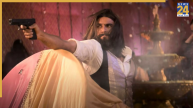


“Kitne Aadmi The?” Even five decades later, this question doesn’t need context. It only takes the image of a man in a dusty ravine, a chilling laugh, and a film that became a landmark in Indian cinema. As Sholay turns 50 this year, its influence is not just remembered on screens, it’s still alive on college stages, in the hearts of actors, artists, and fans. The film’s dialogue, “Yeh haath mujhe de de, Thakur” still manages to send a shiver down the spine, proving it’s not just stuck in time, but it transcends it.
Fifty years later, people still remember the golden sands of Ramgarh, the echo of Gabbar’s footsteps, Jai and Veeru’s friendship, the dialogues, the costumes, and everything about the film.
As Sholay celebrates its Golden Jubilee this August, I decided to look at what continues to make Sholay so unforgettable. Is it the legendary characters, the themes, the razor-sharp dialogues, the music, the story-telling or the emotional weight it still carries?
To find out, I spoke to people from all walks of life, National School of Drama (NSD) alumni and theatre veteran Salim Arif, Sejal, a student from the drama society at Delhi University’s Kirori Mal College, and locals in Delhi’s Connaught Place. And, what I discovered was more than just nostalgia.
As I walked through the blocks of Delhi’s heart, Connaught place and randomly asked people, “Have you watched Sholay?” The answer came with a smile, followed by warm words: “Arrey madam kisne nahi dekhi hogi? bahut baardekhi hai!” No matter what their age was, their faces lit up, and their voice had a hint of excitement as they spoke about Sholay.
“No Film Like Sholay Ever Again:” Fans Recall The Moments
A shopkeeper named Ajay Kumar said that there has been no film that has matched Sholay till date (Sholay ek aisi film hai, jo kaafi time se h aur abhi tak iske takkar ki film nahi banihai). He seemed fascinated by the dialogues and scenes of the film. Kumar even imitated Sanjeev Kapoor’s (Thakur) dialogue, “Ye Hath Mujhe de de Gabbar!” reflecting on one of the most emotionally charged moments in the film.
Another Sholay fan, Akash described his favourite scene from the film, which is Amitabh Bachchan and Dharmendra (Jai and Veeru) fighting Gabbar Singh (Amjad khan). He called it one of the most emotional scenes, that reflects their deep friendship.
While many viewers admire different themes in Sholay, like the anti-hero, action or thriller, it’s the element of friendship, the Yaarana that has etched itself deep into the hearts of fans.
The song “Yeh Dosti Hum Nahin Todenge” is still dedicated by people to their close friends on special occasions like Friendship Day. And the iconic image of Jai and Veeru riding the double-seater scooter remains on as a symbol of true friendship.
Akash specially recalled the coin toss scene during Jai and Veeru’s fight with Gabbar Singh. In the scene, Amitabh’s character Jai wins the toss and asks Dharmendra to go. Later, when Veeru returns, he learns that Jai is no more and realises that the coin toss was rigged, as the coin had heads on both sides. This scene, according to Akash highlighted how Jai always sacrificed himself so Veeru could survive.
He added that he was 13 or 14 years old when he had first watched the film. When asked if a film like Sholay could be made again, he said people might try, but those who could truly make it are no longer around. He remarked that viewers today don’t want to watch masala films anymore as they prefer “fast food”, pointing out how interests of audience have changed over time.
“Gabbar’s Entry Still Echoes”: Theatre Veteran Salim Arif
I then moved my conservation to Salim Arif, a prominent theatre, film, and television personality, who shared his personal memory of watching the film for the first time. He said he saw Sholay when it was released, and it was quite one of those films that immediately caught fancy of the lot of audience – especially the character Gabbar Singh.
He added that the USP of the film at that point of time were Gabbar Singh and Amitabh Bachchan, who had already become a major star by then. Reflecting on the fervour of the audience at that time, Arif highlighted that there was much debate about whether Gabbar Singh should die or not.
“We never realised that it (Sholay) will become such a huge landmark, because over the years it has become a cult film for obvious reasons,” stated Arif.
Arif further enlightened me with an interesting observation, saying “If we look at the scenario, there have been five or six films on the same subject as Sholay, like Khotey Sikkey, Mera Gaon Mera Desh, Seven Samurai, and Pratigya.” He added that the subject had been there for a while in the creation, but what makes Sholay memorable is the way it was packaged. By “packaged,” Arif meant that it was one of those films where each minor character was were very well etched out.
He added that that what people remember most about Sholay are the side characters. He recalled how roles played by actors Asrani, Sachin Pilgaonkar, Jagdeep became metaphors for various kinds of people over the time.
While focussing on Sholay’s script, he drew a parallel between the film and traditional Parsi play or the earlier Nautanki forms of storytelling, which had song, dance, parallels, comic interludes, item songs and a parallel track to a main track as elements. “It is very much like a Parsi play (Parsi Company Natak), with elements of nautanki in it,” Arif added.
To elaborate further, he pointed out how after every major action in the film, there is some relief in terms of comic, dance and songs, and inherent threat. He described Sholay as one of the films with structure like a Parsi play, but told in a western style. “It has a very interesting recall of several sequence from several films, but still works in its own,” Arif commented.
When asked about the excitement among children when Sholay was released, Arif shared that he was in school at that time, and it was very common for school children to watch movies back then. He added that, despite the presence of legendary actors in the film, what is instilled in his memory is the audience repeating Gabbar Singh’s dialogues even before he appeared on screen. He recalls Sholay as a dialogue-oriented film, with EP (Extended Play) and LP (Long Play) of dialogues released and sold just as much as the music.
Upon bringing up the iconic character of Gabbar, the very essence of the film, he gave credit to the director and praised how he was presented. “His introduction in the film itself is so iconic, from his footsteps to eating Khaini, it has remained with all of us,” Arif said.
He called him first no ‘Thakur’ kind of villain, who were usually depicted as devotee of Maa Bhawani with big Tika in their forehead. “But Gabbar was nothing like that, for the first time, we had a pant and shirt wearing dacoit with boots, and there was something enchanting in the way he was presented,”he further remarked.
Arif added, “I don’t remember any other entry of a major character the way Amjad khan was depicted in Sholay. They created a very likeable, charming villain and everything went well with that character.”
When I asked him what makes Sholay so special and why still resonates with the audience, Arif kept his answer simple: “It remains in the mainstream because it has an approval of audience and it was technically well made.”
Highlighting on Sholay’s impact in the creative journey of Indian cinema, he agreed that it had a certain style which was new to the Indian cinema. He mentioned that the film imbibes some elements of Hollywood cinema like ‘Once Upon a Time in the West’, ‘The Good, the Bad and the Ugly’, which were not copied but were recalling of those elements.
“It is not the greatest film made in India, but it has a certain space under the Sun, and I am okay with that,” Arif stated.
Recalling his days in NSD and how Sholay’s marked presence was there, Arif shared that it was not very unusual to have someone saying, “Arrey oh Samba” in the campus. He added, “We were not great fans of Sholay in that sense, we would watch every kind of film, there was no line drawn.”
ALSO READ:
A Timeless Film Through A Young Fan’s Eyes
As theatre veteran and locals shared their personal anecdotes, I followed by quest to learn how Sholay is perceived by the younger generation. I spoke with 20-year-old Sejal, a DU student, and a member of her college’s filmmaking society.
While I didn’t expect an energetic response or any nostalgic reflections from her, I was shocked and delighted to hear what she had to share about Sholay.
Sejal recalled watching Sholay on her computer with her dad who had bought the CD. “He was really excited about it and kept telling me, “Yehscene dekho, Ab dekhna kya hoga” At that time, I didn’t fully understand why it was such a big deal, but I enjoyed watching it with him. Later, when I got more into films in college, I rewatched it and finally saw how brilliant it actually is,” she shared.
She mentioned that her favourite character in the film is ‘Veeru,’ whom she described as funny, full of life, and “just so real.” “Even in serious situations, he manages to make you smile. But more than that, he’s loyal and emotional. I love how he jokes around, but when it’s time to stand up for someone, he does it. He brings heart to the story,” Sejal added.
She further depicted her understanding of the film, calling it a mix of everything emotion, action, comedy, love, friendship. “Every single character is memorable. The dialogues, the music, the story. It’s a film that gives you goose bumps, even today. And I know it’s a very long movie but I feel it to be every iconic,” Sejal said.
At the end of the day, as I sat down to write about their emotions, experiences, and feelings toward Sholay, I realised why it has stood the test of 50 years, why audiences remain glued to it, and why there will be no other film quite like Sholay.
Also Read: When Sholay Met Its Nemesis