
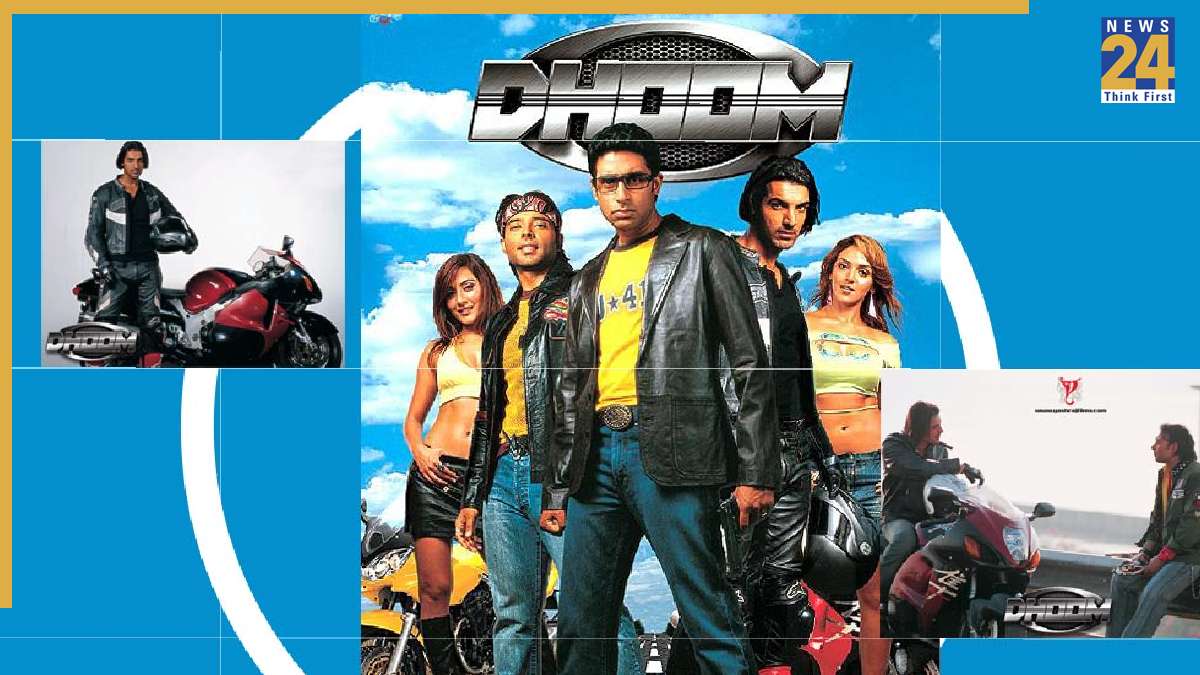


Dhoom machale dhoom machale dhoom…you hear it so often in the course of this 2-hr-15-min excursion on skidding wheels that by the end of it all, you are hopelessly addicted to Pritam’s contagious tune. Aptly titled Dhoom creates a zigzagging zoom across the chic frames. It doesn’t let you stop to catch your breath. Damn! It doesn’t even let you think about the excruciating improbabilities that litter the shrieking skyline.
This has got to be one of the noisiest soundtracks heard in recent times. If it’s not hell on wheels, then it’s Salim-Suleiman’s break-the-winds banshee background score, creating sounds of guys having fun. And then throw in a couple chicks with clothes that look like nappies turned into bikinis….kar voila to ho voila! You have a real guys’ flick crammed with gadgets and nozzles that stare down at us with enticing defiance.
This flick-off-a-wrist dares you not to have fun. ‘How can you not surrender to our all-systems-go brand of in-your-face filmmaking?’ the tone of narration seems to suggest.
Not brain-dead and certainly not a dull moment in sight, Dhoom flicks the essence of the Hollywood thriller—speed, style, and shrieking sounds—and turns it to its own homespun advantage. While the wry cop Jai (played with twirling sang-froid by Abhishek Bachchan) and the marauder on the bike Kabir(John Abraham, so deapan he makes you thankful for the momentum in the narrative) are single- mindedly urbane in their design and purpose, the Lovable Crook Ali played with lovable crookedness by Uday Chopra(he played a very similar role in his last release Charas), is a straightforward desi stereotype.
You can trace him down to Ashok Kumar in the old Kismet, and then you can carry forward his lineage down to Amitabh Bachchan and Rishi Kapoor in Manmohan Desai’s Amar Akbar Anthony.
Remember how Amitabh Bachchan sauntered up to Rishi Kapoor on stage to garland him with currency notes while the latter sang the qawwali Parda hai parda in Amar Akbar Anthony?
There’s no Qawwali in Dhoom and certainly no purdah as Esha Deol gyrates on stage in an unabashed display of female allure. But there Is an Ali instead of Akbar who joins Deol on stage to create a kaleidoscopic motion of commotion.
While Uday Chopra’s rapport with Abhishek’s Bengali wife(Rimii Sen) has echoes of Lethal Weapon, John Abraham’s fiendish transformation from a pizza boy to bank robber is a subversion of the Superman legend. Unlike Superman, Abraham doesn’t wear his underwear on top. It’s the ladies who move around in glorified lingerie. In fact, Esha Deol’s transformation into a new-millennium Bo Derek is quite startling.
The power of moving images is employed in Dhoom to create a stimulating, heady, almost aphrodisiac world of amorality. The cop on the prowl and the villain on the bike are almost interchangeable in their worldview. “We could’ve been friends,” the biker keeps reminding the cop, voicing the moral muddle that Dhoom whips up in a foamy, wet, and stormy display of in-your-face machismo.
In the first half, the narrative borrows heavily from Hollywood films like Gone in 60 Seconds, The Fast & the Furious, and the biker movies of the 1960s like Easy Rider. Post-intermission, we are taken into a casino in a hotel for a climax that echoes Steven Soderbergh’s Ocean’s 11.
To director Sanjay Gadhvi’s credit, the stormy mélange that takes the plot from Kismet in the 1940s to Ocean’s 11 in 2002 never gets unwieldy or even remotely vulgar. Though fast-paced, macho, and amoral, the world of Dhoom is essentially harmless and fun-filled. The violence is contained and often comic-bookish. The chases and stunts, marvellously orchestrated by stunt director Allan Amin, hide the enormous absurdities in the narrative.
In a strange and comic way Dhoom attempts to redefine the laws of formula filmmaking. Its chic and anchorless narrative mode throws you off guard. The focus on monstrous machines and undraped female torsos stops short of being overdone, thanks to the director’s control over his material.
The villain topples over the precipice at the end. Fortunately, the plot doesn’t.
Esha Deol recalls the Dhoom experience with pleasure. “What an experience that was! Dhoom has that forever effect on audiences even today. The new generations relate to it. They all love the film. Social media still buzzes with reels trending of Dhoom machale, and it’s so sweet to see so many boys playing the guitar and singing my song Dilbara. My daughters love dancing to Doom Machale and Dilbara. I’m so touched to receive so much love for my character in Dhoom. Always thankful to Adi Chopra and Yash Uncle(Yash Chopra) for giving me this masterpiece.
Our director, Sanjay Gadhvi, is missing today. He was wonderful to work with. My co-stars Abhishek Bachchan, Uday Chopra, John Abraham, and Rimi Sen were absolutely fantastic and fun to work with. What energy we all had throughout the making! Everyone was on an adrenaline rush. The reaction I received from the audience for DHOOM was unmatchable. Even today, so many say, ‘You were my first crush.’ And yes, I’m still being called the Dhoom girl and Dilbara by fans, which is so cute. Thankful for all the love this film has given. It has made me reach the hearts of many people. I love it!”
Also Read: Half CA Review: This Series Is The Digital Surprise Of The Year